
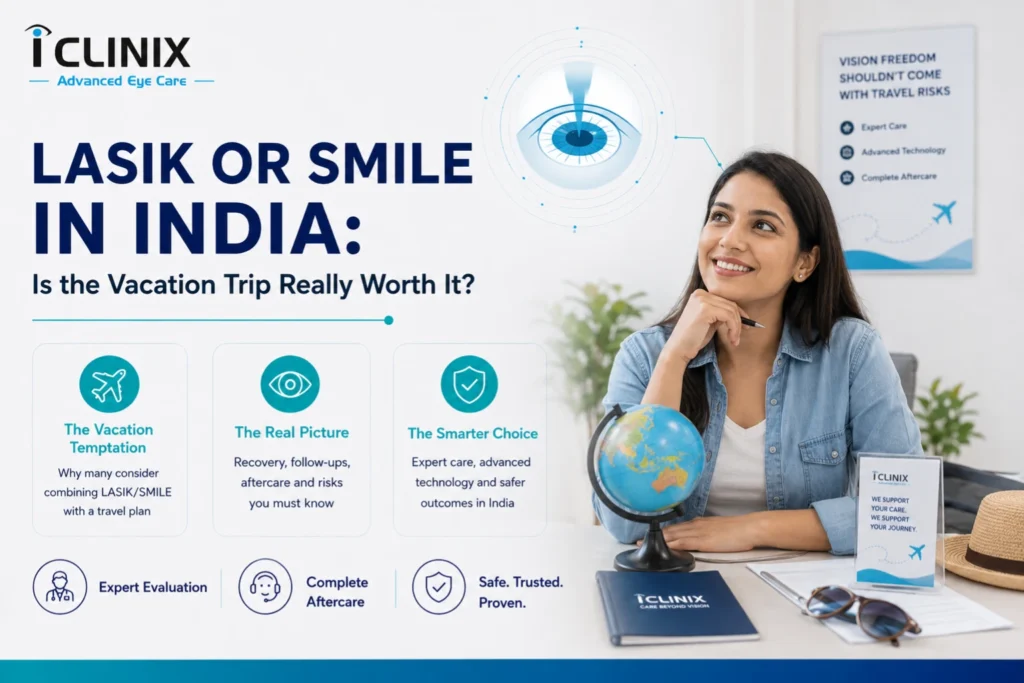
I get this question almost every time an NRI patient books a LASIK consultation during their India trip: “Can I get this done while I’m here for two weeks, and still enjoy the rest of the vacation?” The honest answer is usually yes — but “usually” is doing some work in that sentence, and the details matter more than most people expect before they book flights around it.
Here’s what actually needs to line up for this to work well, and where it tends to go wrong.
Why NRIs Combine LASIK With a Trip Home
It’s a genuinely practical idea, not just a way to save money. LASIK and SMILE in India typically cost a fraction of what the same procedure runs in the US, UK, or Gulf, using the same femtosecond laser technology available at major centres abroad. Add in the fact that most NRIs are already planning a trip home to see family, and getting the procedure done during that window — with support built for international patients coordinating the logistics — rather than taking separate time off later, makes practical sense for a lot of people.
The part that gets underestimated is the timeline. LASIK isn’t a same-day, walk-in-and-out procedure once you factor in everything around it properly.
What the Actual Timeline Looks Like
Before you travel: Ideally, send over your prescription history and any existing eye reports before you land, so we can flag anything that might affect your candidacy before you’ve committed vacation days to it. This isn’t foolproof — some things can only be confirmed with in-person testing — but it avoids the worst-case scenario of arriving, discovering you’re not a candidate, and having built an entire trip around a specific week.
Screening day: Budget at least half a day for the full diagnostic workup — corneal mapping, thickness measurement, refraction, and a general eye health check. This usually needs to happen a day or two before the actual procedure, not the same day, so we have time to review your results properly rather than rushing a decision.
Procedure day: The surgery itself takes about 15 minutes per eye. You’ll need a companion to get you home afterward, since your vision will be blurry for several hours.
The first 3-4 days after: This is the part people plan around badly. Your eyes will be light-sensitive and somewhat uncomfortable for the first day or two, and you’ll need to avoid dust, swimming, and eye makeup for at least a week. If your “vacation” involves outdoor sightseeing, a beach, or a dusty heritage site in the first few days post-surgery, that part of the trip needs rescheduling, not pushed through.
Follow-up visits: We typically want to see you again within the first week, and ideally once more before you fly back, to confirm your eyes are healing correctly. Flying home too soon, before a proper follow-up, means any early complication gets caught by a doctor you’ve never met, in a country where they don’t have your surgical details on file.
SMILE vs LASIK for a Trip-Based Schedule
If your trip is tightly scheduled, this distinction matters more than it might for someone with unlimited time. LASIK tends to give sharper vision faster — often within 24 to 48 hours — while SMILE’s smaller incision means initial clarity can take a few extra days to fully settle, even though many patients find it more comfortable in the days right after. Neither is automatically the better choice for a trip; it depends on your eyes, your prescription, and how much flexibility your itinerary actually has. This is a decision made together after a proper diagnostic workup at our LASIK & refractive surgery centre, not before. The patients who have the smoothest experience combining either procedure with a trip home are usually the ones who share their full itinerary upfront — the family wedding, the beach weekend, the long flight back — so the surgery date and follow-ups can be planned around it, not the other way around.
Where This Goes Wrong
The most common regret we hear isn’t about the surgery itself — it’s about timing. A few patterns to avoid:
- Scheduling the procedure on the last practical day before flying out, leaving no buffer for a follow-up visit or for any unexpected healing delay
- Not telling us about a long-haul flight home within the first week, since cabin air is drier and can aggravate the normal post-LASIK dryness
- Planning strenuous activity — swimming, diving, heavy exercise — within the first two to four weeks, which needs to wait regardless of how good your vision feels
- Assuming eligibility without sending reports ahead of time, then discovering during the trip that your corneas need a different procedure than planned, or aren’t suited to laser correction at all
Making the Logistics Work
A realistic plan for most NRI patients looks like: arrive with at least 10-14 days of total trip length remaining after the procedure date, get your screening done within the first day or two of landing (jet lag and all — it’s a low-effort appointment), have the procedure a day or two after that once results are reviewed, and build in a buffer of at least a week before your return flight for a proper follow-up check.
If your trip is shorter than that, it’s still worth a screening consultation — some patients are better suited to scheduling the actual procedure for a future trip once we know their eyes are good candidates, rather than compressing the recovery window unsafely.
Frequently Asked Questions
Can I get LASIK done in a single week-long trip?
It’s tight but sometimes possible if your eyes heal quickly and your flight home isn’t immediately after surgery. We’d rather be upfront that it’s not ideal than promise a timeline your eyes might not cooperate with.
Will jet lag or the flight over affect my eligibility?
No, but let your surgeon know your travel schedule so the screening and procedure dates can be planned around when you’re rested enough for accurate testing.
Is it safe to fly internationally soon after LASIK or SMILE?
Generally yes after the first follow-up confirms healing is on track, though cabin air can be drying, and we’ll advise on lubricating drops for the flight specifically.
Can I bring my prescription and reports from my eye doctor abroad?
Yes, and we’d encourage it — sending these ahead of your trip helps us flag anything relevant before you’ve committed travel dates around the procedure.
Is SMILE more “vacation-friendly” than LASIK because of the smaller incision?
Not necessarily — recovery speed depends more on your individual eyes than the incision size alone. This is worth discussing specifically during your screening. (For general, independent guidance on evaluating medical travel for eye procedures, the American Academy of Ophthalmology’s patient resources are a useful starting point.)
Planning a Trip Around LASIK or SMILE?
Send us your prescription and any existing eye reports before you book your dates, so we can help you plan a realistic itinerary around the procedure rather than the other way around.