A world where no one loses vision to preventable diabetic blindness
The IClinix Diabetic Eye Trust is India's first vertically integrated ecosystem dedicated to eradicating diabetic retinopathy through prevention, mass screening and world-class treatment — starting with those who need it most.
Our vision
A world where no one loses their vision to preventable diabetic eye disease.
Our mission
To eradicate preventable blindness caused by diabetes by establishing a comprehensive, accessible and sustainable ecosystem of prevention, early detection and world-class treatment, with a special focus on serving underserved communities.
Three years of data-driven care
These numbers represent real people whose sight has been saved, whose futures have been protected, and whose families have been spared the devastating consequences of preventable blindness.
The diabetes capital of the world faces a blindness crisis
India is the diabetes capital of the world, home to over 101 million people living with the condition — a number projected to exceed 135 million by 2030. Among the most devastating consequences of this epidemic is Diabetic Retinopathy (DR): a microvascular complication where persistently high blood sugar damages the delicate blood vessels of the retina, leading to progressive vision loss and, ultimately, irreversible blindness. DR has emerged as a leading cause of blindness among the working-age population, striking people in their most productive years and creating a ripple effect of economic hardship, loss of independence and diminished quality of life for families across the nation.
The tragedy of diabetic retinopathy lies in its insidious nature. The condition remains entirely without symptoms in its early, treatable stages, lulling patients into a false sense of security. By the time vision is noticeably affected, the damage is frequently irreversible, leaving ophthalmologists with limited options to restore sight.
The IClinix Diabetic Eye Trust was established with a singular, urgent purpose: to confront this crisis head-on — not with isolated camps, but with a complete, sustainable and scalable care model that integrates awareness, screening, treatment and long-term follow-up.
Prevention. Detection. Intervention.
We don't just treat diabetic eye disease — we build a complete pathway that follows the patient from risk to recovery, on three interconnected pillars.
Prevention & awareness
We believe the best cure is prevention. Community outreach, workshops, health talks and digital campaigns teach diabetic patients and their families about the risks of diabetic eye disease and the absolute necessity of an annual comprehensive eye exam — because protecting your eyes is as essential as managing your blood sugar.
Early detection through mass screening
Early detection is our strongest weapon against preventable blindness. In-clinic screening, community camps and strategic partnerships with physician networks make sure no at-risk person is missed — catching DR at an early stage, when laser or injections can prevent severe vision loss.
Timely, world-class intervention
For those diagnosed, immediate access to sight-saving treatment: anti-VEGF injections, laser photocoagulation and advanced sutureless vitrectomy — to halt the disease, preserve remaining vision and, wherever possible, restore sight. Every patient gets a personalised treatment plan.
Most NGOs do screening or treatment. We do both — plus long-term monitoring.
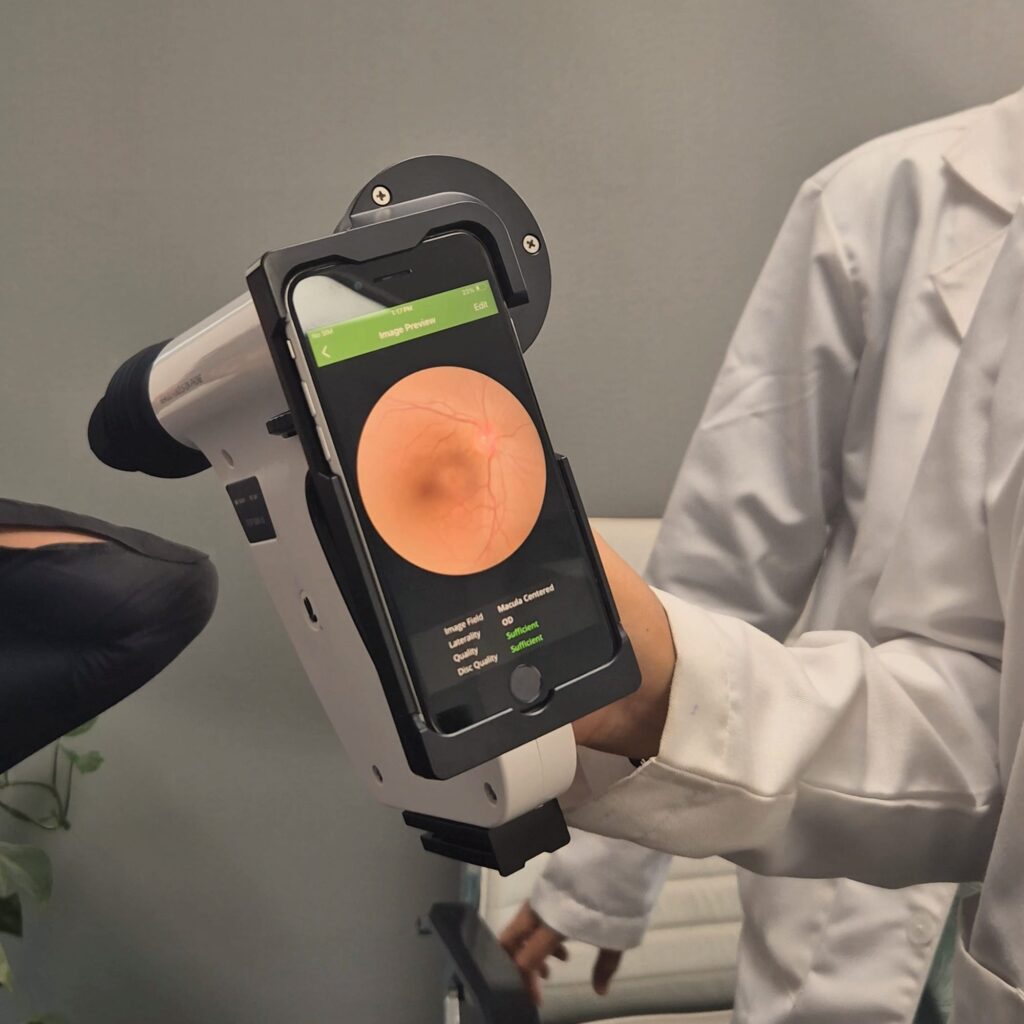
- In-clinic screening — every diabetic patient visiting any IClinix centre receives a comprehensive, dilated eye examination with advanced retinal imaging.
- Community outreach camps — state-of-the-art screening taken to the doorsteps of underserved communities — corporate offices, residential societies, semi-urban areas and rural villages.
- Strategic partnerships — our association with the Diabetic Care and Diabetic Complication (DCDC) programme screens diabetic patients directly within their trusted physician networks, making retinal screening part of routine diabetes care.
How we create impact
Our strategy is data-driven and focused on maximising impact where it is needed most. We continuously analyse screening outcomes to refine our approach, identify high-risk populations and allocate resources effectively.
Doctor Clinic Outreach Programme
Most diabetics see a physician — not an eye doctor — for years. Launched in 2025, the programme integrates retinal screening into the practices of over 10 partner physicians. In just a few months it screened 878 high-risk patients and detected 77 new cases of diabetic retinopathy — an 8.8% detection rate. No extra travel, no extra cost, no delay.
Community eye camps
Taking care to the doorstep — slums, corporate offices, residential societies and rural clusters. Vision testing, an anterior segment examination and non-mydriatic fundus photography (no dilation needed). Hundreds have been referred for cataract, glaucoma and DR treatment, many for the first time.
Cataract surgery for diabetic patients
Diabetics develop cataracts earlier, and their surgery is more complex. A dedicated surgical programme, run in partnership with Adharshila, restores their vision — and removing the cataract also gives doctors a clear view to treat underlying diabetic retinopathy.
One screening does not just save sight. It transforms a family.
Every screening, every surgery and every educational interaction creates a ripple effect that extends far beyond the initial intervention.
- Sight saved — early detection prevents irreversible blindness, so people keep their independence, keep working and enjoy a high quality of life.
- Economic empowerment — preserving sight keeps people in the workforce, supporting their families — preventing blindness breaks the cycle of poverty that so often accompanies disability.
- Reduced healthcare burden — proactive, community-based care reduces the long-term strain on tertiary hospitals and avoids costly, complex treatment of advanced disease.
- Community health awareness — each camp and educational session builds lasting awareness of diabetes management and regular eye check-ups — a culture of health that benefits whole communities.
We are not stopping. We are accelerating.
Building on proven success, our 2026–2028 plan scales our impact dramatically.
- Tripling camp volume — screening 15,000+ people a year through an expanded camp calendar in new geographies — Ghaziabad, Noida, Faridabad and rural Haryana.
- Doubling DCDC integration — working with more diabetes centres to embed retinal screening into routine diabetes management.
- Expanding the physician network — from 10 to 50+ partner doctors within two years, so no patient is missed.
- Leveraging technology — tele-ophthalmology and AI-driven screening tools for faster, more accurate and more scalable detection.
- Advanced surgical capacity — 1,500+ cataract surgeries a year for diabetic patients, with continued support from CSR partners.
Not just another eye charity
We are a super-speciality eye hospital that built a dedicated charitable trust, so that no diabetic patient — rich or poor — goes blind from preventable disease.
- Specialised in diabetic retinopathy — the fastest-growing cause of blindness — where most eye-care NGOs focus on cataracts only.
- An end-to-end ecosystem — awareness, screening, treatment and follow-up — not isolated screening camps.
- Embedded in diabetes care — working within DCDC physician networks.
- Advanced surgical capability in-house — 25G vitrectomy, anti-VEGF injections and pattern laser.
- Verifiable impact data — three years of tracked outcomes.
- Long-term monitoring — an annual recall system for diabetic patients.
The IClinix advantage
Our team is led by Dr. Varun Gogia, an AIIMS-trained vitreoretinal surgeon with over 15,000 retinal surgeries and 35,000 cataract procedures to his name. He is supported by subspecialty-trained experts in cornea, glaucoma, paediatric ophthalmology and refractive surgery — all working together under one roof to provide comprehensive, coordinated care.
Our NABH-accredited facilities are equipped with technology from world-leading manufacturers, including ZEISS, Alcon, Schwind and Ziemer platforms — from advanced retinal imaging to sutureless vitrectomy — for precision, safety and outcomes in every patient.
With 500+ peer-reviewed publications and a strong commitment to research and training, we are not just treating patients — we are advancing ophthalmology and shaping the next generation of eye care professionals.
In their own words
I had diabetes for 15 years but never knew it could make me blind. The camp doctors found the problem early. Now I am getting treatment. Thank you for saving my sight.
— Mr. Sharma, 62, identified at a Lajpat Nagar camp in May 2025
The doctor said my retina was damaged, but they caught it in time. I can still see my grandchildren's faces. I don't know what I would have done if I had lost my vision.
— Mrs. Gupta, 58, DCDC programme patient
The fight against diabetic blindness is a battle we can win. But not alone.
Your support — as a donor, CSR partner, healthcare collaborator or advocate — directly translates into sight saved and futures protected. Together, we can create a world where no one loses their vision to diabetic eye disease.
Why partner with us
- 100% verifiable impact — you receive anonymised, patient-level data.
- Low-cost, high-leverage — a single ₹500 screening can save ₹5,00,000 in future blindness care.
- CSR alignment — directly supports SDG 3 (Good Health) and SDG 1 (No Poverty).
- Tax-exempt status — 80G and FCRA compliant.
Ways to give
- One-time donation — funds a community screening camp.
- CSR partnership — adopt a geographic area for a year.
- In-kind support — equipment, medicines or transport.
- Advocate — share our message with your network.