
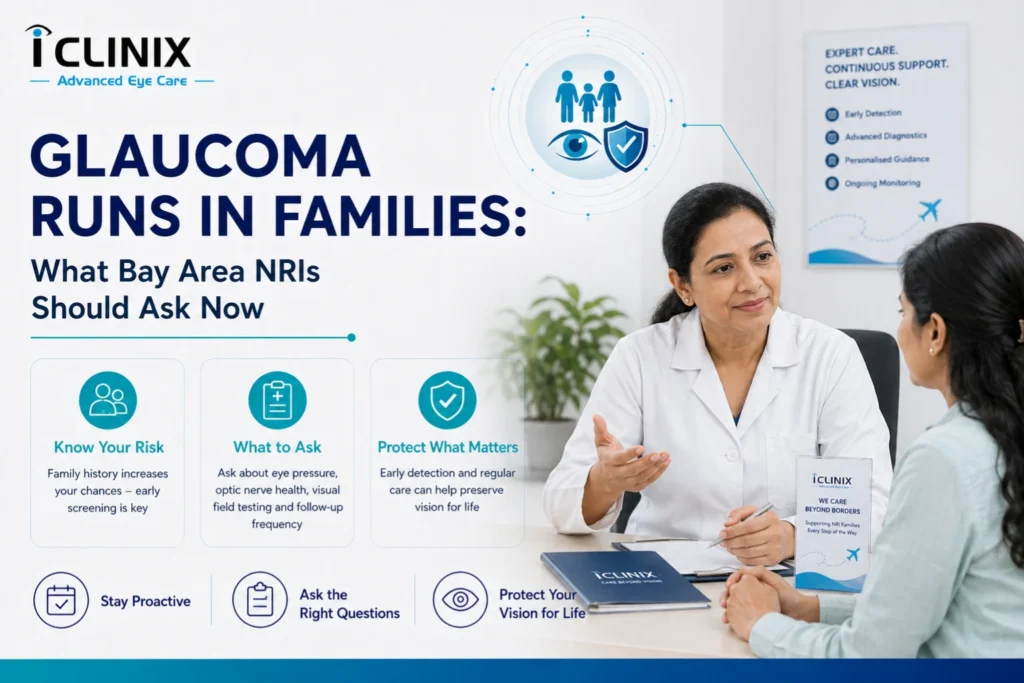
I had a patient last year whose glaucoma was picked up almost by accident — her daughter, living in the Bay Area, happened to mention during a routine call that their grandfather had gone blind from “high pressure in the eye” decades ago in Punjab, a detail nobody had thought to bring up during her own eye checkups in California. That single sentence is what got her scheduled for a proper glaucoma workup. She had early-stage disease with zero symptoms.
This is the exact pattern I see repeatedly with Indian-American families, particularly in tech-heavy communities like the Bay Area where routine eye exams often get pushed down the priority list. Glaucoma runs strongly in families, it has almost no symptoms until real damage has occurred, and family history from India frequently doesn’t make it into conversations with doctors abroad. Here’s what’s worth changing about that.
Why Family History Matters More Than Most People Realise
Having a parent or sibling with glaucoma raises your own risk significantly compared to someone with no family history — most studies estimate the risk is several times higher, and it climbs further if more than one close relative is affected (the Glaucoma Research Foundation has independent background on this if you want to read further). Indian populations also show a higher prevalence of certain glaucoma subtypes, including primary angle-closure glaucoma, which behaves differently and can progress faster than the more commonly discussed open-angle form.
The frustrating part of glaucoma is that it typically has no early warning signs. Vision loss starts at the edges of your visual field, and by the time it’s noticeable, the damage is usually significant and can’t be reversed — only slowed from that point forward. This is why family history is one of the few tools available to catch it before symptoms appear at all.
Why This Information Often Gets Lost Across Generations and Continents
A few reasons this gap shows up so often in NRI families specifically: older relatives in India may never have had a formal diagnosis, especially decades ago — “weak eyes” or “went blind in one eye” as a family story often means something more specific went undiagnosed at the time; routine eye exams abroad often focus on vision correction rather than comprehensive glaucoma screening unless specifically requested; and family medical history conversations tend to focus on heart disease, diabetes, and cancer, with eye conditions rarely coming up unless someone asks directly.
If you haven’t specifically told your eye doctor abroad about a parent or grandparent’s glaucoma or unexplained vision loss, it’s worth raising at your next visit, even if the details are fuzzy.
What to Actually Ask Your Parents or Older Relatives
A short conversation can surface useful information — did any grandparent, parent, aunt, or uncle lose vision in one or both eyes later in life, and was a reason ever given? Has anyone been told they have “high pressure” in their eyes, or been prescribed eye drops used long-term rather than for an infection? Did anyone have eye surgery described as being for “glaucoma” specifically, rather than cataracts?
None of this needs to be medically precise to be useful — even an approximate family history changes how your own eye doctor should be screening you.
What This Means for Your Own Eye Care
If there’s a known or suspected family history, a few things are worth doing regardless of where you live:
- Get a comprehensive dilated eye exam that specifically includes glaucoma screening — intraocular pressure measurement, optic nerve evaluation, and ideally visual field testing — rather than a basic vision check alone
- Start this earlier than you might expect. Glaucoma with a strong family history can appear well before the age most people associate with it, sometimes in the 40s
- Repeat screening periodically, since a single normal test doesn’t rule out future risk, particularly with ongoing family history
“The families who catch glaucoma early are almost always the ones who mentioned a relative’s history out loud, even a vague one. I’d rather review an imprecise family story than have someone assume it isn’t relevant.” — Dr. Shikha Gupta, Co-Director, iClinix
Getting a Parent in India Screened, Coordinated From Abroad
If your parent is in India and hasn’t had a proper glaucoma screening, this is a genuinely useful thing to arrange during their next visit to a doctor, or during your own trip home. At Glaucoma@iClinix, our evaluations include AI-assisted OCT imaging and visual field analysis, which is particularly useful for catching early structural changes before a patient notices any symptoms themselves.
If your parent has already been diagnosed and is on treatment in India, getting a second, specialist review is also worth considering — I lead glaucoma surgery and evaluation at iClinix, and this matters especially for congenital, juvenile, or complex glaucoma types where treatment approaches vary meaningfully between general ophthalmologists and glaucoma specialists.
Frequently Asked Questions
How much does family history actually increase my risk?
Having an immediate family member with glaucoma is one of the strongest known risk factors, alongside age and ethnicity. It doesn’t mean you’ll develop it, but it does mean routine screening matters more for you than for someone with no family history.
At what age should I start getting screened if glaucoma runs in my family?
Many specialists recommend starting comprehensive glaucoma screening in your late 30s to early 40s with a family history, rather than waiting until your 50s or 60s as general guidelines suggest for the average person.
Can glaucoma be prevented if caught early?
It can’t be prevented outright, but it can be managed effectively enough to protect most of your vision if caught before significant damage occurs — which is the entire reason early screening matters so much.
Is angle-closure glaucoma really more common in Indian populations?
Some population studies do suggest a higher relative prevalence of angle-closure glaucoma among South and East Asian populations compared to Western populations, alongside the more universally common open-angle form. Both types benefit from early screening.
Book a Glaucoma Screening for Yourself or a Parent
Whether you’re coordinating a parent’s care in India or thinking about your own risk while living abroad, a proper family-history-informed screening is worth arranging sooner rather than later.