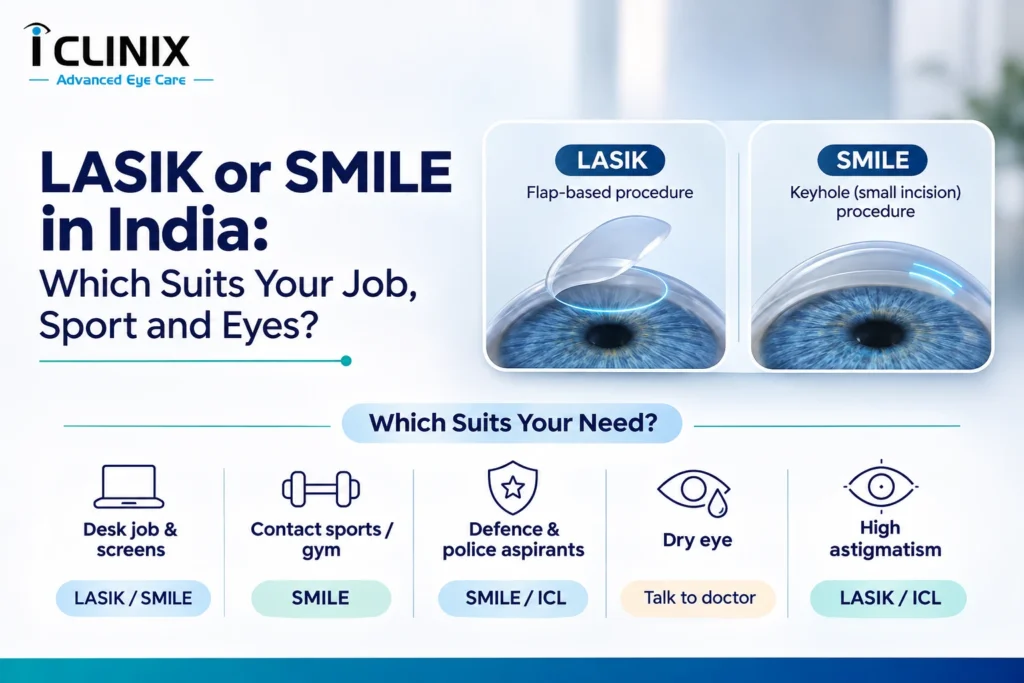
For most people with short-sight and astigmatism, LASIK and SMILE give equally sharp vision. The real differences are elsewhere: LASIK creates a thin corneal flap, while SMILE works through a small keyhole incision. That makes SMILE a little gentler on the eye’s surface nerves and removes the small long-term risk of flap injury, while LASIK treats a wider range of prescriptions and offers more customised treatment options.
So the better question isn’t “which laser is best?” but “which one suits my eyes and the life I lead?” Here’s how to think about it.
How LASIK and SMILE work, in one minute
LASIK: A femtosecond laser makes a thin, hinged flap on the cornea. The surgeon lifts it, an excimer laser reshapes the tissue underneath, and the flap is laid back. Vision is usually clear the next day.
SMILE (Small Incision Lenticule Extraction): A femtosecond laser creates a thin, lens-shaped piece of tissue (a lenticule) inside the cornea. The surgeon removes it through a small incision of a few millimetres. There’s no flap to lift.
Both reshape the cornea. Both are done with numbing drops in about 10 to 15 minutes per eye.
What the research says
A PLOS ONE meta-analysis of 12 studies and over 1,000 eyes found no meaningful difference between SMILE and femtosecond LASIK in sharpness of vision, accuracy of correction or safety at three to six months. The same analysis found less dry eye discomfort and better corneal sensation after SMILE, though the authors rated the evidence quality as low and asked for larger trials.
A separate meta-analysis focusing on dry eye reached a similar conclusion: dry eye after SMILE appeared milder in the early months.
In short: both work well, and the differences are about comfort and lifestyle, not sharpness.
LASIK vs SMILE at a glance
| LASIK (femtosecond) | SMILE | |
| Corneal flap | Yes | No (small keyhole incision) |
| Treats short-sight and astigmatism | Yes | Yes |
| Treats long-sight (hyperopia) | Yes | Limited availability |
| Customised options (e.g. topography-guided Contoura) | Yes | Fewer |
| Early dry eye | More common, usually temporary | Usually milder |
| Visual recovery | Very fast, often next day | Fast, sometimes a day or two slower |
| Risk of flap displacement after an eye injury | Small, lifelong | None (no flap) |
| Enhancement later | Usually straightforward | Possible, but often done with surface laser |
Match the procedure to how you live
You work long hours on screens
Screen work already reduces blinking and dries the eye. If you have mild dry eye now, SMILE may be more comfortable in the first months. If your eyes are healthy and your prescription suits it, LASIK, including topography-guided Contoura Vision, is an excellent option too. Dry eye should be checked and treated before either procedure.
You play contact sports or do martial arts
Boxing, kabaddi, rugby, cricket keepers, martial arts: anything with a real chance of a blow to the eye. A LASIK flap heals well, but it never becomes as strong as untouched cornea, and a hard hit can rarely displace it, even years later. SMILE has no flap, so many surgeons lean towards it for contact sports. PRK, a surface laser, is another flap-free option.
You’re preparing for the armed forces, police or another uniformed service
Many aspirants ask whether refractive surgery affects eligibility. Rules differ by service, change over time, and may specify which procedures are accepted and how long before the medical exam surgery must be done. Always check the latest official recruitment notification before booking surgery, and bring a copy to your consultation so your surgeon can plan accordingly. Keep your surgery records and prescription history safe; you may be asked for them.
You have a high prescription or a thin cornea
Both LASIK and SMILE remove corneal tissue. If your cornea is too thin for the correction you need, neither may be safe. In that case an implantable contact lens (ICL), placed inside the eye without removing corneal tissue, can be the better choice. You can read more about ICL at iClinix.
You’re long-sighted
LASIK has a longer track record for long-sight (hyperopia). SMILE for long-sight is newer and less widely available. Your surgeon will advise on the best option for your prescription.
You want the quickest return to work
Both are quick. Many LASIK patients see well the next morning; SMILE recovery is similar, sometimes a day or two slower for crispness. Most people return to desk work within a few days with either.
Cost: does SMILE cost more than LASIK?
In most Indian centres, SMILE costs more than standard femto-LASIK because of the laser platform and per-procedure costs. Contoura Vision is often priced between the two or similar to SMILE, depending on the clinic. If you’d like a detailed breakdown, see our guide to SMILE laser eye surgery cost in India.
A higher price only makes sense if the procedure actually suits your eyes better. A good surgeon will tell you when standard LASIK is perfectly fine.
Who shouldn’t have either?
Neither LASIK nor SMILE is recommended if you have:
• Keratoconus or a suspicious corneal shape on topography.
• A prescription that’s still changing.
• Uncontrolled diabetes or certain autoimmune conditions.
• Pregnancy or breastfeeding (it’s usually postponed).
• Significant untreated dry eye.
A quick decision guide
• Healthy eyes, moderate short-sight, desk job: LASIK or SMILE; your corneal maps decide.
• Contact sports or high injury risk: SMILE or PRK are often preferred.
• Mild dry eye: treat it first; SMILE may be more comfortable.
• Irregular corneal surface on maps: Contoura Vision may be offered.
• Thin cornea or very high power: ICL is worth discussing.
• Uniformed service aspirant: check the current rules first, then decide.
For a three-way comparison including ICL, read our LASIK vs SMILE vs ICL guide.
What recovery looks like: LASIK vs SMILE
| Time after surgery | LASIK | SMILE |
| Day 1 | Most people see clearly; mild grittiness | Clear but sometimes slightly hazy; mild grittiness |
| First week | Back to desk work in a day or two; avoid rubbing and swimming | Similar; vision sharpens over several days |
| First month | Dry eye drops often needed; avoid contact sports | Dry eye usually milder; avoid contact sports until cleared |
| Three months | Vision settled for most people | Vision settled for most people |
Both procedures need eye drops for a few weeks and follow-up visits. Your surgeon will give you exact timings for gym, swimming, travel and screen use.
Mistakes people make when choosing between LASIK and SMILE
• Picking by price or brand name alone. The right choice depends on your corneal scans, prescription and lifestyle.
• Ignoring dry eye. Mild dryness before surgery can become uncomfortable afterwards if not treated first.
• Not mentioning sports or career plans. Your surgeon can only factor them in if you bring them up.
• Rushing while the prescription is still changing. Wait until it has been stable for at least a year.
Choosing between LASIK and SMILE at iClinix
iClinix offers femtosecond LASIK, Contoura Vision, SMILE, PRK and ICL, so the advice you get isn’t limited by the equipment a centre happens to have. Every assessment includes corneal topography and tomography, anterior segment OCT, a tear film check and a retina examination. Consultations are available at Lajpat Nagar, Paschim Vihar and Shakti Nagar in Delhi, and in Gurugram and Panipat. Call +91 98991 18030 to book.
Frequently asked questions
Is SMILE better than LASIK?
Neither is better for everyone. Studies show similar sharpness of vision. SMILE has no flap and tends to cause less early dry eye; LASIK treats a wider range of prescriptions and offers more customised options.
Which is safer, LASIK or SMILE?
Both are safe when patients are carefully selected. SMILE avoids flap-related risks, which matters most if you play contact sports.
Is SMILE more expensive than LASIK in India?
Usually yes, because of the laser platform. The best value is the procedure that suits your eyes, which may not be the most expensive one.
Can I do sports after LASIK or SMILE?
Yes, after the healing period your surgeon advises. For contact sports, many surgeons prefer SMILE or PRK because there’s no flap.
Can defence or police aspirants have LASIK or SMILE?
It depends on the current rules of the specific service, which can change. Check the latest official recruitment notification before surgery and discuss it with your surgeon.
Does SMILE cause less dry eye than LASIK?
Research suggests dry eye is generally milder in the early months after SMILE, though both usually improve with time and treatment.
How long after LASIK or SMILE can I go back to the gym?
Light exercise is usually fine after a few days. Swimming, contact sports and heavy weights are generally avoided for a few weeks. Your surgeon will give exact timings based on your procedure and how your eyes heal.
Can I have LASIK or SMILE if I have dry eyes?
Often yes, once the dry eye has been treated and the eye surface is healthy. Mild dry eye may tip the choice towards SMILE. Severe or untreated dry eye may mean neither is advised for now.
Still torn between LASIK and SMILE? Book a refractive assessment at iClinix and let your corneal scans, not a brochure, decide.
This article is for general information and does not replace a personal eye examination.