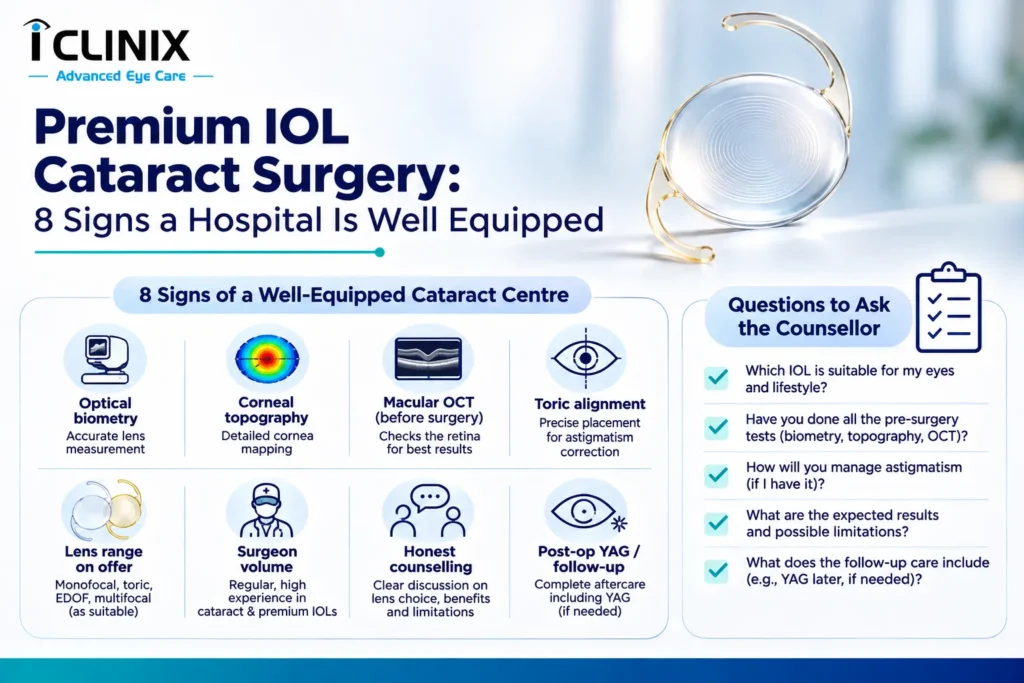
The best hospital for premium IOL cataract surgery is one that measures your eye precisely, checks your retina and cornea before recommending a lens, offers a full range of lens types, and tells you honestly when a premium lens isn’t right for you. A multifocal, EDOF or toric lens can cut your dependence on glasses, but only if the planning is accurate. Small errors that wouldn’t matter much with a basic lens show up clearly with a premium one.
Here are eight signs a hospital is genuinely ready for premium lens surgery, and the questions that will tell you.
First, what counts as a “premium” IOL?
During cataract surgery, your cloudy natural lens is replaced with an artificial intraocular lens (IOL). The US National Eye Institute notes that 9 out of 10 people see better after cataract surgery. Which lens you choose decides how much you’ll still rely on glasses.
| Lens type | What it gives you | Glasses afterwards |
| Monofocal | Clear vision at one distance, usually far | Usually for reading |
| Toric | Corrects astigmatism; can be monofocal, EDOF or trifocal | Depends on base lens |
| EDOF | Distance plus intermediate (computer, dashboard) | Often for small print |
| Trifocal / multifocal | Distance, intermediate and near | Least, but more chance of night halos |
Toric, EDOF and trifocal lenses are generally called “premium” because they cost more and aim to reduce glasses use. Mayo Clinic’s overview of cataract surgery has a neutral summary of the lens types.
Sign 1: Optical biometry, not just ultrasound
To pick the right lens power, the surgeon needs your eye’s exact length and curvature. Optical biometry measures these with light and is highly precise. For premium lenses, where the target is a glasses-free result, even a small miscalculation can leave you needing glasses.
Ask: “Which machine do you use to measure lens power, and which formula?”
Sign 2: Corneal topography for astigmatism
Astigmatism ruins the result of any premium lens if it’s left uncorrected. Corneal topography or tomography maps the shape of your cornea, so the surgeon can decide whether you need a toric lens and exactly how to align it.
Ask: “Have you measured my astigmatism with topography, and do I need a toric lens?”
Sign 3: A macular OCT scan before surgery
Multifocal and EDOF lenses depend on a healthy retina, especially the macula. An OCT scan can pick up early macular degeneration, diabetic swelling or membranes that you might not notice yet. These can make a multifocal lens a poor choice.
Ask: “Has my macula been scanned, and is it healthy enough for this lens?”
Sign 4: Corneal cell count (specular microscopy)
Specular microscopy counts the cells on the inner surface of the cornea. If they’re low, for example in Fuchs’ dystrophy, the cornea may struggle after surgery, and some lens choices or techniques may change.
Sign 5: A real choice of lenses
A hospital that only stocks one or two lens types will tend to recommend those. Look for a range: monofocal, toric, EDOF and trifocal, ideally from more than one manufacturer. Our guide to choosing between monofocal, EDOF and trifocal lenses explains how each one feels in daily life.
Ask: “Which lenses do you offer, and why are you recommending this one for me?”
Sign 6: Precise toric alignment
A toric lens has to sit at an exact angle to correct astigmatism. Good centres mark the eye carefully before surgery or use image-guided alignment, and check the lens position afterwards. A few degrees of rotation can noticeably reduce the correction.
Sign 7: Honest counselling, including “no”
The most important sign is often a conversation, not a machine. A good surgeon will:
• Ask how you use your eyes: driving at night, reading, screen work, hobbies.
• Explain the trade-offs, like halos with trifocals or readers with EDOF.
• Tell you plainly if your eyes aren’t suited to a premium lens, because of glaucoma, macular disease, irregular cornea or other reasons.
If everyone you see is told they need the most expensive lens, that’s a warning sign.
Sign 8: Proper aftercare, including YAG laser
After surgery, you’ll need follow-up checks, and some people develop a thin film behind the lens months or years later (posterior capsule opacification). It’s treated with a quick YAG laser in clinic. Premium lens patients are more sensitive to this film, so check that the hospital provides YAG laser and long-term follow-up.
The American Academy of Ophthalmology’s page on IOL implants for cataract surgery is useful extra reading before your consultation.
Quick checklist: is this hospital premium-IOL ready?
• ☐ Optical biometry for lens power
• ☐ Corneal topography or tomography for astigmatism
• ☐ Macular OCT before surgery
• ☐ Specular microscopy
• ☐ Full range of lens types
• ☐ Careful toric alignment
• ☐ Honest, unhurried counselling
• ☐ YAG laser and long-term follow-up on site
Who should think twice about a premium lens?
Premium lenses may not be the best choice if you have:
• Macular degeneration or diabetic macular swelling.
• Advanced glaucoma.
• An irregular cornea or significant dry eye that hasn’t been treated.
• A job or lifestyle needing the crispest possible night vision, where halos would be a problem.
In these cases, a monofocal or toric monofocal lens often gives the most reliable result.
Questions to ask at your lens consultation
Take this list with you. A good team will be happy to answer every one.
1. Which lens are you recommending for each eye, and why?
2. What will my vision be like for driving at night, computer work and reading?
3. Do I need a toric lens for astigmatism?
4. Is my retina and cornea healthy enough for this lens?
5. Who will do my surgery, and how many premium lenses do they implant?
6. What’s included in the package: tests, lens, surgery, medicines, follow-ups?
7. What happens if I’m not happy with the result?
Mistakes people make when choosing a premium lens
• Choosing the most expensive lens by default. The best lens is the one that suits your eyes and daily life.
• Not mentioning night driving or hobbies. These change which lens is right.
• Skipping dry eye treatment before surgery. A dry eye surface can throw off measurements and blur results.
• Expecting perfect vision on day one. Premium lenses often take a few weeks to a few months for the brain to adapt.
• Choosing a different lens type for each eye without a plan. Mixing lenses can work well, but only when the surgeon plans it deliberately.
Premium lens cataract surgery at iClinix
At iClinix, every cataract patient is assessed with optical biometry, anterior segment OCT and specular microscopy, with corneal topography and retinal OCT where needed. Lens options include monofocal, EDOF, trifocal and toric lenses, and surgery is done with micro-incision phacoemulsification. Cataract surgeons include Dr. Shikha Gupta, AIIMS Gold Medallist, and Dr. Varun Gogia, both trained at AIIMS.
You’ll get a lens recommendation based on your scans and lifestyle, and a transparent estimate after screening. Cashless support is available across major TPAs. Read more about cataract surgery at iClinix. Centres: Lajpat Nagar, Paschim Vihar, Shakti Nagar, Gurugram and Panipat. Call +91 98991 18030.
Frequently asked questions
Which is the best hospital in India for premium IOL cataract surgery?
Look for a hospital with optical biometry, corneal topography, macular OCT, a full range of lenses, experienced cataract surgeons and honest counselling, rather than the one with the loudest advertising.
Is a premium IOL worth it?
For people with healthy eyes who want less reliance on glasses, many find it worthwhile. If you have other eye conditions or are happy with reading glasses, a monofocal lens may be better value.
What tests are needed before premium lens cataract surgery?
Usually optical biometry, corneal topography, a macular OCT scan and specular microscopy, plus a full eye examination.
Can I get a premium IOL if I have astigmatism?
Yes. Toric versions of EDOF and trifocal lenses correct astigmatism as well.
Who should not get a multifocal lens?
People with macular disease, advanced glaucoma, irregular corneas or a strong need for crisp night vision may do better with a monofocal or EDOF lens.
Will I be completely glasses-free with a premium lens?
Many people do most daily tasks without glasses, but no lens can guarantee it. Some still use readers for very small print or dim light.
Considering a premium lens for cataract surgery? Book a lens consultation at iClinix and bring this checklist; we’ll go through every point with you.
This article is for general information and does not replace a personal eye examination.