A patient’s son called me from Chicago last winter, three days before his mother’s cataract surgery, asking a question I get often from NRI families: “Which lens should we actually pick?” His mother was in my clinic in Lajpat Nagar; he was managing the decision over a WhatsApp call at 11 pm his time. That gap — the parent in the chair, the adult child making the call from thousands of miles away — is exactly why this decision needs a clear explanation, not a rushed one.
If you’re coordinating a parent’s cataract surgery in India from the US, UK, Canada, Gulf, or anywhere else, the lens choice is usually the one decision that actually needs your input, since it affects how your parent sees for the rest of their life. Here’s what the three main options actually mean.
Why This Decision Falls to You
Cataract surgery itself is quick and low-risk by modern standards. But the artificial lens implanted during surgery — called an intraocular lens, or IOL — is permanent. Unlike glasses, it isn’t something your parent can swap out later if they’re unhappy with the outcome. That’s why our cataract & lens surgery team walks families through the options rather than picking one by default, and why it’s worth understanding the trade-offs before the consultation, not during it.
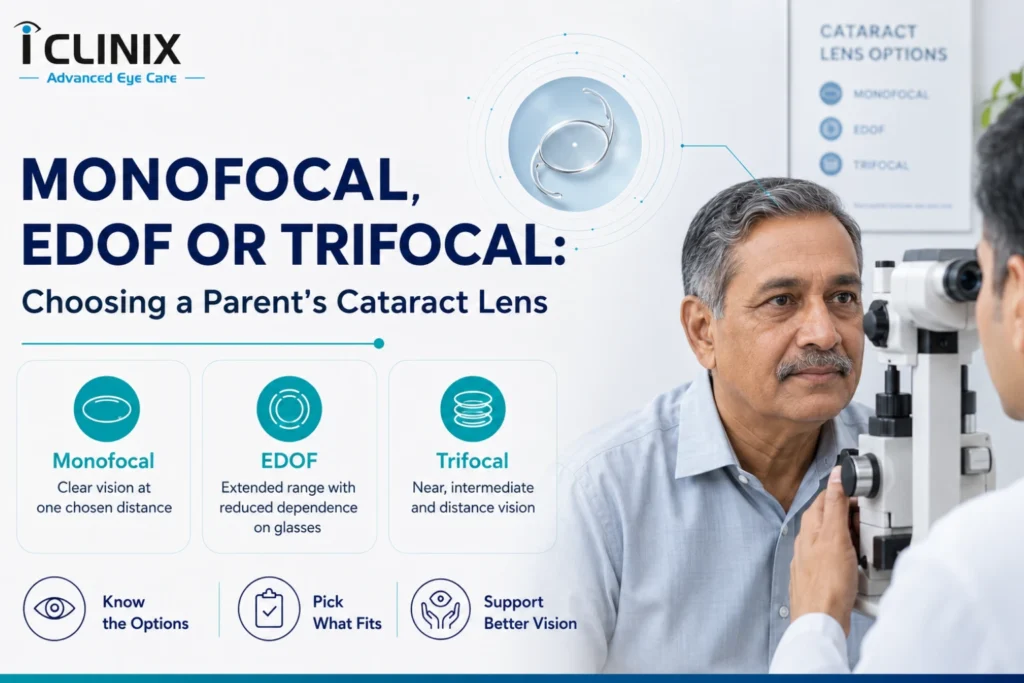
Monofocal Lenses: The Standard, Reliable Choice
A monofocal lens corrects vision clearly at one distance — almost always set for distance vision, since that covers walking, watching TV, and recognising faces, which matter most for daily independence. Reading and close-up work will still need glasses afterward. (For an independent, plain-language overview of how these lens types compare, the American Academy of Ophthalmology’s IOL guide is a good starting point alongside this article.)
This is the most widely used lens worldwide, has the longest track record, and tends to be the most cost-effective option. For a parent who already wears reading glasses and doesn’t mind continuing to, or who has other eye conditions (like diabetic retinopathy or glaucoma) that make a simpler visual outcome more predictable, monofocal is often the sensible default.
Monofocal tends to be the right fit if: your parent is comfortable wearing reading glasses, has other eye conditions that could complicate a more complex lens, or you’re prioritising a well-established, lower-cost option.
EDOF Lenses: A Middle Ground
EDOF stands for Extended Depth of Focus. Instead of a single sharp focal point, these lenses stretch the zone of clear vision across distance and intermediate range — useful for daily tasks like reading a phone screen, checking a medicine label, or looking at a car dashboard, without needing glasses for most of it. Close-up reading of small print may still need reading glasses, but less often than with a monofocal lens.
EDOF lenses also tend to produce fewer visual side effects — like halos or glare around lights at night — compared to some multifocal designs, which matters for parents who still drive after dark or who are especially sensitive to visual disturbances.
EDOF tends to be the right fit if: your parent wants more glasses independence than a monofocal lens offers, without taking on the higher cost or slightly higher glare risk of a full trifocal lens.
Trifocal Lenses: Maximum Spectacle Independence
A trifocal lens is built with three focal zones — distance, intermediate, and near — designed to give clear vision across almost the full range a person needs day to day, with the lowest reliance on glasses of the three options. For a parent who was highly independent before cataracts set in and wants to stay that way, this is often the lens that comes up first in conversation.
The trade-off is cost — trifocal lenses are the most expensive of the three — and a slightly higher chance of noticing glare or halos around lights at night in the initial months, which most patients adapt to but not universally. Trifocal lenses also aren’t ideal for every eye; conditions like significant macular disease or irregular astigmatism can make a simpler lens choice safer.
Trifocal tends to be the right fit if: your parent values glasses independence highly, doesn’t have other eye conditions that complicate the outcome, and is comfortable with the higher cost for that flexibility.
What We Actually Check Before Recommending a Lens
None of these three options should be chosen off a comparison chart alone. Before I recommend anything, I run a full assessment covering the health of the retina and optic nerve, corneal shape and any astigmatism, and any other conditions — diabetes, glaucoma, prior eye surgery — that could affect how well a premium lens performs. A trifocal lens on an eye with early macular degeneration, for instance, won’t deliver the sharp near vision it’s designed for, and I’d say so directly rather than sell the upgrade.
“The best lens for a parent’s eyes isn’t always the most advanced one. It’s the one that matches what their eye can actually deliver, and what their daily life actually needs.” — Dr. Shikha Gupta, Co-Director, iClinix
If your parent also has retinal findings that need monitoring alongside the cataract, that part of the workup involves Dr. Varun Gogia, our Director and vitreoretinal specialist, since a stable retina is part of what makes any lens choice worthwhile in the first place.
How to Make This Decision From Abroad
A few things make this easier when you’re coordinating from outside India: ask for the diagnostic report before the consultation date, not after, so you have time to discuss it with your parent and each other over a call; get on the video or phone consultation yourself if your parent struggles to relay technical details accurately, since most clinics, including ours, are used to including adult children this way; ask specifically about your parent’s lifestyle, not just their eyes, since whether they still drive at night, read for hours, or mainly want independence for daily tasks changes which lens actually serves them best; and confirm the total cost upfront, including the lens itself, since premium lens costs vary meaningfully and this is often where miscommunication happens between family members managing logistics remotely.
Frequently Asked Questions
Can the lens be changed after surgery if my parent isn’t happy?
Generally, no — IOL exchange is possible but is a second surgery with its own risks, and isn’t done casually. This is exactly why the decision deserves time upfront.
Does age affect which lens is suitable?
Not directly, but age-related conditions that become more common over time — like macular degeneration or advanced glaucoma — can affect which lens performs best. This is checked during the diagnostic workup, not assumed from age alone.
Is a premium lens worth the extra cost for an older parent?
It depends entirely on their lifestyle and eye health, not their age. An active 75-year-old who still drives and travels may benefit more from a trifocal lens than a less active 65-year-old with other eye conditions.
Book a Cataract Consultation for Your Parent
If you’re weighing this decision for a parent in India, a proper diagnostic workup is the only way to know which lens will actually work for their eyes — not just their age or budget.