
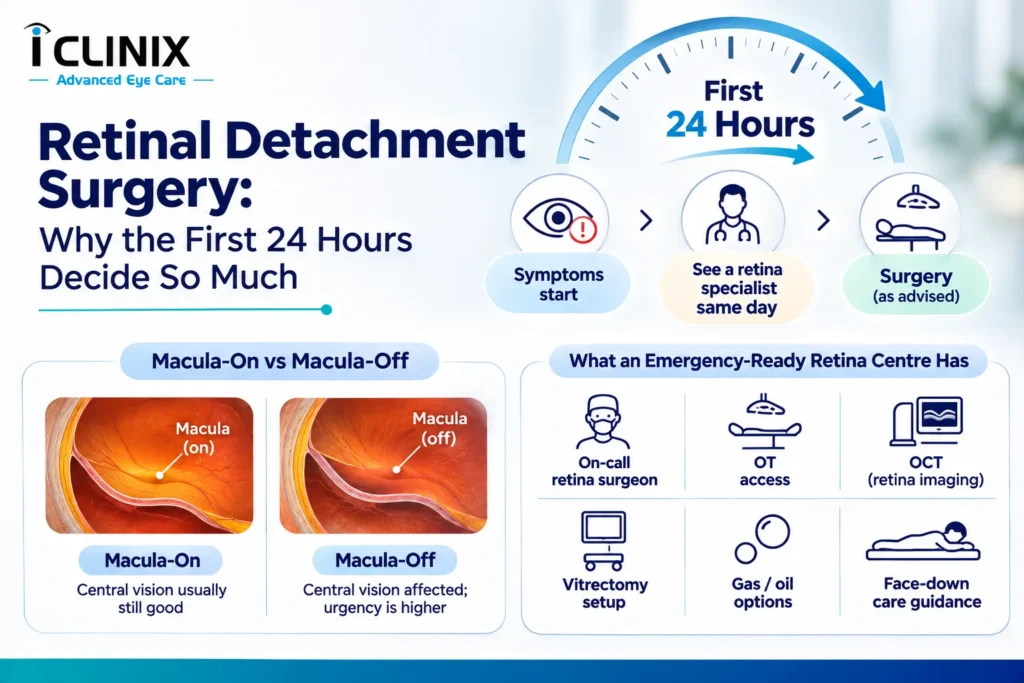
A retinal detachment is an eye emergency. If you notice a sudden shower of new floaters, flashes of light, or a dark curtain spreading across your vision, you should see a retina specialist the same day. Speed matters most while the macula, the centre of the retina that gives sharp reading vision, is still attached. Repairing the retina before the macula comes off gives the best chance of keeping good central vision.
That’s why “which hospital is best?” for retinal detachment really means “which retina team can see me today and operate quickly?” Here’s what to look for, and what to expect.
What is a retinal detachment?
The retina is the thin, light-sensitive layer lining the back of the eye, like the film in a camera. In a detachment, it peels away from the wall of the eye and stops working properly.
The most common type starts with a tear. As we age, the gel inside the eye (the vitreous) shrinks and pulls away from the retina. Sometimes it tugs hard enough to tear it. Fluid then seeps through the tear and lifts the retina off.
Warning signs you should never wait on
The US National Eye Institute lists the key symptoms of retinal detachment:
• A sudden increase in floaters (dots, threads or cobwebs).
• Flashes of light in one or both eyes.
• A dark shadow or curtain over part of your vision.
Other warning signs include blurry vision or straight lines looking wavy. There’s usually no pain, which is why people often wait “to see if it settles”. Please don’t.
What to do right now
• Don’t wait for the weekend or for symptoms to go away.
• Call an eye hospital with a retina specialist and say clearly: “sudden floaters, flashes or a shadow”.
• Avoid heavy lifting, bending and intense exercise until you’re examined.
• If you can’t reach a retina specialist, go to the nearest eye emergency.
Why the first 24 hours matter
Doctors often describe detachments as macula-on or macula-off.
| Macula-on | Macula-off | |
| What it means | The centre of the retina is still attached | The centre has detached too |
| Central vision | Usually still good | Blurred or badly reduced |
| Urgency | Very high: repair before the macula detaches | Still urgent, but some central vision loss may already have happened |
| Typical outcome | Best chance of keeping sharp reading vision | Vision often improves after surgery, but may not fully return |
A macula-on detachment can become macula-off within hours or days. Getting repaired before that happens is the single biggest thing you can do to protect your reading vision.
And if the problem is caught even earlier, as a tear before any detachment, a quick laser or freezing treatment in the clinic can often prevent surgery altogether. The American Academy of Ophthalmology stresses that a retinal tear must be evaluated right away.
Who is at higher risk?
• Moderate to high short-sightedness.
• Previous cataract or other eye surgery.
• A past detachment in the other eye, or a family history.
• Serious eye injury.
• Thin areas of retina (lattice degeneration).
• Advanced diabetic eye disease.
If you’re in one of these groups, knowing the warning signs is especially important. Our article on retinal detachment warning signs in elderly parents is worth sharing with family.
How is retinal detachment repaired?
The National Eye Institute describes the main surgery options for retinal detachment. Your surgeon chooses based on the type of detachment, where the tears are and the state of the eye.
| Procedure | How it works | Often used for |
| Pneumatic retinopexy | A gas bubble is injected to press the retina back, then the tear is sealed with laser or freezing | Some simple detachments with a single tear in the upper retina |
| Scleral buckle | A soft band is placed on the outside wall of the eye to push it towards the retina | Younger patients, certain tear patterns |
| Vitrectomy | The vitreous gel is removed through tiny ports, the retina is flattened, sealed with laser and held with gas or silicone oil | Most complex or extensive detachments, and many detachments in older adults |
The NEI reports that treatment is successful for about 9 in 10 people, though some need more than one procedure.
Recovery: what you should know
• Positioning. If a gas bubble is used, you may need to keep your head in a specific position (sometimes face-down) for several days. This keeps the bubble pressing on the right spot.
• No flying with gas in the eye. Gas expands at altitude and can raise eye pressure dangerously. Don’t fly until your surgeon confirms the bubble has gone.
• Vision recovers gradually over weeks to months.
• Silicone oil, if used, usually needs a second, smaller operation to remove it later.
• Follow-ups are essential to catch any new tears early.
What to look for in a retinal detachment hospital
When time matters, these are the questions that count:
1. Is there a vitreo-retina surgeon, not just a general ophthalmologist?
2. How quickly can I be seen and operated on? Ask directly.
3. Is vitreoretinal surgery done on site, with modern small-gauge instruments?
4. Do they have OCT and wide-field retinal imaging to map the whole retina?
5. Will the same team handle follow-ups, positioning advice and any further procedures?
6. Is cashless insurance available to avoid delays over paperwork?
Life after retinal detachment surgery: the first six weeks
| Time | What to expect |
| First few days | Eye may be red, swollen and blurry. Follow positioning instructions exactly if you have a gas bubble. |
| Week 1–2 | Drops several times a day. Gas bubble starts shrinking; you may see its edge as a wobbly line. No flying, no heavy lifting. |
| Week 3–6 | Vision gradually improves as the gas clears. Return to desk work as advised. |
| After 6 weeks | Most activities resume. A new glasses prescription may be needed once the eye settles. |
If you have silicone oil instead of gas, positioning is usually shorter, but a second operation to remove the oil is often planned after a few months.
Can it happen in the other eye?
Yes, some people go on to develop a tear or detachment in the other eye, especially if they’re very short-sighted or have thin areas of retina. Your retina specialist will examine both eyes carefully, and may treat weak spots in the other eye with laser as a precaution. Learn the warning signs and act on them quickly if they ever appear in either eye.
Retinal detachment care at iClinix
At iClinix, retinal detachment is treated by the vitreo-retina team led by Dr. Varun Gogia, trained at AIIMS (MBBS, MD and Vitreoretinal & Uvea services). The service offers 25G and 27G sutureless vitreoretinal surgery, retinal laser and freezing treatment for tears, gas and silicone oil tamponade, spectral-domain OCT and ultra-widefield retinal imaging. Cashless support is available across major TPAs.
If you have warning signs, call +91 98991 18030 and tell the team it’s urgent. Read more about retinal detachment treatment at iClinix and our wider retina services. Centres: Lajpat Nagar, Paschim Vihar, Shakti Nagar, Gurugram and Panipat.
Frequently asked questions
Is retinal detachment an emergency?
Yes. It needs same-day assessment by an eye specialist. The sooner it’s repaired, especially before the central retina detaches, the better the chance of keeping good vision.
How long can a retinal detachment wait before surgery?
It shouldn’t wait. A detachment that hasn’t yet reached the macula can do so within hours or days, so most are repaired urgently once diagnosed.
What is the success rate of retinal detachment surgery?
The US National Eye Institute reports that treatment works for about 9 in 10 people, though some need more than one procedure.
Which surgery is best for retinal detachment?
It depends on the detachment. Pneumatic retinopexy, scleral buckle and vitrectomy each suit different situations. Your retina surgeon will advise after examining your eye.
Can I fly after retinal detachment surgery?
Not while there’s a gas bubble in your eye. Gas expands at altitude and can be dangerous. Your surgeon will tell you when it’s safe.
Will my vision be normal after retinal detachment surgery?
Many people regain useful vision, especially if the macula was still attached. If it had detached, vision usually improves but may not return fully.
Can retinal detachment be prevented?
Not always, but catching a retinal tear early and sealing it with laser can often prevent a detachment. Know the warning signs, and have a dilated eye check if you’re very short-sighted or have had eye surgery.
How long does retinal detachment surgery take?
It varies with the technique and complexity, usually from under an hour to a couple of hours. Many patients go home the same day or the next.
Sudden floaters, flashes or a shadow in your vision? Don’t wait to see if it settles. Contact iClinix now or call +91 98991 18030 and say it’s urgent.
This article is for general information and does not replace a personal eye examination.