
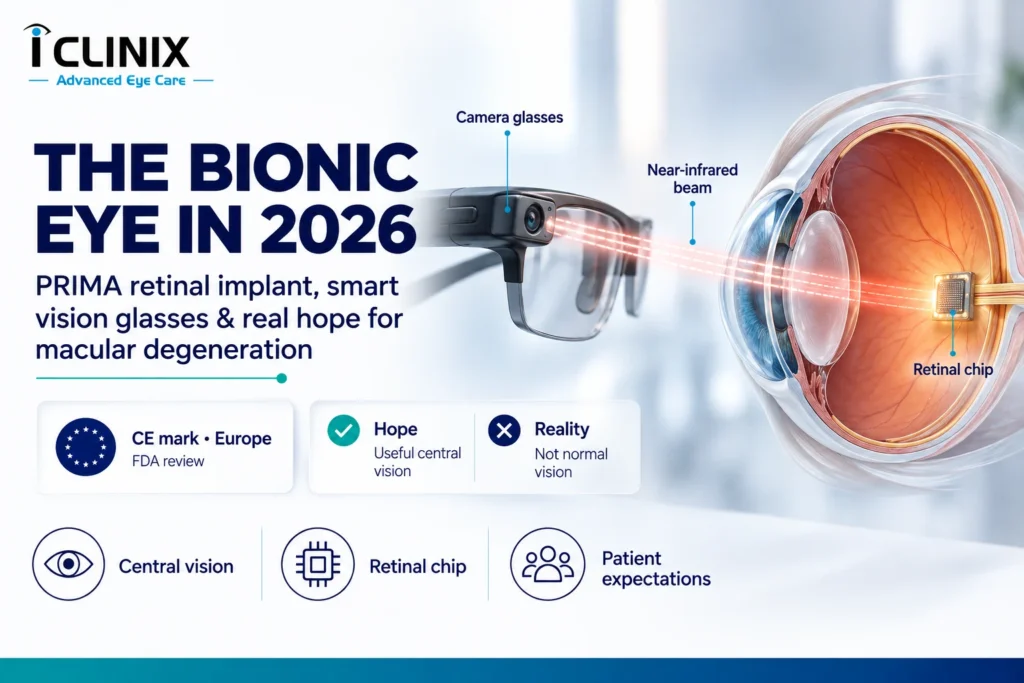
A “bionic eye” for macular degeneration is now a real treatment in Europe. The PRIMA system, made by Science Corporation, uses a tiny wireless chip placed under the retina and a pair of camera glasses to restore some central vision in people with advanced dry age-related macular degeneration (geographic atrophy). In its main trial, most patients regained enough vision to read letters and words. PRIMA received CE marking in July 2026. It is not yet available in India or approved in the US.
If you or a parent live with dry AMD, here’s an honest look at what PRIMA can and can’t do, and the help that’s available today.
Understanding macular degeneration
The macula is the small central part of the retina responsible for sharp, detailed vision: reading, recognising faces, threading a needle. Age-related macular degeneration (AMD) damages it.
There are two main forms:
• Wet AMD, where abnormal blood vessels leak under the retina. It can cause fast vision loss but is often controlled with eye injections.
• Dry AMD, which is more common and progresses slowly. In its advanced stage, called geographic atrophy (GA), patches of light-sensing cells in the macula die.
In geographic atrophy, a blind spot grows in the centre of vision. Peripheral (side) vision usually remains, so people can often walk around independently but struggle to read or see faces. Until recently, no treatment could bring back the central vision lost to GA.
How the PRIMA bionic eye works
PRIMA has two parts that work together.
1. The implant. A wireless photovoltaic chip measuring about 2 mm × 2 mm, thinner than a sheet of paper, is placed under the damaged macula during retinal surgery. It contains hundreds of tiny solar-cell-like pixels.
2. The glasses. The patient wears glasses with a built-in camera. The camera captures the scene, a small processor enhances it, and the glasses project it onto the chip as near-infrared light, which is invisible to the remaining natural eye.
Each pixel on the chip turns that infrared light into a small electrical signal. The signal stimulates the retina’s surviving nerve cells, which pass it to the brain as a visual image. The result is a form of artificial central vision, laid over the person’s own remaining side vision.
Science Corporation’s PRIMA technology page has diagrams of the system.
What the trial results showed
The pivotal European study, PRIMAvera, included 38 patients with geographic atrophy at 17 centres. At 12 months, as summarised by touchOPHTHALMOLOGY’s report on the CE mark:
• Average vision improved by 25.5 letters on the eye chart, roughly five lines.
• 80% of patients improved by a clinically meaningful amount.
• 84% said they used the system to read letters, numbers or words at home.
The results were also published in the New England Journal of Medicine in 2025.
For people who had lost central vision entirely in that eye, regaining the ability to read anything is a big change.
Hope vs reality: what PRIMA does not do
It’s important to be clear about the limits.
• It isn’t natural vision. The artificial vision is black-and-white and lower in resolution than normal sight. Reading usually needs magnification through the glasses’ zoom.
• It needs training. Patients go through rehabilitation to learn how to use the image and combine it with their side vision.
• It requires retinal surgery. As with any retinal surgery, there are risks. Some trial participants had complications, most of which resolved.
• It’s for advanced geographic atrophy only. It’s not a treatment for early dry AMD, wet AMD or other retinal diseases.
• It doesn’t stop the disease. PRIMA works around the damaged area; it doesn’t reverse AMD itself.
Where PRIMA is available
| Region | Status (October 2026) |
| Europe | CE-marked July 2026; first commercial implants planned in Germany; reimbursement sought across 30 countries |
| United States | FDA Breakthrough Device and Humanitarian Use Device designations; not yet approved for sale |
| India | Not available |
New implant technology usually takes several years to reach India after its European launch, once surgeons are trained and approvals are in place.
Smart glasses: help you can use today
While implants develop, wearable electronic glasses already help many people with AMD make the most of the vision they have.
Devices like eSight Go use a high-definition camera and screens in front of the eyes to magnify and enhance what you’re looking at, adjust contrast and brightness, and let you zoom in on faces, text or the TV. No surgery is involved. They work best for people with some remaining vision.
Other low-vision aids are simpler and cheaper:
• Hand-held and stand magnifiers.
• Electronic video magnifiers for reading at a desk.
• Phone and tablet accessibility tools, such as zoom, high contrast and text-to-speech.
• Better lighting at home, especially for reading and stairs.
• Large-print and audio books.
A low-vision assessment can match the right tools to your needs.
What iClinix’s retina team can do today
The best outcome in AMD still comes from catching it early and treating what can be treated.
• AMD screening and monitoring with OCT imaging, to detect changes before they cause major vision loss.
• Injections for wet AMD, which can stabilise and sometimes improve vision when started promptly.
• Guidance for dry AMD, including lifestyle advice, monitoring with an Amsler grid at home, and discussion of newer treatments as they become available in India.
• Low-vision support, including advice on magnifiers and devices.
Our retina clinic is led by vitreoretinal specialists. Our guide to advanced retina treatment in Delhi explains how we approach long-term retinal care.
See a retina specialist quickly if you notice straight lines looking wavy, a new dark or blurry spot in your central vision, or a sudden drop in reading vision. These can be signs of wet AMD, where early treatment matters most.
The short answer
The PRIMA bionic eye is a real milestone: for the first time, people with advanced dry AMD have regained some ability to read with a retinal implant. It’s approved in Europe, still under review in the US, and not yet available in India. It isn’t a cure, and it isn’t normal vision. For now, early detection, prompt treatment of wet AMD and good low-vision support remain the most powerful tools.
If you’re worried about macular degeneration, for yourself or a parent, book a retina consultation at iClinix.
Frequently asked questions
What is the PRIMA bionic eye?
PRIMA is a retinal implant system for advanced dry AMD (geographic atrophy). A 2 mm wireless chip under the retina receives images projected as near-infrared light from camera glasses and turns them into electrical signals the brain can see as central vision.
Is the PRIMA implant available in India?
No. As of October 2026, PRIMA has CE marking in Europe and is not approved in India or the US. It’s likely to take several years to reach India.
Can a bionic eye cure macular degeneration?
No. PRIMA doesn’t cure or stop AMD. It provides a form of artificial central vision in people who have lost it to geographic atrophy, helping many read letters and words again.
What treatments are available for dry AMD today?
There is no cure for dry AMD yet. Management includes regular monitoring, lifestyle measures, low-vision aids, and in some countries, injections that slow geographic atrophy. Ask your retina specialist which options are available in India.
Do smart glasses help with macular degeneration?
Electronic glasses like eSight Go can help people with some remaining vision by magnifying and enhancing images. They don’t restore sight, but many people find them useful for reading, TV and recognising faces.
Worried about macular degeneration, for yourself or a parent? Book a retina check at iClinix. Catching changes early still protects the most vision.
This article is for general information and does not replace a personal eye examination.