In India, cataract surgery with a multifocal (or trifocal) lens costs noticeably more than with a monofocal lens, mainly because of the lens itself. Most health insurance policies cover cataract surgery, but many have a fixed limit per eye, and that limit is often built around a standard monofocal lens. So the real question is usually not “does insurance cover cataract surgery?” but “how much of a premium lens will I pay for myself?”
This guide explains how lens prices compare, how insurance usually treats each lens, and how to decide whether a multifocal lens is worth the extra spend.
Monofocal vs multifocal: what you’re paying for
| Monofocal | Multifocal / trifocal | |
| Vision without glasses | Clear at one distance (usually far) | Far, intermediate and near |
| Reading glasses | Usually needed | Often not needed for most tasks |
| Night halos and glare | Minimal | More common, often fade with time |
| Contrast in dim light | Best | Slightly lower |
| Suits eyes with other conditions | Yes, most | Not always |
| Relative cost | Lowest | Highest |
In between sit EDOF lenses (distance and computer vision, fewer halos) and toric lenses (for astigmatism, available in all types). Our guide to monofocal, EDOF and trifocal lenses explains how each feels in daily life.
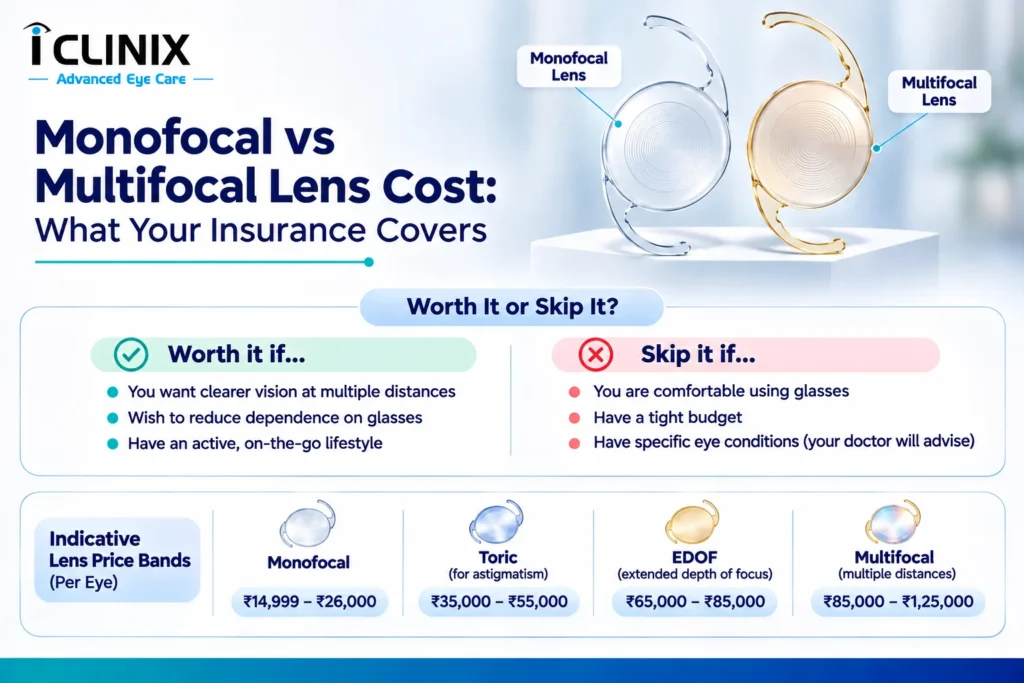
Indicative package ranges at iClinix (per eye)
| Lens type | Indicative range |
| Monofocal | ₹25,000 – ₹45,000 |
| Toric monofocal | ₹45,000 – ₹75,000 |
| EDOF | ₹70,000 – ₹1,10,000 |
| Trifocal / multifocal | ₹90,000 – ₹1,40,000 |
Indicative as of November 2026. The final estimate is given after screening. For a wider breakdown, see cataract surgery cost in Delhi NCR.
How health insurance usually treats cataract surgery
Policies differ a lot, so treat this as a guide to what to check, not a promise of what you’ll get.
1. Cataract is usually covered. Most individual and family health policies, and many group policies, cover cataract surgery as a day-care procedure.
2. There may be a waiting period. Many policies have a waiting period, often one to two years from the start of the policy, before cataract claims are paid. Group policies through employers often waive it.
3. Sub-limits are common. Many policies cap cataract claims at a fixed amount per eye, whatever the actual bill. As SBI General Insurance explains, if the bill is higher than that cap, the payout stays within it, and premium lenses beyond the standard limit are typically not covered.
4. Co-pay may apply. Some policies, especially senior citizen plans, ask you to pay a fixed percentage of every claim.
5. Cashless works at network hospitals. The hospital sends a pre-authorisation request to your insurer or TPA, and the approved amount is settled directly. Under the IRDAI Master Circular on Health Insurance Business (May 2024), insurers must give final authorisation within three hours of the hospital’s discharge request.
Where the out-of-pocket gap comes from
With a monofocal lens, the full bill often falls within the policy’s cataract limit, so you may pay little or nothing beyond any co-pay or non-medical items.
With a multifocal or trifocal lens, the bill is higher. If your policy has a sub-limit, the difference above it is yours to pay. Even without a sub-limit, some insurers treat the premium part of the lens as an upgrade and may not pay it in full.
A simple way to picture it:
• Insurance-covered part: surgery, standard lens up to the limit, medicines, day-care charges.
• Your part: any amount above the sub-limit, co-pay, and in some policies the extra cost of a premium lens.
Five questions to ask before you choose a lens
1. Does my policy have a cataract sub-limit per eye? How much?
2. Has my waiting period for cataract finished?
3. Is there a co-pay?
4. Will the insurer pay for a premium lens, or only up to a standard lens?
5. Can the hospital’s TPA desk check this and give me the exact out-of-pocket amount before surgery?
At iClinix, the TPA desk submits pre-authorisation and shares the approval, including any co-pay, before surgery. You can check whether your insurer or TPA is on our list of empanelled insurers and TPAs.
Is a multifocal lens worth the extra cost?
It’s worth considering if:
• You want to read your phone, menus and price tags without glasses.
• Your retina, optic nerve and cornea are healthy.
• You’re comfortable with some halos around lights at night, which usually become less noticeable over a few months.
• You’ll use the benefit daily for years.
A monofocal (or EDOF) lens may be the better value if:
• You don’t mind wearing reading glasses.
• You drive a lot at night or need the crispest contrast.
• You have macular degeneration, diabetic eye disease, advanced glaucoma or an irregular cornea.
• The out-of-pocket difference would stretch your budget.
A good surgeon will tell you when the simpler lens is the right call. Spending more doesn’t always mean seeing better.
What about government schemes?
Government and public schemes usually cover cataract surgery with a standard lens at fixed package rates. At iClinix, Ayushman Bharat (PM-JAY) covers selected eye procedures at empanelled centres. Premium lenses are typically outside these packages.
A worked example (illustrative numbers only)
To see how the gap works, imagine a policy with a cataract limit of ₹40,000 per eye and a 10% co-pay. These figures are made up to show the calculation; your policy and quote will differ.
| Monofocal lens | Multifocal lens | |
| Example bill per eye | ₹38,000 | ₹90,000 |
| Amount within the policy limit | ₹38,000 | ₹40,000 |
| Co-pay (10% of admissible amount) | ₹3,800 | ₹4,000 |
| Insurer pays | ₹34,200 | ₹36,000 |
| You pay | ₹3,800 | ₹54,000 |
The point isn’t the exact numbers. It’s that once a limit applies, almost every rupee of a premium lens upgrade comes from your pocket. Knowing this before surgery makes the decision much easier.
Documents to bring for a cashless cataract claim
• Health insurance card or policy number, and the TPA name.
• Photo ID (Aadhaar or similar) of the patient.
• Previous eye reports and prescriptions.
• A list of current medicines and any other health conditions.
• For employer policies, your employee ID if the policy needs it.
Cataract surgery and insurance at iClinix
At iClinix, cataract surgery is done with micro-incision phacoemulsification after full screening with optical biometry, anterior segment OCT and specular microscopy. Lens options include monofocal, toric, EDOF and trifocal. The hospital is empanelled with 28 insurers and TPAs, and the team handles pre-authorisation and paperwork. EMI is available where applicable.
Centres: Lajpat Nagar, Paschim Vihar, Shakti Nagar, Gurugram and Panipat. Call +91 98991 18030 and bring your policy details to your consultation.
Frequently asked questions
What is the price difference between monofocal and multifocal lenses in India?
Multifocal and trifocal lenses cost noticeably more than monofocal lenses, mainly because of the lens itself. Ask for a written estimate for each option after your eye is measured.
Does insurance cover multifocal lenses for cataract?
Insurance usually covers cataract surgery, but many policies have a per-eye limit, and premium lenses above that limit are often not fully covered. Check your policy wording and ask the hospital’s TPA desk.
Is there a waiting period for cataract in health insurance?
Many policies have one, often one to two years. Group policies through employers often don’t. Check your policy schedule.
Is cataract surgery cashless?
Yes, at network hospitals. The hospital sends a pre-authorisation request and the insurer settles the approved amount directly.
Which is better, monofocal or multifocal?
Neither is better for everyone. Multifocal lenses reduce glasses use; monofocal lenses give the crispest vision with fewer night halos and suit more eyes.
Can I choose a premium lens under Ayushman Bharat?
Government packages usually cover a standard lens. Ask the hospital whether you can pay the difference for a premium lens and how it’s billed.
What is a cataract sub-limit in health insurance?
It’s the maximum amount a policy will pay for cataract surgery, usually per eye, regardless of the actual bill. Anything above it is paid by you.
Not sure what your policy will pay for a premium lens? Book a cataract consultation at iClinix with your policy details, and our TPA desk will work out the numbers before you decide.
This article is for general information and does not replace a personal eye examination or advice from your insurer.