
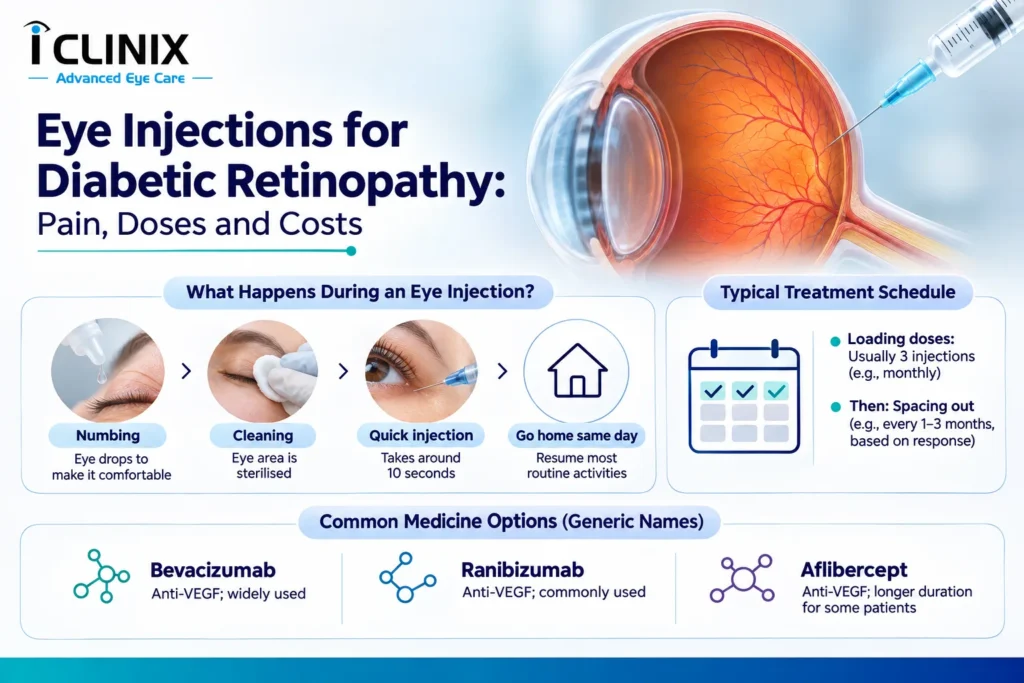
Eye injections are now one of the main treatments for diabetic eye disease, especially diabetic macular oedema (swelling at the centre of the retina) and some cases of advanced diabetic retinopathy. The injection takes a few seconds, the eye is numbed first, and most people describe it as pressure rather than pain. Treatment usually starts with monthly doses for a few months, then the gap between injections is stretched as the eye responds.
If you or a parent have just been told “you need injections”, here’s what really happens, how many you might need, and what affects the cost.
Why diabetes damages the retina
High blood sugar over years weakens the tiny blood vessels of the retina. They can leak fluid, causing swelling (diabetic macular oedema), or the eye may grow fragile new vessels that bleed (proliferative diabetic retinopathy).
Early on, there are usually no symptoms. That’s why the US National Eye Institute advises people with diabetes to have a dilated eye exam at least once a year, and more often once retinopathy is found.
What do the injections actually do?
Most injections for diabetic eye disease are anti-VEGF medicines. VEGF is a protein that drives leaky, abnormal blood vessels. Blocking it:
• Reduces swelling at the centre of the retina.
• Helps stabilise, and often improve, reading vision.
• Can make abnormal new vessels shrink.
Medicines commonly used include ranibizumab (including Indian biosimilar versions), aflibercept and faricimab. Some centres also use bevacizumab. For some patients, especially those who don’t respond fully to anti-VEGF, steroid injections or implants (such as dexamethasone) are used instead or as well.
What happens during an eye injection?
The National Eye Institute’s guide to injections for eye conditions describes the same steps we follow:
1. Numbing. Anaesthetic drops or gel are put in the eye.
2. Cleaning. The eyelids and eye surface are cleaned with an antiseptic to prevent infection.
3. Holding the lids open. A small clip keeps you from blinking.
4. The injection. A very fine needle is used. It takes a few seconds.
5. Going home. You leave the same day, usually within an hour, and can resume most normal activities.
Does an eye injection hurt?
Most people are surprised by how little it hurts. Common experiences:
• A feeling of pressure for a second or two.
• A gritty or scratchy feeling for a few hours, mostly from the antiseptic.
• Small floating dots or a bubble in vision for a day, which settles.
• Sometimes a small red patch on the white of the eye, which fades in a week or two.
Call your doctor the same day if you have increasing pain, worsening vision, more redness or light sensitivity in the days after an injection. These can be signs of infection, which is rare but needs urgent treatment.
How many injections will I need?
There isn’t a single number, but a typical pattern looks like this:
| Phase | What usually happens |
| Loading phase | One injection a month for about three months |
| Review | OCT scans show how much the swelling has reduced |
| Extending | The gap is stretched to 6, 8, 10 or more weeks if the retina stays dry |
| Long term | Some people can stop; others need injections at longer intervals for years |
Newer medicines such as faricimab are designed to allow longer gaps between injections for some patients, which can mean fewer visits overall.
Controlling blood sugar, blood pressure and cholesterol makes a real difference to how well injections work and how many you need.
Injections or laser: which is better?
Both are still used, and the right choice depends on what’s happening in your eye.
• For diabetic macular oedema (swelling at the centre): anti-VEGF injections are now the standard first treatment in most cases.
• For proliferative diabetic retinopathy: both injections and panretinal laser (PRP) work. In the US DRCR Protocol S trial, ranibizumab was as good as laser for vision at two years, with fewer patients developing macular swelling and fewer needing vitrectomy surgery. Laser has the advantage of fewer visits and lasting effect, which matters if regular follow-up is hard.
• Many patients get both at different stages.
What affects the cost of eye injections in India?
| Factor | Why it matters |
| Medicine chosen | Biosimilar ranibizumab is usually the most affordable; aflibercept and faricimab cost more |
| Number of injections | Total cost depends on how many doses your eye needs |
| OCT scans | Needed regularly to track response |
| Insurance | Many policies cover intravitreal injections as a day-care procedure; check your policy |
Indicative cost per injection at iClinix: [CONFIRM WITH BILLING]. Your retina specialist will discuss medicine options and the likely total for your treatment plan. iClinix offers cashless support across major TPAs and EMI where applicable.
The cheapest medicine isn’t always the best value if it needs more frequent injections in your eye, and the most expensive isn’t always necessary. A good retina specialist will explain the trade-off honestly.
What makes a good diabetic retinopathy centre?
When choosing where to be treated, look for:
• A vitreo-retina specialist, not just a general eye clinic.
• OCT and wide-field retinal imaging on site, to measure swelling and see the whole retina.
• All treatments in one place: injections, laser and vitreoretinal surgery for advanced cases.
• A clean, dedicated injection room with strict sterility.
• A clear plan for how often you’ll be seen and how decisions about extending or stopping injections are made.
Before and after your injection: a simple checklist
On the day:
• Eat and take your usual diabetes and blood pressure medicines unless told otherwise.
• Skip eye makeup and face creams around the eyes.
• Bring someone with you if possible, as your pupil may be dilated.
• Bring your latest blood sugar (HbA1c) report and a list of medicines.
For the next few days:
• Use any drops exactly as prescribed.
• Don’t rub the eye.
• Avoid swimming pools and dusty places for a few days.
• Keep your next appointment, even if your vision feels better. Stopping too early is one of the most common reasons swelling comes back.
Questions worth asking your retina specialist
• Which medicine are you recommending, and why for my eye?
• How many injections do you expect in the first year?
• How will we decide when to extend the gap or stop?
• Do I also need laser, now or later?
• What should my HbA1c and blood pressure targets be to help my eyes?
Diabetic eye care at iClinix
At iClinix, diabetic eye care is led by Dr. Varun Gogia, Vitreo-Retina, Refractive & Cataract Specialist, trained at AIIMS (MBBS, MD and Vitreoretinal & Uvea services). The retina service uses spectral-domain OCT and ultra-widefield retinal imaging, offers anti-VEGF injections (ranibizumab and biosimilars, aflibercept, faricimab), steroid injections and implants, retinal laser, and 25G/27G sutureless vitreoretinal surgery.
Read more about retina and diabetic eye care at iClinix, or our broader guide to diabetic retinopathy treatment in India. Centres: Lajpat Nagar, Paschim Vihar, Shakti Nagar, Gurugram and Panipat. Call +91 98991 18030.
Frequently asked questions
Are eye injections for diabetic retinopathy painful?
Most people feel only brief pressure, because the eye is numbed first. A gritty feeling for a few hours is common and settles quickly.
How many eye injections are needed for diabetic macular oedema?
Usually monthly injections for about three months, then the gap is extended based on OCT scans. Some people can stop after a year or two; others need injections at longer intervals.
Which injection is best for diabetic retinopathy?
Ranibizumab, aflibercept and faricimab are all effective. The choice depends on how severe the swelling is, how your eye responds, cost and how often you can come for visits.
What is the cost of an eye injection in India?
It depends mainly on the medicine. Biosimilar ranibizumab is usually the most affordable; aflibercept and faricimab cost more. Ask for an estimate for your full treatment plan, not just one dose.
Can eye injections restore lost vision?
They often improve vision when swelling is treated early, but they can’t always reverse long-standing damage. Starting treatment promptly gives the best chance.
Do I still need laser if I’m getting injections?
Sometimes. Laser and injections are often used together at different stages, especially for proliferative diabetic retinopathy.
Can I drive after an eye injection?
It’s best not to drive on the day, especially if your pupil was dilated. Most people are comfortable driving from the next day.
Does controlling blood sugar reduce the number of injections?
Good control of blood sugar, blood pressure and cholesterol helps the retina respond better and can lower the risk of swelling coming back. It works alongside injections, not instead of them.
This World Diabetes Day, don’t wait for blurry vision. Book a diabetic retina check at iClinix, it usually takes about an hour and could save years of sight.
This article is for general information and does not replace a personal eye examination.