
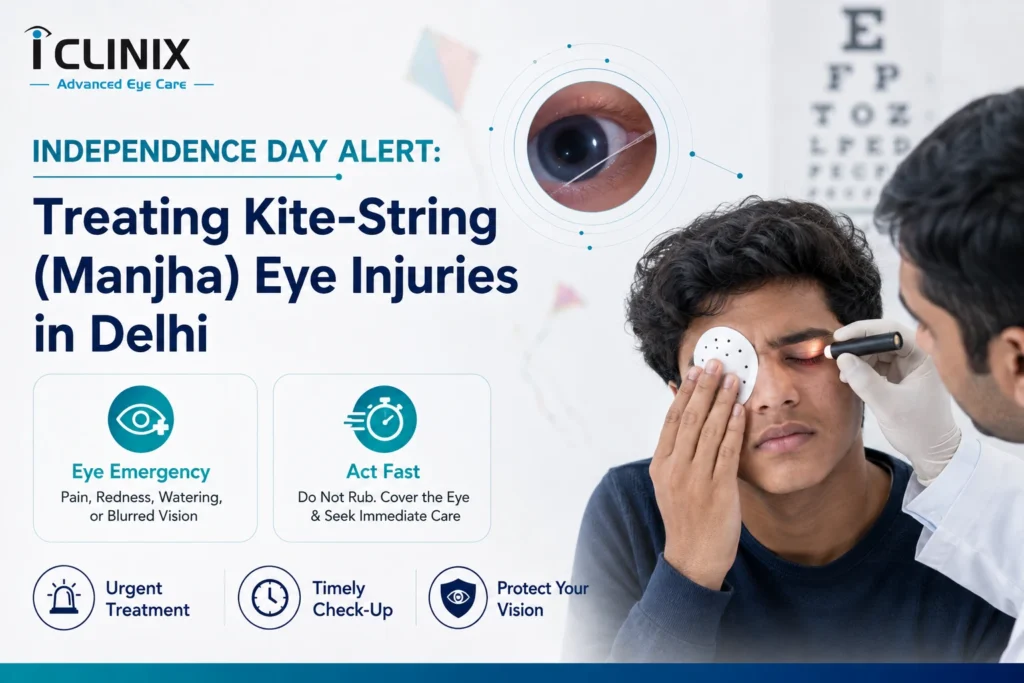
Every 15th of August, I brace for the same pattern in the ER: a steady stream of two-wheeler riders, most of them young, coming in with a hand cupped over one eye, having no idea a piece of string caused this much damage. Last year, one of them was a delivery rider who’d ridden nearly ten minutes with a corneal laceration before someone at a signal told him to stop and get it looked at — those ten minutes could have gone very differently for his vision.
Every August 15th, Delhi’s skies fill with kites — and every year, our emergency lines get busier too. Manjha, the sharpened or glass-coated string used for kite flying, is responsible for a predictable spike in eye injuries around Independence Day, particularly among people riding two-wheelers or standing on terraces and rooftops to watch the kites overhead.
Manjha injuries can range from a minor surface scratch to something that threatens permanent vision loss, and the difference often comes down to what happens in the first few minutes after the injury. Here’s what you actually need to know before it happens, not after.
Why Manjha Is So Dangerous to the Eyes
Manjha isn’t just thread. Much of it is coated with a mixture of powdered glass, metal dust, or other abrasive material, specifically to give it a cutting edge for kite-fighting. This is exactly what makes it dangerous when it comes into contact with skin or eyes at speed — whether from a taut string stretched across a road, or a stray piece caught by the wind.
The eye is particularly vulnerable because the cornea, the clear front surface of the eye, is thin and can be cut easily by a sharp edge moving at speed. Injuries often happen suddenly and without warning, commonly to people on two-wheelers who don’t see the string until contact. And the resulting wound can be a simple scratch, or it can be a deeper cut that opens the eye itself — it’s not always obvious which one you’re dealing with just by looking.
This unpredictability is exactly why every manjha-related eye injury should be treated as a potential emergency, even if it looks minor at first glance.
What to Do Immediately After a Manjha Injury
If you or someone with you sustains an eye injury from kite string, the next few minutes matter. Stay calm and stop what you’re doing — if you’re riding a two-wheeler, pull over safely first before attending to the injury. Do not rub or press the eye, even if it feels irritated or something feels stuck, since rubbing can worsen a cut or push debris deeper in. Do not try to remove anything stuck in or near the eye yourself, including string fragments, glass particles, or blood clots, as pulling anything out can cause further damage. Avoid applying any home remedy — no water rinsing under pressure, no ice, no eye drops, no ointment — until a doctor has examined the eye, since some of these can worsen an open injury. Loosely cover the eye with a clean cloth or a rigid cup-like shield, without pressing down, to protect it while you get to care. Then get to an eye emergency room immediately — this is not an injury to wait out overnight or manage with a chemist visit, since every hour of delay can affect the outcome.
Signs That Indicate a Serious Injury
While every manjha eye injury needs prompt evaluation, certain signs point to something more urgent: a visible cut or laceration on the eyeball itself, blood pooling inside the eye or around the iris, sudden and significant loss of vision in the injured eye, leaking clear or watery fluid from the eye, an oddly shaped or irregular pupil after the injury, or severe pain that doesn’t ease.
Even without these specific signs, any injury involving manjha near the eye deserves same-day medical evaluation, since some damage — particularly to the deeper structures of the eye — isn’t visible without proper equipment.
What Happens at the Clinic
When a manjha eye injury comes in, the priority is establishing exactly what’s been damaged before anything else. This typically involves a careful examination under magnification to assess the extent and depth of the injury, checking for a ruptured globe (a full-thickness injury to the eye wall, which changes the entire treatment approach if present), imaging where needed to check for any foreign material that may have entered the eye, and immediate treatment ranging from cleaning and protecting a surface wound to emergency surgical repair for deeper injuries. Where a ruptured globe or deeper surgical repair is needed, that’s handled together with Dr. Varun Gogia, our Director, given his surgical background in the retina and anterior segment.
The single biggest factor in how well these injuries recover is how quickly proper treatment begins. Injuries treated within the first few hours generally have significantly better outcomes than those where treatment was delayed.
“I’ve treated the same injury two hours apart with very different outcomes — not because the cut was different, but because one patient rode straight to us and the other stopped at a chemist first. The string doesn’t care how minor it looks. Get to an eye doctor, not a pharmacy counter.” — Dr. Digvijay Singh, MBBS, MD (AIIMS), FAICO, iClinix
It’s also worth knowing that eye trauma — even after the initial wound has healed — can occasionally lead to a rise in eye pressure weeks or months later, a condition called traumatic glaucoma. This is part of why we recommend a follow-up check even after a manjha injury looks fully healed, and it’s an area Dr. Shikha Gupta, our Co-Director and Head of Glaucoma Surgery, monitors closely for any patient with a history of significant eye trauma.
Prevention: Reducing Risk This Independence Day
A few precautions make a real difference during kite season, especially for anyone commuting by two-wheeler: wear a full-face helmet while riding, particularly during the days around Independence Day when kite flying peaks; avoid riding close to areas with heavy kite activity, especially near open grounds, rooftops, or narrow lanes where string is more likely to stretch across the road; be extra cautious around dusk, when visibility is lower and manjha strung across roads is harder to spot; if you’re flying kites yourself, use cotton or nylon string instead of glass-coated manjha where possible, and be mindful of others nearby; and keep children supervised during kite flying, since young kite enthusiasts are among the most frequent injury cases we see.
Frequently Asked Questions
Should I rinse my eye with water if manjha cuts it? Generally, no — not with force or pressure. If there’s visible debris on the surface of the eye (not embedded), gentle rinsing with clean water can help, but if there’s any suspicion of a deeper cut, avoid rinsing altogether and get to a doctor immediately, since pressure can worsen an open wound.
How do I know if the injury is serious or just a minor scratch? You often can’t tell without an examination. Even injuries that look minor on the surface can involve deeper structures. Treat every manjha eye injury as needing same-day medical evaluation, regardless of how it appears.
Is it too late to get treated if a few hours have passed? No — get evaluated as soon as possible regardless of how much time has passed. Outcomes are generally better with faster treatment, but delayed care is still far better than no care.
Can manjha injuries cause permanent vision loss? Yes, in more severe cases, particularly deeper cuts or injuries involving the inner structures of the eye. This is exactly why prompt evaluation and treatment matter so much.
Manjha Eye Injury? Get Emergency Care Now
If you or someone near you has suffered a kite-string eye injury, don’t wait — reach out immediately. Our team, including Dr. Varun Gogia for surgical cases and Dr. Shikha Gupta for pressure-related follow-up, is set up to see trauma cases the same day.
Contact iClinix for emergency care →
For urgent cases outside clinic hours, iClinix operates a 24/7 emergency helpline at +91 70655 51400.