

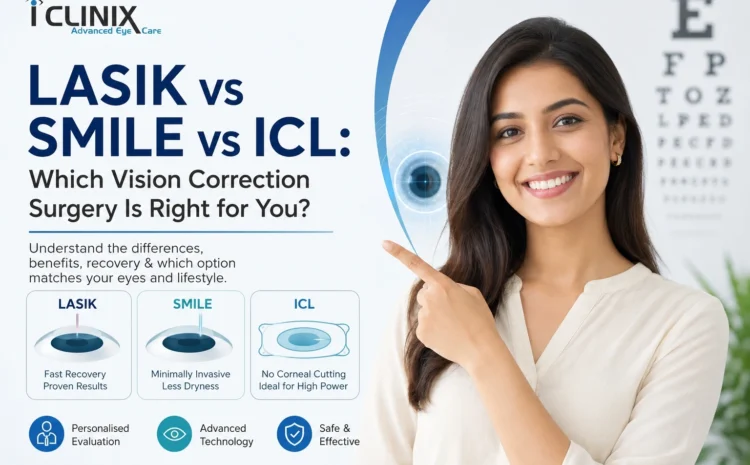
A patient walked into my Lajpat Nagar clinic last month with three browser tabs open on her phone — one for LASIK, one for SMILE, one for something called ICL she’d seen mentioned in a comment thread. She wasn’t confused about wanting to get rid of her glasses. She was confused about which of these three would actually work for her eyes, and honestly, most of what she’d read online didn’t say.
That conversation is one I have several times a week, and it’s rarely a quick answer. By the time most people come in for a vision correction consultation, they’ve already spent a few evenings on Google trying to figure out the difference between LASIK, SMILE, and ICL. It’s a fair question — all three get you out of glasses, all three get advertised as “the latest technology,” and none of the marketing really explains which one applies to your eyes specifically.
The honest answer is that there isn’t one best option. Each of these procedures solves for a slightly different situation, and the right one for you depends on your prescription, your corneal thickness, and a few other factors we can only confirm with proper testing. Here’s how they actually compare.
The Quick Comparison
| LASIK | SMILE | ICL | |
| Technique | Creates a corneal flap, reshapes tissue underneath with a laser | Flapless — a small lenticule is removed through a tiny incision | No corneal reshaping — a lens is implanted in front of your natural lens |
| Best for | Mild to moderate myopia, hyperopia, astigmatism | Moderate to high myopia, patients wanting a flapless option | High myopia, thin corneas, or patients not suited to laser correction |
| Incision size | Larger flap (18-20mm) | Small (2-4mm) | Small (2.8-3.2mm) |
| Recovery | 24-48 hours for sharp vision | Slightly longer initial haze, stabilises within days | Vision improves almost immediately |
| Reversible | No | No | Yes — the lens can be removed if needed |
| Dry eye risk | Slightly higher due to corneal nerve disruption | Lower than LASIK | Lowest of the three, since cornea isn’t reshaped |
This table is a starting point, not a diagnosis. Which one suits you comes down to your eye measurements, and that’s where the real decision gets made.
LASIK: The Established Option
LASIK (laser-assisted in situ keratomileusis) remains the most performed vision correction surgery worldwide, and for good reason — it’s well studied, predictable, and suitable for the majority of people with mild to moderate refractive errors. During LASIK, the surgeon creates a thin flap in the outer cornea, reshapes the tissue underneath using a laser, and repositions the flap, which begins healing almost immediately.
At iClinix, I perform LASIK using Z-LASIK, a femtosecond-based flap creation method that reduces trauma to the eye compared to older blade-based techniques. For patients who also have corneal irregularities alongside their prescription, Contoura Vision offers sharper visual outcomes by correcting both together.
LASIK tends to be the right fit if: your prescription is mild to moderate, your corneal thickness is adequate for flap creation, and you want one of the fastest, most established recovery timelines available.
SMILE: The Flapless Alternative
SMILE (Small Incision Lenticule Extraction) skips the flap entirely. Instead, the surgeon uses a femtosecond laser to create a small lens-shaped piece of tissue — the lenticule — inside the cornea, then removes it through a tiny incision of just a few millimetres. No flap means less disruption to the corneal nerves, which is part of why SMILE is often associated with a lower risk of post-surgery dry eye compared to LASIK.
SMILE tends to suit patients with moderate to high myopia, and because the incision is so much smaller than a LASIK flap, some surgeons consider it a gentler option for people with active lifestyles or contact sports involvement, since there’s a lower theoretical risk of flap displacement.
SMILE tends to be the right fit if: you have moderate to high myopia, you’re concerned about dry eye risk, or you want a smaller incision with a quicker return to strenuous activity.
Not All “Lenticule Extraction” Is the Same: Understanding the Platforms
Here’s something that trips up a lot of patients doing their own research: SMILE isn’t the only name for this category of procedure, and it isn’t performed on just one machine. The broader category is now referred to in ophthalmology as Keratorefractive Lenticule Extraction, or KLEx — an umbrella term covering several proprietary platforms that all work on the same underlying principle (removing a small lens-shaped piece of corneal tissue through a tiny incision) but differ in the hardware and software behind them.
The names you’re likely to come across:
- SMILE, performed on Carl Zeiss Meditec’s VisuMax platform — the original and most widely studied of these procedures, with over a decade of published outcomes worldwide
- SMILE Pro, performed on the newer VisuMax 800 platform — a faster version of the same procedure, with lenticule creation taking roughly 8-10 seconds compared to 20-30 seconds on the earlier VisuMax, along with additional centration software
- CLEAR, a similar lenticule-extraction procedure developed on Ziemer’s laser platform
- SmartSight, developed by Schwind eye-tech-solutions on their own platform
- SILK, a newer entrant from Johnson & Johnson Vision
The core idea across all of these is the same — a flapless, small-incision approach to reshaping the cornea. What differs is the specific laser system, the software guiding lenticule creation and centration, and in some cases, the speed of the procedure itself. None of these names represents a fundamentally different surgery; they’re different manufacturers’ versions of the same underlying technique.
What actually matters for you as a patient isn’t which brand name sounds newest — it’s which platform your treating surgeon is trained and experienced on, and whether your eyes are suited to that specific technology’s parameters. If you’ve been quoted a procedure under one of these names elsewhere, it’s a reasonable question to ask directly: which platform is this performed on, and how many procedures has the surgeon done on it.
ICL: When Laser Correction Isn’t the Answer
ICL (Implantable Collamer Lens) works completely differently from the other two. Instead of reshaping your cornea, a thin lens is inserted through a small incision and placed just in front of your natural lens, working alongside it rather than replacing anything. Your cornea is left untouched.
This makes ICL the go-to option for patients who aren’t good candidates for laser correction — most commonly, people with very high myopia or corneas too thin to safely support a LASIK or SMILE procedure. It’s also the only one of the three that’s reversible: if your prescription changes dramatically or you need the lens removed for any reason, that’s possible without permanent changes to your cornea.
ICL tends to be the right fit if: you have high myopia, thin corneas, or you were told during a consultation elsewhere that you’re not eligible for laser vision correction.
How We Decide Which One Is Right for You
None of the above should be used to self-diagnose which procedure you need — this comparison is meant to help you walk into your consultation with better questions, not to replace the actual measurements. At your screening, I run a full diagnostic workup covering corneal topography (which maps the surface shape of your cornea and flags any irregularities), pachymetry (which measures corneal thickness and rules certain procedures in or out), refraction testing (confirming your exact prescription and how stable it’s been), and a general eye health check for any condition that could affect surgical candidacy.
I review all of this together, not just one number in isolation, before recommending an option. If your eyes are borderline for one procedure, I’ll tell you that directly rather than push you toward whichever is being promoted that month. A couple of situations bring Dr. Shikha Gupta, our Co-Director and Head of Glaucoma Surgery, into this decision too — if your pre-surgery workup flags narrow drainage angles or early glaucoma risk, she’s the one who evaluates whether that changes your candidacy for ICL specifically, since the lens sits close to structures she monitors closely in her own practice. And for the small number of patients who eventually develop cataracts years after any of these three procedures, she’s also who you’d see for that, since cataract and lens surgery is her core specialty at iClinix.
“The question I ask myself before recommending anything isn’t ‘which technology is newest’ — it’s ‘what does this particular cornea actually need.’ Two patients with the same prescription can need two completely different procedures once you look at their corneal maps.” — Dr. Varun Gogia, Director, iClinix
A Few Questions Worth Asking at Any Consultation
Regardless of where you go for vision correction, it’s worth asking directly: based on my test results, which of these am I actually eligible for, not just which do you recommend? What’s the realistic dry eye risk for someone with my history? What happens if my eyes aren’t stable enough for any of these yet? And who is performing the procedure, and what’s their experience with it specifically?
A good clinic won’t mind being asked these questions. If anything, specific answers rather than general ones are usually a sign you’re in the right place.
Recovery Timelines Compared
Recovery is often the deciding factor for patients juggling work schedules or upcoming travel, so it’s worth laying out honestly:
LASIK: Most patients see a sharp improvement within 24-48 hours. Some dryness and light sensitivity can linger for a week or two, gradually settling. Return to screen-based work is typically possible within a few days, with a full return to contact sports or swimming usually advised after about a month.
SMILE: Initial vision can feel slightly hazier than LASIK in the first day or two, since the smaller incision heals a little differently, but most patients report full clarity within three to five days. The reduced disruption to corneal nerves means many patients report less dryness during recovery compared to LASIK.
ICL: Because the cornea isn’t touched at all, visual recovery tends to be the fastest of the three, often noticeable within hours. The main precaution during recovery is avoiding eye rubbing and strenuous activity for the first week while the incision fully seals.
None of these timelines are guarantees — individual healing varies, and I’ll give you a recovery plan specific to your eyes and the procedure you undergo.
Cost Considerations Across the Three
Cost is rarely the only factor worth weighing, but it does shape the decision for a lot of patients. As a general pattern, LASIK tends to be the most accessible in cost, reflecting its established technology and shorter procedure time. SMILE usually costs somewhat more due to the specialised laser platform required. ICL tends to be the most expensive of the three, since each lens is custom-made to your eye’s exact measurements rather than mass-produced.
We’d caution against choosing based on price alone. A procedure that isn’t suited to your eyes, chosen because it was cheaper, can end up costing more in follow-up care or a second procedure later. The diagnostic workup determines which options are actually available to you — cost comparisons only make sense within that eligible set.
Frequently Asked Questions
Is SMILE better than LASIK? Neither is universally better — they suit different prescriptions and priorities. SMILE tends to have a lower dry eye profile, while LASIK has a longer track record and works well across a broader range of mild to moderate prescriptions.
Can I get ICL if I’m eligible for LASIK? Yes, ICL isn’t limited to patients who fail LASIK eligibility. Some patients choose it specifically because it’s reversible and doesn’t involve reshaping the cornea, even when they’d qualify for laser correction.
Which procedure has the fastest recovery? ICL tends to show the quickest initial visual improvement, often within a day. LASIK follows closely, with SMILE sometimes taking a few extra days for full clarity due to the healing pattern around the smaller incision.
Can I switch from one option to another after starting the process? Generally, yes, as long as you haven’t gone into surgery yet. If your test results suggest a different procedure suits you better, I’ll discuss that with you before any date is confirmed.
Book Your Vision Correction Consultation
The only way to know which of these three is actually right for your eyes is a proper diagnostic workup — not a guess based on what a friend had done. I’ll walk you through your results and your options myself, in a single visit, and bring Dr. Shikha Gupta into the conversation if your case calls for her input on glaucoma risk or future cataract planning.
Read more about Dr. Varun Gogia → | Read more about Dr. Shikha Gupta →
Explore our LASIK & refractive surgery options →
Book your appointment at iClinix →
You can also reach any of our centres directly by phone or WhatsApp to check same-week screening availability — details for Lajpat Nagar, Paschim Vihar, and Shakti Nagar are listed on each centre page.