
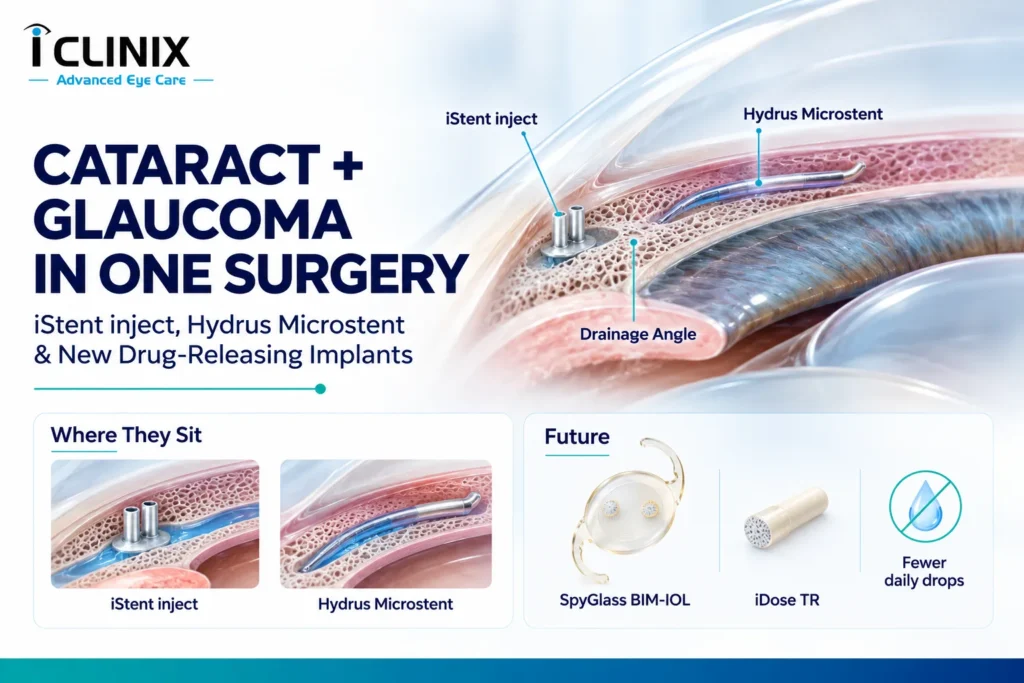
If you have both a cataract and early-to-moderate open-angle glaucoma, the two can often be treated in a single operation. During cataract surgery, the surgeon can place a tiny drainage device, such as the iStent inject W or the Hydrus Microstent, to help lower eye pressure. This approach, part of a group called MIGS (minimally invasive glaucoma surgery), can reduce how many glaucoma drops you need, with little added recovery time.
Research is also moving towards implants that release glaucoma medicine slowly inside the eye. Some are approved; one, a cataract lens carrying its own glaucoma drug, is still in trials.
Why cataract and glaucoma so often show up together
Both conditions become more common with age. Many people in their 60s and 70s have a cataract developing while they’re already using drops for glaucoma.
Glaucoma damages the optic nerve, usually because fluid inside the eye doesn’t drain well and pressure builds up. Early on, it causes no symptoms at all. The National Eye Institute and most eye societies stress regular eye checks for this reason. Our glaucoma care page explains how it’s diagnosed and monitored.
The usual treatment is daily eye drops. They work, but many people find them hard to keep up with: drops get missed, they sting or redden the eyes, and costs add up over decades.
If you need cataract surgery anyway, it’s a natural moment to ask: can we do something for the glaucoma at the same time?
Cataract surgery alone can lower eye pressure a little
Removing the cloudy natural lens often opens up the eye’s drainage angle slightly, especially in eyes with narrow angles. Many people see a modest drop in eye pressure after cataract surgery alone.
For some, that’s enough. For others with glaucoma on one or more drops, adding a MIGS device can give an extra, more lasting reduction.
What is MIGS?
MIGS stands for minimally invasive (or micro-invasive) glaucoma surgery. These procedures:
• Use tiny incisions, often the same ones made for cataract surgery.
• Work with the eye’s natural drainage system rather than creating a new outflow route.
• Have a lower risk of serious complications than traditional glaucoma surgery.
• Are mainly for mild to moderate open-angle glaucoma.
The Glaucoma Research Foundation has a clear explainer on what MIGS is and who it’s for.
iStent inject W: two tiny snorkels
The iStent inject W, from Glaukos, is among the smallest medical devices implanted in the human body. The surgeon places two tiny titanium stents through the trabecular meshwork, the eye’s natural filter, into Schlemm’s canal, the channel that carries fluid out.
Think of a clogged drain with two snorkels pushed through the blockage. Fluid can bypass the resistance and flow out more freely.
What to expect: a modest lowering of eye pressure and, for many patients, fewer glaucoma drops. Placement adds only a few minutes to cataract surgery, and recovery is typically the same.
Hydrus Microstent: a scaffold inside the drain
The Hydrus Microstent, now from Alcon, is a small, flexible scaffold about 8 mm long. It sits inside Schlemm’s canal and holds it open across roughly a quarter of its circumference.
If iStent is a pair of snorkels, Hydrus is like a stent holding a section of pipe open.
Hydrus has strong long-term data. In the five-year results of the HORIZON trial, which included 556 patients, the Hydrus group needed further glaucoma surgery less than half as often as the cataract-surgery-only group (2.5% vs 6.4%). Among patients with mild glaucoma on one medication at the start, 73% were medication-free at five years with Hydrus, compared with 48% after cataract surgery alone. These figures come from the device maker’s announcement of the trial results.
iStent vs Hydrus at a glance
| iStent inject W | Hydrus Microstent | |
| Maker | Glaukos | Alcon (originally Ivantis) |
| What it is | Two tiny titanium stents | One flexible scaffold, about 8 mm |
| Where it sits | Through the trabecular meshwork into Schlemm’s canal | Inside Schlemm’s canal |
| How it helps | Creates bypass channels for fluid | Opens and dilates a section of the canal |
| Best for | Mild to moderate open-angle glaucoma with cataract | Mild to moderate open-angle glaucoma with cataract |
| Added recovery | Minimal | Minimal |
Both are well-studied. The choice usually depends on your eye’s anatomy, your glaucoma stage and your surgeon’s experience.
Sustained-release implants: medicine without daily drops
A newer idea is to place a small reservoir of glaucoma medicine inside the eye so it works continuously, without daily drops.
iDose TR (Glaukos). A tiny titanium implant that releases travoprost, a common glaucoma drug, inside the eye. The US FDA approved it in December 2023. In January 2026, the FDA updated its labelling to allow repeat administration in suitable patients. It can be placed as a separate procedure, and it’s not yet widely available outside the US.
BIM-IOL System (SpyGlass Pharma), investigational. This is a cataract lens with small drug pads attached to its edge that slowly release bimatoprost, another glaucoma medicine, for around three years. It would be implanted during routine cataract surgery, treating both problems with one lens. According to SpyGlass Pharma’s latest company update, phase 3 trials are underway, with enrolment expected to finish in 2027.
To be clear: the BIM-IOL is not approved anywhere and is available only within clinical trials. It’s an exciting direction, but it’s some years away from routine use.
Who is a good candidate for combined surgery?
You may benefit if you:
• Have a cataract that is affecting your vision and
• Have mild to moderate open-angle glaucoma, or raised eye pressure, and
• Use one or more glaucoma drops, or struggle with side effects or remembering them.
Combined MIGS surgery is usually not the right choice for:
• Advanced glaucoma needing a large pressure reduction. Trabeculectomy or a drainage valve may be needed.
• Angle-closure glaucoma, which is managed differently.
• Certain secondary glaucomas.
Our guide to glaucoma surgery options in Delhi lays out the full range, from laser to drainage valves.
What combined surgery won’t do
• It doesn’t cure glaucoma. Damage already done to the optic nerve can’t be reversed. The aim is to protect the vision you have.
• You may still need some drops. Many patients reduce their drops; some stop them; others still need one.
• Follow-up is for life. Glaucoma needs regular pressure checks, visual fields and OCT scans, whatever surgery you’ve had.
At iClinix, combined surgery is considered after a full glaucoma assessment, including OCT, visual field testing and angle evaluation, alongside the work-up for cataract surgery. If you’re on glaucoma drops and your cataract is starting to bother you, book a combined consultation to see whether one surgery could address both.
Frequently asked questions
Can cataract and glaucoma surgery be done together?
Yes, for many patients with mild to moderate open-angle glaucoma. A MIGS device such as iStent inject W or Hydrus can be placed during cataract surgery through the same incisions, usually adding only a few minutes.
What is the difference between iStent and Hydrus?
iStent inject W uses two tiny titanium stents that create bypass channels through the eye’s drainage filter. Hydrus is a single, flexible scaffold that holds open a section of the drainage canal. Both aim to lower eye pressure and reduce reliance on drops.
Will I still need glaucoma eye drops after MIGS?
Many patients need fewer drops, and some stop entirely. Others still need one. Results depend on your glaucoma stage and how your eye responds.
What is a drug-eluting IOL for glaucoma?
It’s a cataract lens designed to release glaucoma medicine slowly inside the eye. SpyGlass Pharma’s BIM-IOL is the leading example. It is investigational and in phase 3 trials, not approved for routine use.
Is combined cataract and glaucoma surgery safe?
MIGS devices have a strong safety record and add little risk to cataract surgery. Like any eye surgery, there are some risks, which your surgeon will discuss after examining your eye.
On glaucoma drops and starting to notice a cataract? Book a combined assessment at iClinix to see whether one surgery could take care of both.
This article is for general information and does not replace a personal eye examination.