
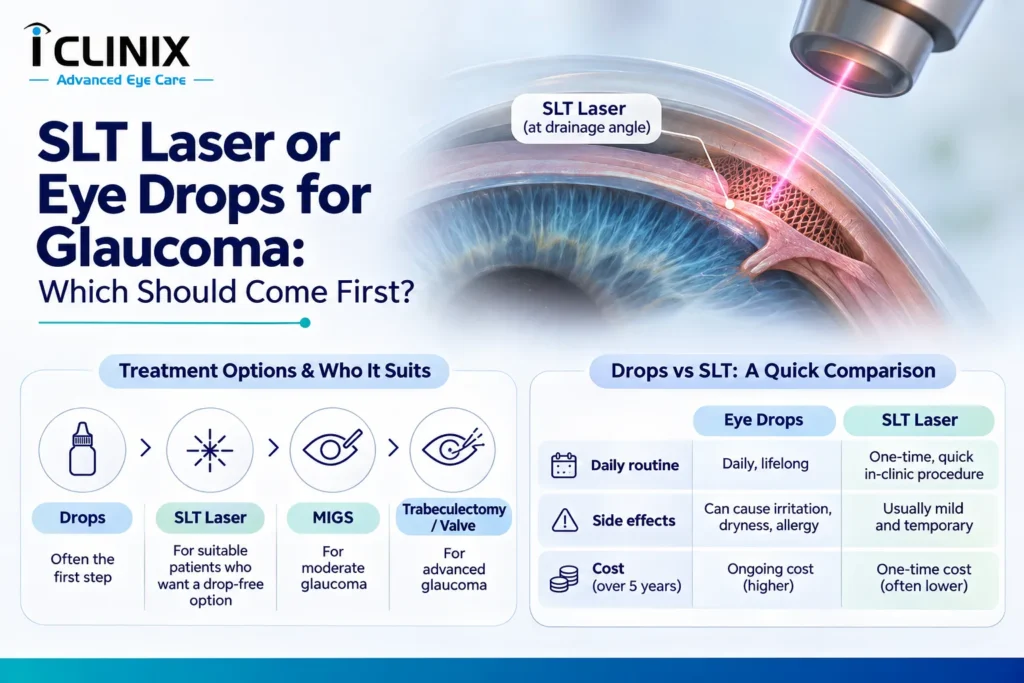
For many people with newly diagnosed open-angle glaucoma or high eye pressure, SLT laser is a strong first treatment, not just a back-up when drops fail. In the large UK LiGHT trial, about three out of four people treated with SLT first were still free of glaucoma drops after three years, and nearly 70% after six years. Eye drops remain effective and are the right choice for some patients, so the decision depends on your type of glaucoma, your eye pressure and how well you can manage daily drops.
Here’s how the two compare, and where surgery fits in.
Why lowering eye pressure matters
Glaucoma damages the optic nerve, the cable that carries images from the eye to the brain. In most types, the main risk factor you can control is eye pressure. Lowering it slows or stops further damage.
Glaucoma usually has no early symptoms. The US National Eye Institute’s glaucoma overview explains why regular eye checks matter, especially after 40 or if glaucoma runs in your family. Vision already lost can’t be brought back, so the aim of every treatment, drops, laser or surgery, is to protect the sight you still have.
Option 1: Glaucoma eye drops
Drops either reduce how much fluid the eye makes or help it drain better. Common groups include prostaglandin analogues, beta-blockers, alpha-agonists and carbonic anhydrase inhibitors.
What works well: drops are effective, quick to start and easy to adjust.
What’s hard about them:
• They need to be used every day, often for life.
• Many people need more than one bottle as time goes on.
• Side effects can include red or irritated eyes, darkening of the iris or eyelid skin, longer lashes and, with some drops, effects on heart rate or breathing.
• Missed doses are common. Pressure that rises between doses can let damage continue quietly.
• The monthly cost adds up over years.
Option 2: SLT laser (selective laser trabeculoplasty)
SLT treats the eye’s drainage tissue, the trabecular meshwork, with very low-energy laser pulses. This triggers the tissue to drain fluid more efficiently, which lowers eye pressure.
What it’s like:
• Done in the clinic with numbing drops, usually in 5 to 10 minutes.
• No cut, no stitches, no hospital stay.
• Most people go back to normal activities the same or next day.
• The pressure-lowering effect builds over a few weeks.
What the LiGHT trial found
The Laser in Glaucoma and Ocular Hypertension (LiGHT) trial compared SLT first with eye drops first in nearly 700 newly diagnosed patients in the UK. As summarised by Glaucoma Australia:
• At three years, about three in four eyes treated with SLT first needed no drops.
• At six years, nearly 70% of SLT-first eyes still needed no drops.
• Eyes treated with SLT first had lower rates of disease progression over six years.
• SLT was more cost-effective than starting with drops over three years.
• A significant pressure spike after laser happened in only about 1% of eyes.
Results like these are why many glaucoma specialists now offer SLT as a first-line option, not only after drops have failed.
SLT vs eye drops at a glance
| Eye drops | SLT laser | |
| How often | Every day, usually for life | Once; repeat may be needed after a few years |
| Procedure | None | 5–10 minutes in clinic |
| Common side effects | Red eyes, irritation, lash or colour changes | Mild ache or blur for a day |
| Depends on remembering doses | Yes | No |
| Cost pattern | Ongoing monthly cost | One-time cost per treatment |
| Can be combined | Yes, with laser | Yes, drops can be added later |
Who is a good candidate for SLT first?
SLT tends to suit people with:
• Open-angle glaucoma or ocular hypertension (high pressure without damage yet).
• Mild to moderate disease.
• Trouble remembering drops, side effects from drops, or more than one bottle already.
• Busy routines, frequent travel or difficulty affording long-term drops.
It’s usually not the right first step for:
• Angle-closure glaucoma, where the drainage angle is narrow or closed. This usually needs a laser peripheral iridotomy (a different laser) or other treatment.
• Advanced glaucoma needing a large pressure drop quickly.
• Some secondary glaucomas, such as those caused by inflammation.
That’s why a full glaucoma work-up, including gonioscopy to look at the drainage angle, comes before any decision.
Does SLT wear off?
The effect can fade over a few years. The good news is that SLT can often be repeated. In the LiGHT trial, many patients controlled with laser alone needed only one treatment, and some needed a repeat. Your specialist will keep checking your pressure and optic nerve to decide when or if a repeat is needed.
When is glaucoma surgery needed?
If drops and laser can’t keep pressure at a safe level, or glaucoma is advanced when it’s first found, surgery is considered. Options include:
• MIGS (minimally invasive glaucoma surgery): tiny devices that improve natural drainage, often combined with cataract surgery for early to moderate glaucoma.
• Stents: a tiny tube or gel stent that creates a new drainage route.
• Drainage valves: a tube and plate with a regulating valve for advanced or difficult cases.
Our guide to glaucoma surgery options in Delhi walks through each in detail.
What makes a good glaucoma centre?
Whether you need drops, laser or surgery, look for a centre that offers:
• Full testing: applanation tonometry for pressure, gonioscopy for the drainage angle, OCT of the optic nerve and nerve fibre layer, and visual field testing.
• All levels of treatment in one place: drops, SLT, iridotomy, MIGS and surgery, so the advice isn’t limited by what’s available.
• A glaucoma specialist who’ll follow you for the long term, since glaucoma care is lifelong.
• Clear explanation of your pressure target and what your scans show over time.
What to expect on SLT day
1. Before the laser: your eye pressure is checked and a drop is put in to prevent a pressure spike.
2. During the laser: you sit at a machine like the one used for routine eye checks. A special contact lens is placed on the numbed eye, and you see bright flashes for a few minutes.
3. After the laser: your pressure is checked again before you go home. Some people are given anti-inflammatory drops for a few days.
4. Follow-up: pressure is rechecked after a few weeks, when the full effect starts to show.
You can usually go back to work the same or next day. Bring someone along if your pupils are dilated.
If you use glaucoma drops, use them well
Drops only work if they reach the eye at the right times. A few tips patients find useful:
• Link each dose to a daily habit, like brushing your teeth or a meal.
• After putting in a drop, close your eye and press gently on the inner corner for a minute. This keeps more medicine in the eye and less in your bloodstream.
• If you use two different drops, wait about five minutes between them.
• Bring all your bottles to every visit, so your specialist knows exactly what you use.
• Never stop drops on your own because your eyes “feel fine”. Glaucoma doesn’t cause symptoms until damage is advanced.
Glaucoma care at iClinix
At iClinix, glaucoma care is led by Dr. Shikha Gupta, Glaucoma, Refractive & Cataract Specialist, with MBBS, MD (Gold Medallist) and glaucoma super-speciality training from AIIMS. Assessments include OCT nerve fibre analysis, Humphrey visual field testing, applanation tonometry and gonioscopy. Treatment options range from drops and SLT laser to laser iridotomy, MIGS, stents and drainage valves.
You can read more about glaucoma treatment at iClinix. Centres are in Lajpat Nagar, Paschim Vihar and Shakti Nagar in Delhi, and in Gurugram and Panipat. Call +91 98991 18030 to book.
Frequently asked questions
Is laser better than eye drops for glaucoma?
For many people with open-angle glaucoma, SLT works as well as drops at controlling pressure, without the daily routine. In the LiGHT trial, nearly 70% of SLT-first eyes needed no drops after six years. Drops are still right for some patients.
Is SLT laser painful?
Most people feel little or nothing beyond mild pressure. The eye may ache or feel slightly blurry for a day.
How long does SLT last?
The effect often lasts several years, and it can be repeated if pressure rises again.
Can I stop my glaucoma drops after SLT?
Some people can stop or reduce drops after SLT, but only on your specialist’s advice once your pressure is confirmed to be at target.
Is SLT suitable for angle-closure glaucoma?
Usually not as the first step. Angle-closure glaucoma is usually treated with laser peripheral iridotomy or other treatments. A gonioscopy test tells which type you have.
When is glaucoma surgery needed?
When drops and laser can’t keep eye pressure at a safe level, or when glaucoma is already advanced. Options include MIGS, stents and drainage valves.
Tired of juggling glaucoma drops, or just diagnosed? Book a glaucoma consultation at iClinix to find out whether SLT laser could work for you.
This article is for general information and does not replace a personal eye examination.