
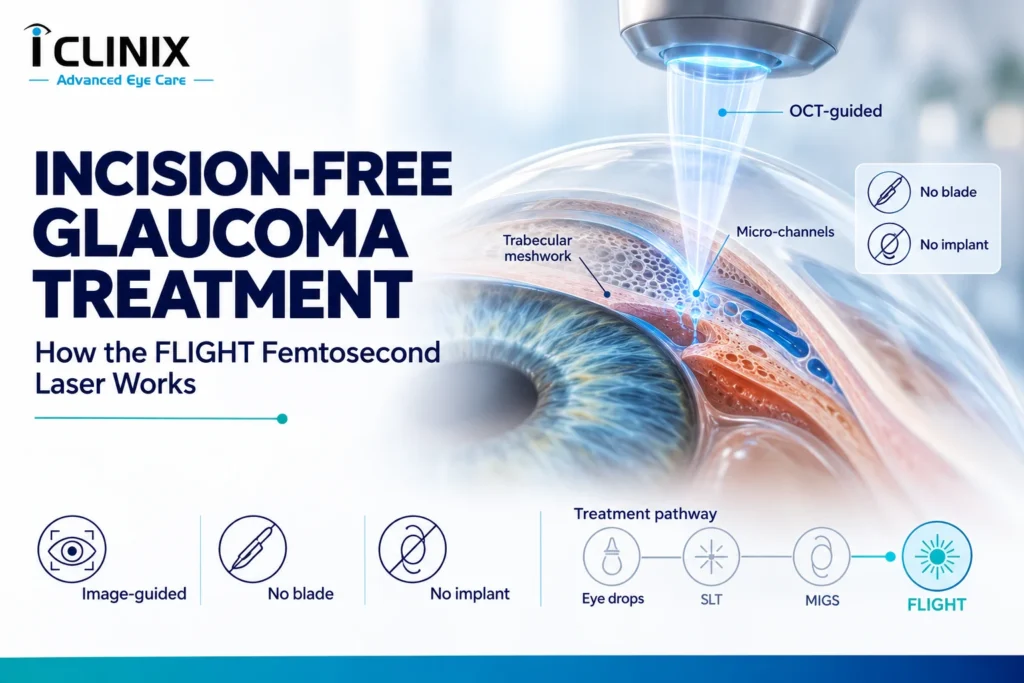
FLIGHT is a new laser treatment for open-angle glaucoma that creates tiny drainage channels inside the eye without any incision or implant. It uses a femtosecond laser guided by high-resolution OCT imaging to open precise pathways through the eye’s natural drainage tissue, helping fluid flow out and lowering eye pressure. The first commercial FLIGHT procedures took place in London and Düsseldorf in May 2026. In the US it is still an investigational treatment, and it is not yet available in India.
Here’s how it works, what the early results show, and how it fits alongside the glaucoma treatments available today.
A quick refresher: why eye pressure matters in glaucoma
Your eye constantly makes a clear fluid called aqueous humour, which drains out through a spongy filter called the trabecular meshwork, at the angle where the iris meets the cornea. In open-angle glaucoma, this filter becomes less efficient. Pressure builds, and over time it damages the optic nerve.
The damage is silent at first and can’t be reversed. Lowering eye pressure is the only proven way to slow it down. The National Eye Institute’s glaucoma overview is a useful primer if you’re new to the condition. If glaucoma runs in your family, our post on what to ask when glaucoma runs in the family explains why early screening matters.
Today’s main ways to lower eye pressure
Most treatment plans move along a ladder, from least to most invasive:
1. Eye drops. Effective, but need daily use for life.
2. SLT (selective laser trabeculoplasty). A gentle laser applied to the drainage tissue to improve outflow. No incision. The effect can wear off over a few years, and it can be repeated.
3. MIGS (minimally invasive glaucoma surgery). Tiny devices such as iStent or Hydrus, often placed during cataract surgery. We covered these in our post on combining cataract and glaucoma surgery.
4. Traditional surgery. Trabeculectomy or drainage valves for advanced or hard-to-control glaucoma.
FLIGHT is designed to sit between SLT and MIGS: more targeted than SLT, but with no incision or implant like MIGS.
How the FLIGHT procedure works
FLIGHT stands for Femtosecond Laser Image-Guided High-precision Trabeculotomy. The system, called ViaLuxe, is made by the US company ViaLase.
In simple steps:
1. Imaging. The system uses high-resolution OCT to see the drainage angle in detail through the cornea.
2. Planning. The surgeon picks exactly where to place the channels.
3. Laser treatment. Femtosecond laser pulses, each lasting a millionth of a millionth of a second, create small channels through the trabecular meshwork into Schlemm’s canal, the eye’s main drainage channel.
4. Done. No cut is made in the eye and nothing is left behind.
Because the laser passes through the clear cornea and focuses only at the target, the eye’s surface stays intact. That’s what “incision-free” means here.
A way to picture it: SLT is like treating the surface of a clogged filter so it works better. MIGS is like inserting a small pipe through it. FLIGHT is like drilling a few precise holes through the filter with light.
What the evidence shows so far
The published data is still early.
In the first-in-human safety study, published with 24-month results, 17 eyes completed two years of follow-up. Average eye pressure fell from 22.3 mmHg to 14.5 mmHg, a reduction of about 35%. About 82% of eyes achieved at least a 20% drop in pressure. There were no serious adverse events linked to the laser, and the channels were still visible and open at two years. The number of glaucoma medications didn’t change significantly.
That’s encouraging, but it’s a small study. Larger trials with longer follow-up and comparisons against SLT and MIGS are needed before we know where FLIGHT fits best.
Where FLIGHT stands in 2026
| Region | Status (October 2026) |
| Europe | CE-marked; first commercial procedures May 2026 in London and Düsseldorf |
| United States | Investigational; available only in clinical trials |
| India | Not yet available |
ViaLase announced the global commercial introduction of FLIGHT in May 2026. New glaucoma technology usually reaches India a few years after its European launch, once training, regulatory approval and supply are in place.
FLIGHT vs SLT vs MIGS
| SLT | FLIGHT | MIGS (iStent, Hydrus) | |
| Incision | None | None | Small, often shared with cataract surgery |
| Implant | None | None | Yes |
| How it works | Laser stimulates the drainage tissue | Laser creates channels through the drainage tissue | Device bypasses or opens the drainage canal |
| Evidence base | Large, long-term | Early, small studies | Large, multi-year trials |
| Available in India | Yes | Not yet | Yes (device-dependent) |
Who might benefit in future?
If larger studies confirm the early results, FLIGHT could suit people with:
• Mild to moderate open-angle glaucoma.
• Trouble using drops, or side effects from them.
• No need for cataract surgery right now (so MIGS isn’t a natural add-on).
• A preference to avoid incisions or implants.
It’s unlikely to replace traditional surgery for advanced glaucoma, and it’s not meant for angle-closure glaucoma.
What you can do today
You don’t need to wait for new technology to protect your sight. Glaucoma that’s found early and treated well rarely causes serious vision loss.
• Get your eyes checked regularly from 40, earlier if glaucoma runs in your family.
• Use your drops as prescribed. If they’re causing problems, tell your doctor. There are options, including SLT.
• Ask about SLT if you’d like to reduce drops. It’s available, incision-free and well studied.
• Ask about MIGS if you’re also due for cataract surgery.
At iClinix, glaucoma care includes OCT imaging, visual field testing and the full range of today’s treatments, from drops and SLT to MIGS and surgery. Book a glaucoma assessment if you’d like a clear plan for your eyes, and we’ll keep you posted as treatments like FLIGHT develop.
Frequently asked questions
What is the FLIGHT procedure for glaucoma?
FLIGHT (Femtosecond Laser Image-Guided High-precision Trabeculotomy) is a laser treatment that creates tiny drainage channels through the eye’s trabecular meshwork using an OCT-guided femtosecond laser. It needs no incision and leaves no implant.
Is FLIGHT available in India?
Not yet. As of October 2026, FLIGHT is commercially available in Europe and investigational in the US. It’s likely to take some time before it reaches India.
How is FLIGHT different from SLT?
SLT uses a laser to stimulate the drainage tissue so it works better. FLIGHT uses a femtosecond laser to create actual channels through the drainage tissue. Both are incision-free, but SLT has a much larger and longer evidence base.
Does FLIGHT replace glaucoma eye drops?
It’s designed to lower eye pressure, which may reduce the need for drops in some patients. In the early 24-month study, pressure fell by about 35%, though medication use didn’t change significantly. Larger studies are needed.
Is laser glaucoma treatment painful?
Laser glaucoma treatments such as SLT are done with numbing drops and are generally well tolerated. FLIGHT is also designed as an outpatient, incision-free procedure.
Want to rely less on glaucoma drops? Book a glaucoma assessment at iClinix to explore SLT, MIGS and the other options available today.
This article is for general information and does not replace a personal eye examination.