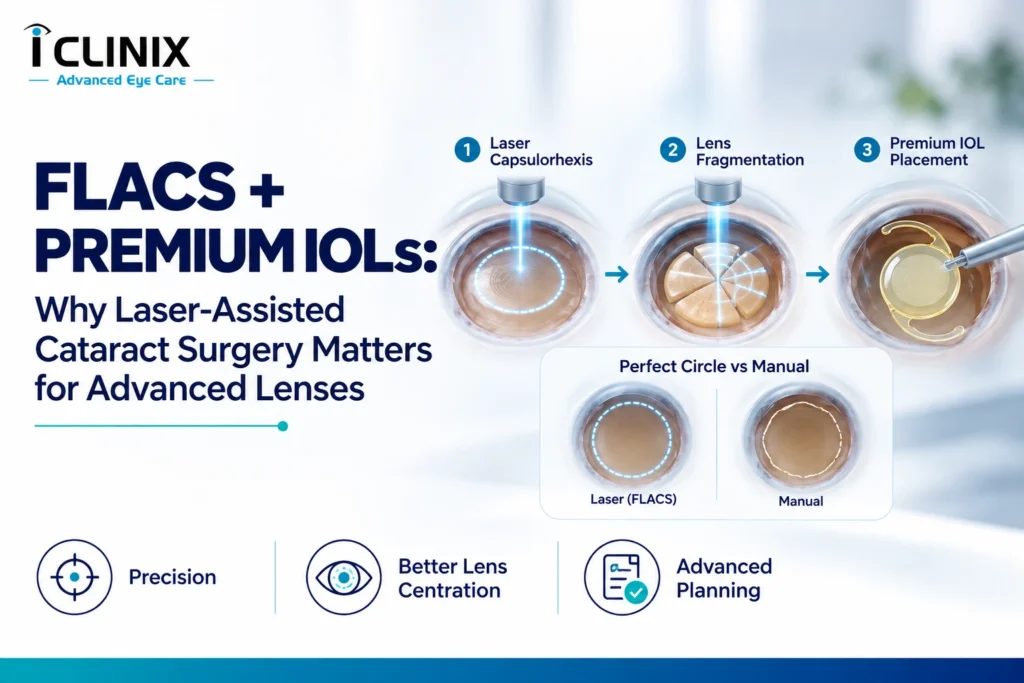
Femtosecond laser-assisted cataract surgery (FLACS) uses a computer-guided laser to perform some of the most delicate steps of cataract surgery: opening the lens capsule, softening the cataract and, in some cases, making the corneal incisions. Large trials show it is about as safe and effective as standard phaco surgery for most patients. Where it can earn its place is in precision-sensitive cases, especially toric and premium lenses, where a perfectly round, centred opening helps the new lens sit exactly where it should.
Here’s what the laser does, what the evidence says, and how to decide whether it’s worth it for you.
Standard cataract surgery in 60 seconds
Modern cataract surgery, called phacoemulsification or “phaco”, follows a set sequence:
1. A tiny incision is made at the edge of the cornea.
2. The surgeon opens a round window in the thin capsule that surrounds the lens. This step is called the capsulorhexis.
3. Ultrasound breaks the cloudy lens into fragments, which are gently removed.
4. A folded artificial lens (IOL) is placed in the capsule bag and unfolds.
In skilled hands, every step is done manually with very high precision. This is the operation most people worldwide have, with excellent results.
What the femtosecond laser changes
In FLACS, the patient first lies under a femtosecond laser. The laser uses built-in OCT imaging to map the eye, and then:
• Cuts the capsule opening in a near-perfect circle, of a chosen size, centred where the surgeon plans.
• Pre-softens or segments the cataract into small pieces, so less ultrasound energy is needed afterwards.
• Can make the corneal incisions, and small relaxing incisions to reduce mild astigmatism.
The patient then moves to the operating microscope, and the surgeon completes the surgery much like standard phaco: removing the lens fragments and placing the IOL.
People sometimes call this “robotic” or “bladeless” cataract surgery. It isn’t fully robotic: the surgeon still performs the key steps of removing the cataract and implanting the lens.
Why precision matters more with premium lenses
With a basic monofocal lens, small variations in where the lens sits often make little difference to vision. Premium lenses are less forgiving.
• Centration. Trifocal, full-range and EDOF lenses have optical zones designed around the centre. A lens that sits slightly off-centre or tilted can increase halos or soften vision. A round, well-centred capsule opening that overlaps the lens edge evenly helps keep it in place.
• Toric alignment. Toric lenses correct astigmatism only when they sit at the correct angle. Each degree of rotation away from target reduces the correction. A stable, even capsule opening helps the lens stay where it was placed.
• Predictable lens position. Lens power calculations assume the IOL settles at a certain depth. A consistent capsule opening can make that more predictable, which matters when the goal is to cut down on glasses.
That’s why FLACS is often discussed alongside the lenses in our 2026 premium lens guide, such as PureSee, Galaxy, PanOptix Pro and their toric versions.
What the research says
This is where an honest answer is important.
The largest randomised trial, the UK’s FACT trial, compared FLACS with standard phaco in around 600 patients followed for one year. It found that standard phaco was not inferior to FLACS for vision, patient-reported outcomes or safety, and that FLACS cost more without a clear clinical benefit for routine cases. You can read the FACT trial summary on UCL Discovery.
A review of FLACS evidence published after 2020 reached similar conclusions: precise capsulotomies and less ultrasound energy, but no proven advantage in final vision for the average patient.
What does this mean for you? For a routine cataract with a standard lens, skilled manual phaco gives excellent results. FLACS may add value in specific situations, which many surgeons consider to include:
• Premium or toric lenses where centration and alignment matter most.
• Very dense or hard cataracts, where less ultrasound energy is kinder to the cornea.
• Weak corneal endothelium (for example, Fuchs’ dystrophy).
• Weak lens support (zonules), such as after trauma or with pseudoexfoliation.
Who may not be suited to FLACS
The laser needs a stable dock on the eye and a clear view. It may be less suitable if you have:
• Small pupils that don’t dilate well.
• Deep-set eyes or a narrow eyelid opening.
• Corneal scars that block the laser’s view.
• Advanced glaucoma, where the brief pressure rise during docking is a concern.
Your surgeon will check these during your pre-operative assessment.
Cost: is laser cataract surgery worth it?
FLACS adds a separate laser fee to cataract surgery, and insurance in India usually doesn’t cover that extra. Whether it’s worth paying for depends on your case:
• Standard monofocal lens, routine cataract: usually not necessary.
• Premium or toric lens: worth discussing. Precision may help, though a highly experienced manual surgeon can achieve excellent results too.
• Complex eye (dense cataract, weak cornea, weak zonules): may offer real advantages.
The most important factors are still the surgeon’s experience, accurate measurements and a healthy eye surface before surgery. A laser doesn’t replace those.
Precision cataract surgery at iClinix
At iClinix, femtosecond laser-assisted surgery is available for patients where it adds value, particularly those choosing premium or toric lenses. Your surgeon will tell you honestly whether it’s likely to help in your case.
You can read more about our approach to cataract surgery or book a cataract consultation to discuss your options.
The American Academy of Ophthalmology’s patient guide to cataract surgery risks, recovery and costs is also a useful background read.
The short answer
Femtosecond laser cataract surgery adds computer-guided precision to a few key steps. For routine cases it hasn’t been shown to improve final vision compared with skilled manual surgery. For premium and toric lenses, and for some complex eyes, that extra precision can be worth discussing. Ask your surgeon what it would change for your eye specifically.
Frequently asked questions
What is femtosecond laser cataract surgery?
FLACS is cataract surgery in which a femtosecond laser performs some steps, such as opening the lens capsule, softening the cataract and making incisions. The surgeon then removes the cataract and implants the lens.
Is laser cataract surgery better than normal phaco?
For most routine cases, large trials show similar visual results and safety. FLACS may help in specific situations, such as premium or toric lenses, dense cataracts or a weak cornea.
Is laser cataract surgery bladeless?
The laser can make the incisions without a blade, but the cataract is still removed with ultrasound and the lens is placed by the surgeon. It’s often called bladeless, but some instruments are still used.
Does FLACS cost more?
Yes. FLACS usually adds a separate laser charge, which insurance often doesn’t cover in India. Ask for a full written estimate before surgery.
Do I need FLACS for a premium lens?
Not necessarily. Excellent results with premium lenses are achieved with both FLACS and skilled manual surgery. FLACS can make the capsule opening more consistent, which some surgeons prefer for premium and toric lenses.
Planning cataract surgery with a premium or toric lens? Book a consultation at iClinix to talk through the most precise approach for your eyes.
This article is for general information and does not replace a personal eye examination.