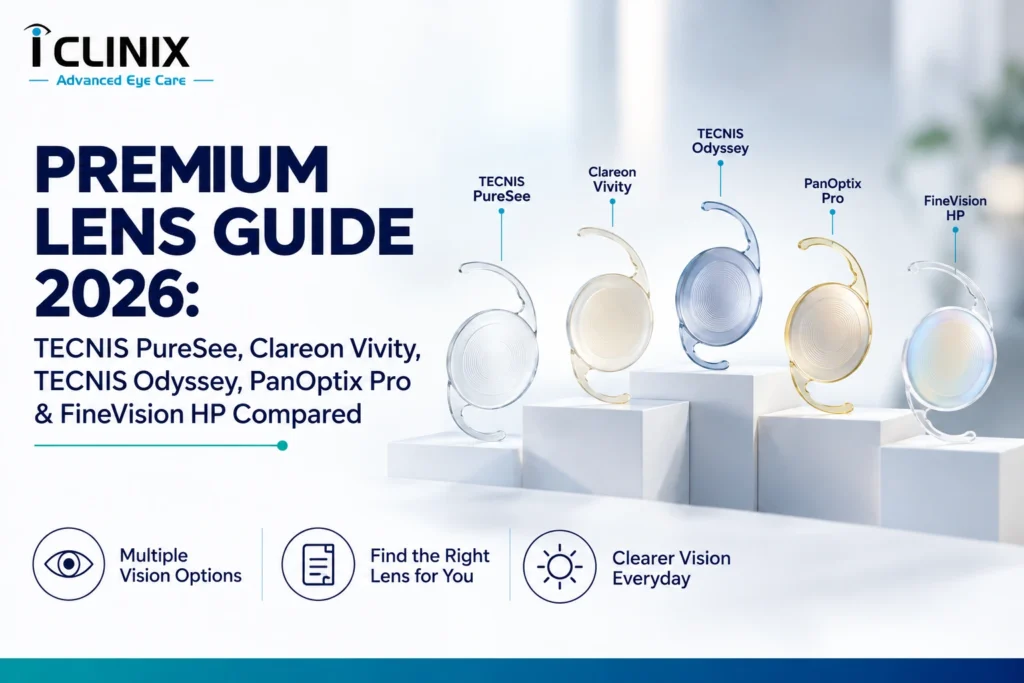
The best premium cataract lens in 2026 is the one that matches your eyes and your daily life. There is no single winner. EDOF lenses such as TECNIS PureSee and Clareon Vivity give strong distance and intermediate vision with few halos. Trifocal and full-range lenses such as PanOptix Pro, FineVision HP and TECNIS Odyssey give the best chance of reading without glasses, with more potential for night-time halos. Newer non-diffractive designs, like the RayOne Galaxy spiral lens, try to bridge the two.
This guide compares the main options side by side, explains the trade-offs in everyday terms, and lists the questions that will help you and your surgeon decide.
First, the three families of premium lenses
Every premium IOL is trying to do the same thing: give you more than one useful focus after cataract surgery or refractive lens exchange. They go about it in three ways.
1. EDOF (extended depth of focus) These lenses stretch a single focus into a longer zone that covers distance and intermediate (computer, dashboard, cooking). Near vision is partial, so many people still use readers for small print. Their big plus: halos and glare are usually close to a standard monofocal.
2. Trifocal and full-range diffractive lenses These use fine rings on the lens surface to split light into distance, intermediate and near focus. They offer the most glasses-free reading. The trade-off is a higher chance of halos or starbursts around lights at night, and a little less contrast in dim light.
3. Non-diffractive full-range lenses The newest group. These try to give a full range of vision without diffractive rings, using refractive designs or, in Galaxy’s case, a continuous spiral. Long-term data is still building.
If you just want sharp distance vision plus a bit more screen range, an enhanced monofocal like Eyhance or Clareon TruPlus may be enough. We compared those two in our enhanced monofocal guide.
The 2026 premium lenses at a glance
| Lens (maker) | Type | Uses diffractive rings? | Strongest ranges | Night halo tendency* | Toric version |
| TECNIS PureSee (J&J) | EDOF, purely refractive | No | Distance, intermediate; some near | Low | Yes |
| Clareon Vivity (Alcon) | EDOF, non-diffractive | No | Distance, intermediate; some near | Low | Yes |
| RayOne Galaxy (Rayner) | Full range, spiral optic | No | Distance, intermediate, near | Low to moderate | Yes |
| TECNIS Odyssey (J&J) | Full visual range | Yes | Distance, intermediate, near | Moderate | Yes |
| Clareon PanOptix Pro (Alcon) | Trifocal | Yes | Distance, intermediate, near | Moderate | Check locally |
| FineVision HP (BVI) | Trifocal | Yes | Distance, intermediate, near | Moderate | Check locally |
*General tendency by lens type, based on published data and clinical experience. Individual results vary with pupil size, eye health and surgery.
TECNIS PureSee: the EDOF that keeps contrast
PureSee is Johnson & Johnson’s purely refractive EDOF lens. The US FDA approved it on 12 March 2026, after it had already been used in close to half a million eyes worldwide.
According to J&J’s FDA approval announcement, 97% of patients in its US study reported no very bothersome halos or glare. J&J also says it is the first FDA-approved EDOF lens to keep contrast sensitivity comparable to a standard aspheric monofocal. A toric version (PureSee Toric II) is available for astigmatism.
Good fit for: people who drive at night, want excellent distance and computer vision, and don’t mind readers for fine print.
Clareon Vivity: Alcon’s non-diffractive EDOF
Vivity uses Alcon’s wavefront-shaping design to stretch focus without diffractive rings. It has been widely used for several years, so there is a large base of patient experience. On Alcon’s Clareon material, it’s designed to stay glistening-free.
Good fit for: similar patients to PureSee. Some surgeons also consider Vivity for eyes with mild ocular conditions where a diffractive lens would be less suitable. Ask whether that applies to you.
RayOne Galaxy: the spiral newcomer
Galaxy, from Rayner, uses an AI-designed continuous spiral instead of diffractive rings, aiming for distance, intermediate and near vision with fewer light effects. The US FDA approved Galaxy and Galaxy Toric in September 2026, and a hydrophobic version is rolling out in Europe from late 2026. We explained how it works in our RayOne Galaxy explainer.
Good fit for: people who want a fuller range than EDOF but are wary of trifocal halos. Long-term independent data is still building.
TECNIS Odyssey: J&J’s full-range diffractive lens
Odyssey is designed to give a continuous range from distance to near, with a diffractive design that J&J has tuned to reduce halos compared with older multifocals. It is widely used in the US and other markets.
Good fit for: people who want to read without glasses and accept a moderate chance of night halos.
Clareon PanOptix Pro: a refined trifocal
PanOptix Pro is the updated version of Alcon’s established PanOptix trifocal. In Alcon’s release, the company states that the lens uses 94% of incoming light (up from 88% in the original) and has half the light scatter. Less scatter should mean slightly better contrast and fewer night-time light effects, though these are lab measurements.
Good fit for: people whose top priority is reading and phone use without glasses.
FineVision HP: the trifocal pioneer’s latest version
BVI’s FineVision was the first trifocal IOL. The newer FineVision HP received US FDA approval in October 2025, as reported by Eyewire+. It’s a diffractive trifocal with more than 15 years of FineVision use behind it.
Good fit for: people who want trifocal performance from a lens family with a long track record.
How to choose: match the lens to your life
Start with how you spend your day, not the brand.
• “I drive at night a lot and work on a laptop.” EDOF (PureSee, Vivity) or an enhanced monofocal. Expect readers for small print.
• “I want to read my phone and menus without glasses.” Trifocal or full range (PanOptix Pro, FineVision HP, Odyssey), or Galaxy. Accept some night halos.
• “I’m somewhere in between.” EDOF with mini-monovision, or a non-diffractive full-range lens. This is where a detailed talk with your surgeon pays off.
• “I have glaucoma, macular changes or diabetic retinopathy.” Diffractive lenses are often less suitable. EDOF, enhanced monofocal or monofocal lenses tend to be safer bets.
• “I have astigmatism.” You’ll likely need a toric version of whichever lens you choose.
If you’re in your 40s or 50s and considering lens surgery for reading glasses rather than a cataract, our post on refractive lens exchange vs LASIK covers that decision.
What every premium lens has in common
• Expectations matter. Most people with a premium lens do most daily tasks without glasses. “Never wearing glasses again” isn’t a fair promise for anyone.
• Your brain adapts. It can take a few weeks to a few months for halos to fade into the background and for near vision to feel natural.
• Measurements decide success. Precise biometry, astigmatism correction and a healthy ocular surface are as important as the lens model.
• PCO can still happen. A thin film can form behind any lens months or years later. It’s cleared with a quick YAG laser.
Questions to ask before you choose
• Which of these lenses do you use, and how many have you implanted?
• Are my retina, optic nerve and cornea healthy enough for a presbyopia-correcting lens?
• Do I need a toric lens?
• What will my night vision be like compared with a monofocal?
• What’s the plan if I’m unhappy with the result?
• What does the full package cost, and what does my insurance cover?
At iClinix, lens choice comes after a full work-up for cataract surgery, including optical biometry and anterior segment imaging. If you’d like a straight answer on which of these lenses suits your eyes, book a lens consultation.
The bottom line
2026 has been a big year for cataract lenses. PureSee and Galaxy gained US approval, PanOptix Pro refined the trifocal, and enhanced monofocals got stronger. More choice is good news, but it also means the conversation with your surgeon matters more than ever. Pick the lens for your eyes and your day, and be wary of anyone who says one lens is best for everybody.
Frequently asked questions
What is the best premium IOL in 2026?
There’s no single best lens. EDOF lenses like TECNIS PureSee and Clareon Vivity suit people who prioritise distance and computer vision with few halos. Trifocals like PanOptix Pro and FineVision HP suit people who want to read without glasses. The right choice depends on your eye health and lifestyle.
What is the difference between EDOF and trifocal lenses?
EDOF lenses stretch one focus to cover distance and intermediate, with some near vision and few halos. Trifocal lenses split light into three focus points for distance, intermediate and near, giving better reading vision but more chance of night halos.
Which premium lens has the fewest halos?
Non-diffractive EDOF lenses such as TECNIS PureSee and Clareon Vivity generally have the lowest halo and glare rates among presbyopia-correcting lenses. In J&J’s US study, 97% of PureSee patients reported no very bothersome halos or glare.
Can I be completely glasses-free after cataract surgery?
Many people with trifocal or full-range lenses do almost everything without glasses, but some still use readers for very small print or in dim light. No lens can guarantee complete independence from glasses.
Is a premium IOL worth the extra cost?
For people who want less reliance on glasses and have healthy eyes, many find it worthwhile. For people with other eye conditions, or who are happy using readers, a monofocal or enhanced monofocal may be the better value.
Are these lenses available in India?
Many premium lenses from J&J, Alcon, Rayner and BVI are available in India, though specific newer models can arrive later than in the US or Europe. Ask your surgeon which lenses they use.
Shortlisting premium lenses? Bring this list to a lens consultation with Dr. Gogia at iClinix, and we’ll tell you which ones genuinely suit your eyes.
This article is for general information and does not replace a personal eye examination.