
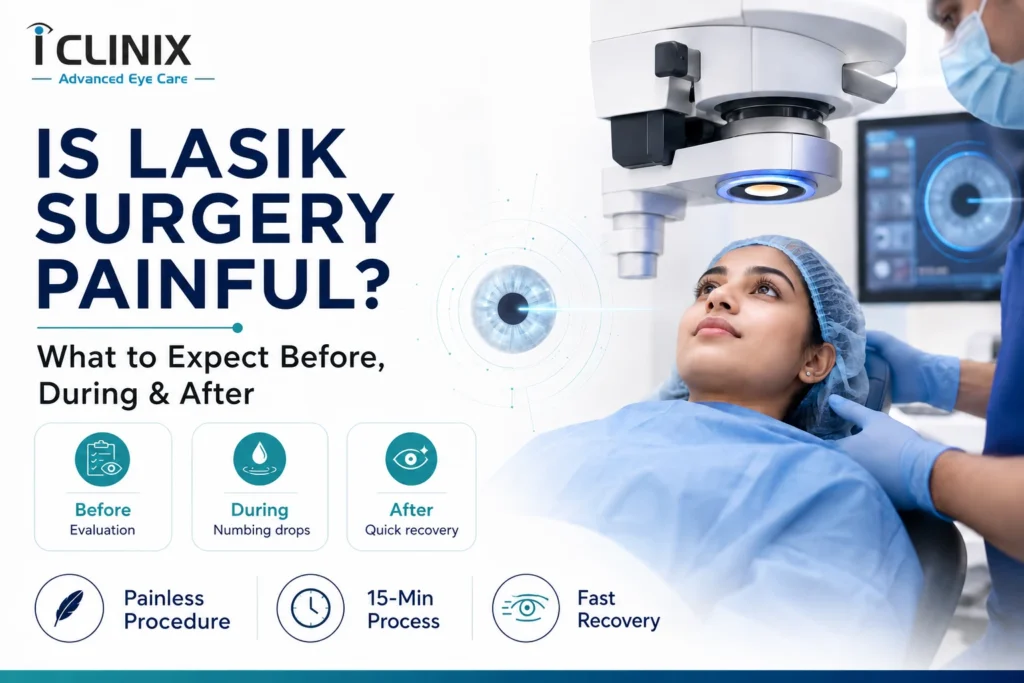
“Will it hurt?” is usually the first question a patient asks once we’ve confirmed they’re a good candidate for LASIK — sometimes before we’ve even discussed cost or scheduling. I remember one patient, a first-year law student who’d been putting off LASIK for two years purely out of fear of pain, asking me to describe every single sensation in order before she’d agree to a date. So we did exactly that, step by step, and she went ahead with it a week later.
This is, without question, the single most common question I get asked about LASIK. More than cost, more than recovery time, more than which technology we use — people want to know if it’s going to hurt. It’s a reasonable thing to worry about; the idea of a laser near your eye sounds intense even when you know, logically, that millions of these procedures happen safely every year.
So here’s a straight answer: LASIK is not a painful procedure. You may feel some pressure or mild discomfort at specific moments, and there’s a period after surgery where your eyes will feel irritated rather than hurt outright. But “painful” isn’t the word most patients use to describe it once it’s done. Here’s what actually happens, stage by stage.
Before the Procedure: What You’ll Feel
Nothing about the lead-up to LASIK is painful. You’ll go through a diagnostic workup — corneal mapping, thickness measurement, and a full eye exam — none of which involves any discomfort beyond the mild adjustment of dilation drops, standard for any thorough eye exam.
On the day of surgery, I apply numbing eye drops before anything begins. This is the step that removes pain from the equation almost entirely. Within a minute or two, your eyes will feel numb, similar to how your mouth feels after dental anaesthesia, minus any needle.
During the Procedure: Pressure, Not Pain
Once the numbing drops take effect, an eyelid holder is placed to keep you from blinking — this can feel slightly unusual, but isn’t painful. What most patients describe during the actual laser correction is a sensation of pressure during flap creation, lasting a few seconds; a faint burning smell, which is normal and comes from the laser interacting with corneal tissue rather than a sign of pain; and some blurring or dimming of vision as the flap is created, which can feel disorienting but isn’t uncomfortable.
The entire procedure typically takes around 15 minutes per eye, and the parts involving actual laser correction are measured in seconds, not minutes. I talk patients through each step as it happens, so they know exactly what’s coming.
“The patients who cope best aren’t the ones with the highest pain tolerance — they’re the ones who know what’s coming next. I’ve never had a patient tell me the surgery itself was worse than they expected once we’d walked through it beforehand.” — Dr. Varun Gogia, Director, iClinix
Immediately After: Irritation, Not Agony
This is the part where most of the “is it painful” concern actually lives — and it’s worth being honest about, rather than glossing over it. For the first few hours after surgery, once the numbing drops wear off, it’s common to feel a gritty, foreign-body sensation like something’s stuck in your eye, watering or mild burning, sensitivity to light, and an urge to rub your eyes, which you’ll be advised strongly against.
This discomfort is usually at its most noticeable in the first 4-6 hours and settles significantly by the next morning. Most patients describe it as similar to chopping onions or having shampoo run into your eyes — unpleasant, but not what most people would call pain. Prescribed lubricating drops help manage this window, and resting with your eyes closed for a few hours after the procedure makes a real difference.
The Days After: Mild Discomfort That Fades Fast
By day two, most patients report the gritty sensation has eased considerably, and by the end of the first week, it’s largely gone. Some mild dryness can persist longer for a smaller number of patients, particularly those who were already prone to dry eyes before surgery, but this is managed with continued use of lubricating drops as advised.
A few things genuinely help during this window: using your prescribed drops on schedule even once your eyes feel fine, avoiding dusty or smoky environments for the first few days, wearing the protective eyewear provided while sleeping, and resisting the urge to rub your eyes, no matter how tempting it gets.
Why Some People Report More Discomfort Than Others
Pain tolerance and dry eye history both play a role in how any individual experiences the recovery window. Patients who already deal with dry eyes, or who don’t follow the post-op drop schedule closely, tend to report more discomfort than those who do. This is part of why follow-up visits after LASIK matter — they let me catch and manage any unusual irritation early.
If your discomfort feels like genuine pain rather than irritation, or if it’s getting worse instead of better after the first day, that’s worth getting checked promptly rather than waiting out.
What Makes the Difference Between a Comfortable Recovery and a Rough One
In our experience, three things consistently separate an easy recovery from an unpleasant one: following the drop schedule exactly, not just when your eyes feel irritated; not rubbing your eyes, even reflexively, since this is the single biggest avoidable cause of post-LASIK complications; and attending every follow-up, since some healing markers are only visible on examination, not to you. None of this requires anything difficult — just consistency for a short window.
Frequently Asked Questions
Will I be awake during LASIK? Yes. LASIK is performed under numbing eye drops, not general anaesthesia, and you’ll be awake and able to communicate with me throughout.
How long does the discomfort last after surgery? Most of the noticeable irritation settles within the first 24 hours, with continued improvement over the following days. Full comfort typically returns within a week for most patients.
Is SMILE or PRK less painful than LASIK? SMILE has a smaller incision and some patients report a slightly different recovery sensation, though it isn’t necessarily “less painful.” PRK, since it doesn’t involve a flap, tends to have a longer discomfort window during healing rather than a shorter one.
When should I call the clinic after surgery? If discomfort feels like actual pain rather than irritation, worsens instead of improves after the first day, or comes with vision changes, contact the clinic directly rather than waiting for your scheduled follow-up — don’t wait it out until your next appointment date.
Still Have Questions Before Booking?
The best way to know exactly what LASIK will feel like for your eyes is a proper consultation, where you can ask everything directly and get a straight answer — the same way I walked my law-student patient through it before she agreed to a date.
Read more about Dr. Varun Gogia →
Learn more about LASIK at iClinix →
Book your appointment at iClinix →
About the Author
Dr. Shikha Gupta is the Co-founder & CEO of EyeSetu and an ophthalmologist with over 15 years of experience in clinical practice and telemedicine. An AIIMS alumna (MBBS, MD Ophthalmology, Gold Medalist) and former Senior Consultant at AIIMS, she is dedicated to making quality eye care accessible through innovation, AI-powered retinal screening, and technology-enabled healthcare.