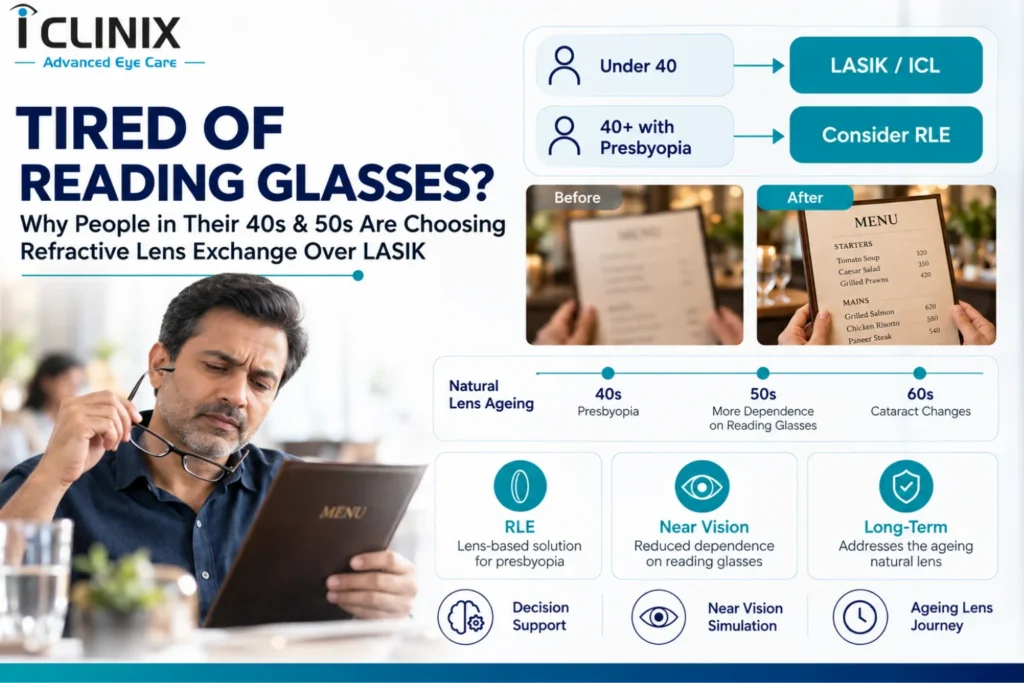
Refractive lens exchange (RLE) replaces your eye’s natural lens with an artificial one to correct your prescription, including the need for reading glasses that starts in your 40s. It is the same operation as cataract surgery, done before a cataract has formed. For many people over 45 who want to reduce their dependence on glasses, RLE solves a problem LASIK can’t: the ageing lens itself.
That doesn’t make RLE the right choice for everyone. Here’s how it works, how it compares with LASIK, and how to tell which way to lean.
Why reading glasses show up in your 40s
Inside your eye sits a clear, flexible lens. When you’re young, tiny muscles change its shape so you can switch focus from a road sign to a phone screen in a split second.
From around 40, that lens slowly stiffens. Close focus gets harder, and you start holding your phone further away. This is presbyopia. It happens to nearly everyone, whether or not you’ve worn glasses before.
The same lens keeps ageing. Over the next two decades it gradually yellows and clouds, which eventually becomes a cataract, usually in your 60s or 70s.
So in your late 40s and 50s, the lens is the part of the eye causing the trouble. That’s the key to understanding RLE.
Why LASIK can’t fix presbyopia on its own
LASIK and SMILE reshape the cornea, the clear window at the front of the eye. They’re excellent for correcting short-sight, long-sight and astigmatism in younger adults, and our LASIK vs SMILE vs ICL comparison explains the options in detail.
But corneal surgery doesn’t restore the stiffening lens behind it. After 40, people who have LASIK for distance usually still need reading glasses. Some surgeons use monovision LASIK, setting one eye for distance and one for near. It works for some, but not everyone adapts. And it does nothing about the cataract that is still on its way.
How refractive lens exchange works
RLE is done under local anaesthesia, usually as a day procedure, one eye at a time.
1. The surgeon makes a tiny incision at the edge of the cornea.
2. The natural lens is broken up and gently removed using ultrasound (phacoemulsification).
3. A folded artificial lens (intraocular lens, or IOL) is placed in the same capsule bag and unfolds.
4. The incision usually seals on its own, without stitches.
The second eye is often done within a few days to a couple of weeks. Most people return to desk work within a few days, following their surgeon’s drop schedule and precautions.
Cleveland Clinic has a clear patient guide on what to expect with refractive lens exchange.
The lens you choose is the whole game
With RLE, the type of IOL decides your result:
• Monofocal: sharp at one distance; you’ll still need readers (or monovision).
• Enhanced monofocal: distance plus useful screen-distance vision; readers for small print.
• EDOF (extended depth of focus): distance and intermediate, some near; fewer halos than trifocals.
• Trifocal: distance, intermediate and near; best chance of reading without glasses, with more risk of night halos.
• Full-range non-diffractive (e.g. spiral): a newer approach aiming for the full range with fewer halos.
Named lenses in the presbyopia-correcting group include TECNIS PureSee, Clareon Vivity, TECNIS Odyssey and RayOne Galaxy. We compare them in our premium lens guide on 15 October. Lens material matters less than optic design, but if you’re curious, our post on hydrophobic vs hydrophilic IOLs covers it.
RLE vs LASIK: side by side
| LASIK / SMILE | Refractive lens exchange | |
| What it changes | Shape of the cornea | Replaces the natural lens |
| Best age range | Roughly 18–40 | Usually 45+ with presbyopia, or high prescriptions |
| Fixes reading vision? | Not on its own (monovision possible) | Yes, with a presbyopia-correcting IOL |
| Future cataract in that eye | Still develops later | Cannot develop (natural lens removed) |
| Recovery | Very quick | Quick, slightly longer than LASIK |
| Type of surgery | Corneal laser, outside the eye | Intraocular surgery, inside the eye |
| Main risks | Dry eye, under- or over-correction | Infection (rare), retinal detachment (higher in high myopia), PCO |
Who is a good candidate for RLE?
You may be a strong candidate if you:
• Are in your mid-40s or older and bothered by reading glasses.
• Have a high prescription (long-sight in particular) that makes LASIK less suitable.
• Have a thin or irregular cornea that rules out LASIK.
• Already have early lens changes that will turn into a cataract in time.
• Want a solution that also takes cataract surgery off your future to-do list for that eye.
RLE may not be right if you:
• Are under 40 with a healthy, still-flexible lens. LASIK, SMILE or an implantable contact lens is usually a better fit.
• Are very short-sighted with a long eyeball. The risk of retinal detachment after lens surgery is higher in high myopia, so a careful retinal check and frank discussion are essential.
• Have significant retinal disease, advanced glaucoma or uncontrolled diabetes affecting the eye.
• Expect perfect vision at every distance in every light. Even the best lenses involve some trade-offs.
The American Academy of Ophthalmology’s EyeNet has a balanced look at the debate around refractive lens exchange that’s worth reading if you like seeing both sides.
What RLE does and doesn’t promise
This part matters, so it is worth saying clearly.
• RLE removes the chance of a cataract forming in that eye, because the natural lens is gone.
• It doesn’t stop other eye conditions. Glaucoma, macular degeneration, dry eye and retinal problems can still happen, so regular eye checks still matter.
• A secondary clouding called PCO can still occur. Months or years later, a film can form behind the new lens and blur vision. It’s treated with a quick, painless YAG laser in the clinic. Cleveland Clinic explains how YAG laser capsulotomy works.
• Your result depends on the lens and on your eye. Most people with presbyopia-correcting lenses do the majority of daily tasks without glasses, but some still reach for readers in dim light or for tiny print.
A simple way to decide
• Under 40, healthy eyes, want to stop wearing distance glasses: start with LASIK, SMILE or ICL.
• 40–45, early presbyopia, mild prescription: discuss both. Monovision LASIK or simply readers may be enough for now.
• 45+, bothered by readers, or high long-sight: RLE deserves a serious look.
• Early cataract already present: the conversation becomes cataract surgery with a premium lens, which is the same operation.
At iClinix, the starting point is a full refractive work-up: corneal topography, biometry, retinal check and a frank conversation about your daily life. You can read about our LASIK and refractive surgery options, or book a refractive consultation to find out which route fits your eyes.
Frequently asked questions
What is refractive lens exchange?
Refractive lens exchange (RLE) is surgery that removes your natural lens and replaces it with an artificial lens to correct your prescription and, with the right lens, reduce the need for reading glasses. It is the same procedure as cataract surgery, done before a cataract forms.
Is RLE better than LASIK for people over 45?
Often, yes, if reading glasses are the main problem. LASIK reshapes the cornea but doesn’t fix the ageing lens that causes presbyopia. RLE addresses the lens directly. The right choice depends on your eye measurements and health.
Will I get a cataract after refractive lens exchange?
No cataract can form in that eye because the natural lens has been removed. A separate clouding behind the new lens, called PCO, can still happen and is cleared with a quick YAG laser.
How long does RLE recovery take?
Most people see well within a day or two and return to desk work within a few days. Full stabilisation takes a few weeks. Your surgeon will give you a drop schedule and activity guidelines.
Is refractive lens exchange safe?
RLE is a well-established procedure with a strong safety record, the same as modern cataract surgery. As with any eye surgery, there are risks, including infection and, in highly short-sighted eyes, a higher risk of retinal detachment. A full pre-operative check helps identify these risks.
Can I still need glasses after RLE?
Possibly, for some tasks. Presbyopia-correcting lenses reduce dependence on glasses, but some people still use readers for very small print or in low light.
Medically reviewed by Dr. Varun Gogia, MBBS, MD Ophthalmology (AIIMS), Vitreo-Retina, Refractive & Cataract Specialist, iClinix Eye Hospitals.
Over 40 and tired of hunting for your reading glasses? Book a refractive assessment at iClinix to find out whether RLE, LASIK or ICL is the right route for your eyes.
This article is for general information and does not replace a personal eye examination.