Most modern cataract lenses are made of one of two kinds of acrylic: hydrophobic, which repels water, or hydrophilic, which absorbs some water. Both are safe, well-tested materials. The differences show up in small ways: how the lens handles during surgery, how it behaves over decades, and, to a lesser degree than once thought, your chance of developing a “secondary cataract” later on.
If your lens quote lists a material and you’re not sure what it means, this guide explains it in plain terms.
First, what is an IOL made of?
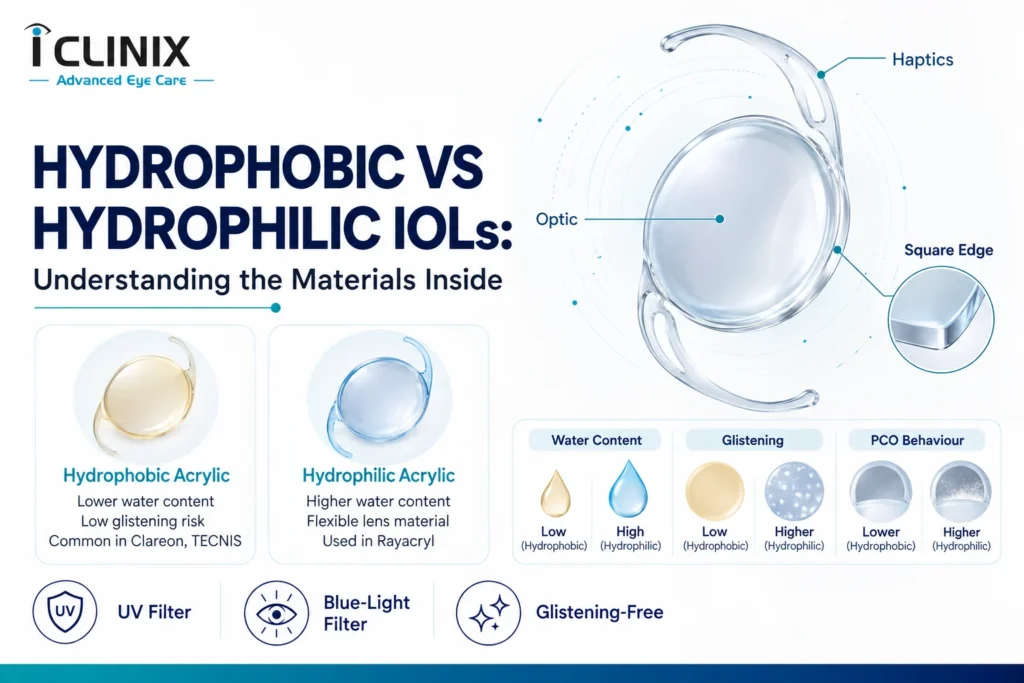
An intraocular lens has two parts. The optic is the clear, round centre that focuses light, usually about 6 mm across. The haptics are the thin arms or loops that hold the lens in place inside the eye’s natural capsule bag.
Modern IOLs are foldable. They go into the eye through a cut of about 2–2.5 mm and unfold once inside. That flexibility comes from acrylic materials, which have largely replaced the rigid PMMA lenses of the past.
Within acrylics, the big split is between hydrophobic and hydrophilic.
Hydrophobic acrylic: the water-repelling option
Hydrophobic acrylic lenses contain very little water. They tend to unfold slowly and gently in the eye, and they bond closely to the capsule bag.
Well-known examples include Alcon’s Clareon lenses (the material behind the Clareon TruPlus lens we discussed in our enhanced monofocal comparison) and many lenses on Johnson & Johnson’s TECNIS platform.
Strengths
• A long track record, especially in the US and Europe.
• Usually paired with a sharp, square posterior edge that helps block the cells that cause secondary cataract.
• Very low risk of calcification (clouding of the lens itself), which is a rare problem with some hydrophilic lenses.
What to know
• Some older hydrophobic materials developed glistenings: tiny fluid-filled pockets inside the lens. In most people these don’t affect vision noticeably. Newer materials such as Clareon are made to be glistening-free.
Hydrophilic acrylic: the water-loving option
Hydrophilic acrylic lenses absorb water and are softer and more flexible. They unfold quickly and can pass through very small incisions.
Rayner’s Rayacryl material, used in the original RayOne Galaxy lens we covered in our spiral IOL explainer, is a well-known hydrophilic acrylic.
Strengths
• Easy to handle and inject, which suits micro-incision surgery.
• Highly biocompatible, with little inflammation.
• No glistenings, because the material already holds water.
What to know
• In rare cases, hydrophilic lenses can develop calcium deposits that cloud the optic, sometimes years later. This has been linked mostly to certain other eye surgeries, such as corneal transplants that use an air or gas bubble. If you may need that kind of surgery in future, mention it to your surgeon.
The big question: which causes fewer secondary cataracts?
Posterior capsule opacification (PCO), often called a secondary cataract, is the most common reason vision gets cloudy again after cataract surgery. It isn’t the cataract coming back. Leftover lens cells grow across the back of the capsule bag that holds your new IOL, and the film blurs your vision.
The fix is simple. A quick YAG laser capsulotomy makes a small opening in that film, usually in a few minutes and without any incision. Cleveland Clinic’s page on posterior capsular opacification explains the condition and treatment well.
For years, hydrophobic lenses were thought to cause clearly less PCO. Recent research has softened that view. A study at St Thomas’ Hospital in London compared hydrophilic and hydrophobic versions of the same RayOne lens over 24 months. It found no significant difference in visually significant PCO between the two groups. The researchers concluded that surgical technique and the lens edge design may matter more than the material. You can read Rayner’s summary of the St Thomas’ study, which was presented at ESCRS 2025. Note that Rayner makes both lenses tested, and the full paper was still awaiting publication at the time.
The practical takeaway: a well-designed square edge and careful surgery, including thorough cleaning of the capsule, do much of the work in preventing PCO, whatever the material.
Side-by-side summary
| Hydrophobic acrylic | Hydrophilic acrylic | |
| Water content | Very low | Higher |
| Handling in surgery | Unfolds slowly, controlled | Unfolds quickly, very flexible |
| Glistenings | Possible in older materials; newer ones glistening-free | Not seen |
| Calcification risk | Very low | Rare, mainly linked to certain later eye surgeries |
| PCO (secondary cataract) | Low, helped by square edge | Comparable in recent studies when edge design is similar |
| Examples | Alcon Clareon, many J&J TECNIS lenses, Galaxy Hydrophobic | Rayner Rayacryl lenses (e.g. original RayOne Galaxy) |
Filters: UV, blue light and “yellow” lenses
Almost all modern IOLs block ultraviolet light. Your natural lens did this job too, so the new lens takes over.
Some IOLs also filter part of the blue light spectrum. These lenses have a faint yellow tint, much like a healthy natural lens in middle age. The idea is to give the retina some extra protection. The evidence that blue-light filtering lenses prevent macular disease is not firm, and most people notice no difference in colour after the first few weeks. It’s a reasonable thing to ask about, but rarely a deciding factor.
Does the material change the optics?
Not directly. The design of the optic, whether monofocal, enhanced monofocal, EDOF, trifocal or spiral, decides what range of vision you get. Material affects how the lens behaves physically in your eye over time.
That’s why lens makers now offer the same optic in different materials. Rayner, for example, announced a glistening-free hydrophobic version of its Galaxy spiral lens in September 2026, alongside the original hydrophilic version.
How to use this when choosing a lens
You don’t need to become a materials expert. A few questions cover it:
• What material is the lens you’re recommending, and why?
• Does it have a square posterior edge?
• Is it glistening-free (if hydrophobic)?
• Is there anything in my eye history, such as a possible future corneal transplant, that makes one material better for me?
• If I develop a secondary cataract, is YAG laser treatment available on site?
At iClinix, lens selection is part of the full work-up we do before cataract surgery, including biometry and anterior segment imaging. The National Eye Institute’s cataract overview is a good neutral background read.
The short answer
Both hydrophobic and hydrophilic acrylic lenses give excellent, long-lasting results. Hydrophobic lenses have the longer record and newer versions avoid glistenings. Hydrophilic lenses are soft and very biocompatible, with a small, specific calcification risk. For secondary cataract, edge design and surgical technique matter more than the material. Choose the optic for your vision goals first, then let your surgeon guide the material.
Frequently asked questions
Which is better, a hydrophobic or a hydrophilic IOL?
Neither is better for everyone. Both are safe and widely used. Hydrophobic lenses have a longer track record; hydrophilic lenses are softer and easier to inject. Your eye history and the lens design matter more than the material alone.
Do hydrophobic lenses reduce secondary cataract (PCO)?
They were long thought to. A 24-month study at St Thomas’ Hospital found no significant difference in PCO between hydrophilic and hydrophobic versions of the same lens, suggesting edge design and surgical technique matter more.
What are glistenings in an IOL?
Glistenings are tiny fluid pockets that can form inside some hydrophobic lenses over time. They rarely affect vision. Newer materials, such as Alcon’s Clareon, are designed to be glistening-free.
Can a lens implant turn cloudy?
The lens itself rarely clouds. Cloudy vision after cataract surgery is usually PCO, a film behind the lens that is cleared with a quick YAG laser. In rare cases, some hydrophilic lenses can calcify, mostly after certain other eye surgeries.
Should I choose a blue-light filtering IOL?
It’s an option, not a necessity. All modern IOLs block UV light. Blue-light filtering lenses add a slight yellow tint; evidence that they prevent retinal disease is not conclusive.
Medically reviewed by Dr. Varun Gogia, MBBS, MD Ophthalmology (AIIMS), Vitreo-Retina, Refractive & Cataract Specialist, iClinix Eye Hospitals.
Got a lens quote and not sure what the material means for you? Book a cataract consultation at iClinix and we’ll walk you through it in plain words.
This article is for general information and does not replace a personal eye examination.