
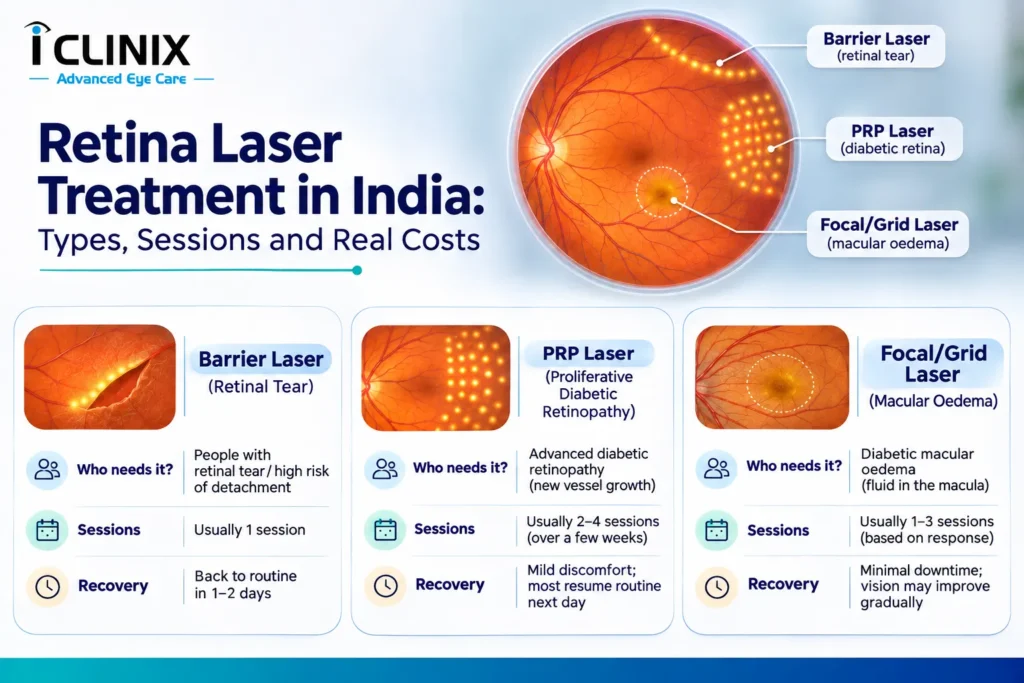
“Retina laser” isn’t one treatment. It’s a group of laser procedures used for different problems: barrier laser seals retinal tears, panretinal photocoagulation (PRP) treats advanced diabetic retinopathy, and focal laser treats some types of retinal swelling. The type of laser you need decides how many sittings it takes, how it feels and what it costs.
Here’s a clear guide to each, so a quote or treatment plan makes sense when you get one.
How retina laser works
A retina laser delivers focused light through the pupil to precise spots on the retina. The light creates tiny, controlled burns. Depending on where and how it’s applied, these:
• Form scars that “weld” the retina to the eye wall around a tear.
• Reduce the oxygen demand of the outer retina, so the eye stops making fragile new blood vessels.
• Seal specific leaking spots.
Most retina laser is done in the clinic, sitting at a machine much like the one used for a normal eye check, after numbing drops and dilation.
Type 1: Barrier laser for retinal tears and weak areas
What it treats: a retinal tear, or thin weak patches (such as lattice degeneration) that a specialist feels are at risk.
Why it matters: a tear can let fluid get under the retina and cause a retinal detachment, which needs surgery. Sealing the tear early can prevent that.
How many sittings: usually one, sometimes a top-up.
What it’s like: you see bright flashes; some people feel a mild ache. The American Academy of Ophthalmology notes that laser for a retinal tear usually takes under 15 minutes and is often done in the office. The US National Eye Institute explains that both laser and freeze treatment can seal retinal tears, and that you should avoid strenuous activity for a short while afterwards.
The usual warning signs of a tear are sudden new floaters, flashes of light or a shadow in your vision. Our guide to floaters and when to worry explains the difference between harmless floaters and urgent ones.
Type 2: PRP (panretinal photocoagulation)
What it treats: proliferative diabetic retinopathy, where abnormal new blood vessels grow and can bleed. It’s also used for some severe retinal vein blockages.
How it works: hundreds to a few thousand small laser spots are placed across the outer retina, leaving the central vision area alone. This makes the abnormal vessels shrink.
How many sittings: often two to four, a week or two apart, so each session is easier to tolerate.
What it’s like: more uncomfortable than barrier laser because more spots are needed. Some people feel aching, especially towards the edges of the retina. A numbing injection around the eye can be given if needed.
Trade-offs: PRP can reduce side vision and night vision a little. Anti-VEGF injections are an alternative or partner treatment. In the DRCR Protocol S trial, injections were as good as PRP for vision at two years, with less macular swelling. PRP’s advantage is that it lasts and needs fewer visits, which matters for people who can’t come back every month.
Type 3: Focal or grid laser
What it treats: some types of macular swelling, such as specific leaking spots in diabetic macular oedema, or certain other retinal conditions.
How many sittings: usually one, repeated if needed.
Today’s role: for diabetic macular oedema, anti-VEGF injections are now the main treatment. Focal laser is still used selectively, sometimes alongside injections.
Retina laser types at a glance
| Laser type | Treats | Usual sittings | Time per sitting | Recovery |
| Barrier laser | Retinal tears, weak areas | 1 | 10–15 min | Same day; avoid heavy exertion briefly |
| PRP | Proliferative diabetic retinopathy, severe vein occlusion | 2–4 | 15–30 min | Same day; mild ache possible |
| Focal / grid | Selected macular swelling | 1, repeat if needed | 10–15 min | Same day |
What affects the cost of retina laser in India?
| Factor | Why it matters |
| Type of laser | PRP needs more spots and sittings than barrier laser |
| One eye or both | Diabetic retinopathy often needs treatment in both eyes |
| Number of sittings | PRP is often split into several sessions |
| Imaging | OCT and wide-field retinal scans before and after |
| Combined treatment | Some patients need injections along with laser |
| Insurance | Many policies cover retina laser as a day-care procedure; check your policy |
Indicative ranges at iClinix (per eye):
| Procedure | Indicative range |
| Barrier laser | ₹5,000 to ₹20,000 |
| PRP (full course) | ₹15,000 to ₹50,000 |
| Focal / grid laser | ₹1,500 to ₹5,000 |
Indicative as of November 2026; your estimate is confirmed after examination. For diabetic laser specifically, see our earlier article on the cost of laser treatment for diabetic retinopathy.
Is retina laser safe?
Yes, it’s a long-established treatment. Possible side effects depend on the type:
• Temporary blur or dazzle for a few hours.
• Mild aching for a day.
• With PRP: some reduction in side or night vision, and rarely a rise in macular swelling.
Laser seals and stabilises; it doesn’t usually improve vision on its own. Its main job is to stop things getting worse.
What makes a good retina laser centre?
• A vitreo-retina specialist who examines the full retina, including the far edges.
• Wide-field retinal imaging and OCT to plan treatment and check results.
• Access to injections and surgery on site, so you’re not sent elsewhere if laser alone isn’t enough.
• Prompt appointments for tears, because a tear treated quickly may avoid detachment surgery.
Before and after retina laser: practical tips
Before:
• Your pupils will be dilated, so bring someone along and don’t plan to drive for a few hours.
• Eat normally and take your usual medicines, including diabetes medicines.
• Mention any blood thinners or recent eye procedures to your doctor.
After:
• Vision may be dazzled or blurred for a few hours. This settles.
• A mild ache can be eased with a simple painkiller if your doctor agrees.
• After barrier laser, avoid heavy lifting and very intense exercise for the period your doctor advises.
• Come back immediately if floaters or flashes suddenly increase, or a shadow appears.
When laser alone isn’t enough
Laser is one tool among several. You may need more if:
• Macular swelling is present: anti-VEGF injections are usually the main treatment.
• There’s bleeding inside the eye (vitreous haemorrhage) that doesn’t clear: vitrectomy surgery may be needed.
• A retinal tear has already become a detachment: surgery, rather than laser alone, is usually required.
That’s why it helps to be treated at a centre that offers laser, injections and retinal surgery under one roof.
Retina laser at iClinix
At iClinix, retina care is led by Dr. Varun Gogia, AIIMS-trained Vitreo-Retina, Refractive & Cataract Specialist. The retina service has a retinal laser platform, spectral-domain OCT and ultra-widefield retinal imaging, along with anti-VEGF injections and 25G/27G sutureless vitreoretinal surgery for cases that need more than laser.
Learn more about retina care at iClinix. Centres: Lajpat Nagar, Paschim Vihar, Shakti Nagar, Gurugram and Panipat. Call +91 98991 18030. If you have new flashes, floaters or a shadow in your vision, don’t wait for a routine slot; call and say so.
Frequently asked questions
What is the cost of retina laser treatment in India?
It depends on the type of laser (barrier, PRP or focal), how many sittings are needed and whether one or both eyes are treated. Ask for an estimate covering the full course, not just one sitting.
How many sittings of retina laser are needed?
Barrier laser for a tear usually takes one sitting. PRP for diabetic retinopathy often takes two to four sittings. Focal laser usually needs one, repeated if necessary.
Is retina laser painful?
Barrier and focal laser are usually well tolerated, with bright flashes and mild discomfort. PRP can be more uncomfortable; it’s often split into sessions, and extra numbing can be given.
Does retina laser improve vision?
Laser mainly stabilises the retina and prevents further damage. It doesn’t usually sharpen vision on its own.
Is laser or injection better for diabetic retinopathy?
Both work. Injections are the main treatment for macular swelling; for proliferative retinopathy, both laser and injections are effective, and many patients have both.
Can I go to work after retina laser?
Most people can return to normal desk work the next day. Your doctor may advise avoiding heavy lifting or intense exercise for a short time after barrier laser.
Been advised retina laser and want a clear plan and estimate? Book a retina consultation at iClinix and we’ll explain exactly which laser you need and why.
This article is for general information and does not replace a personal eye examination.