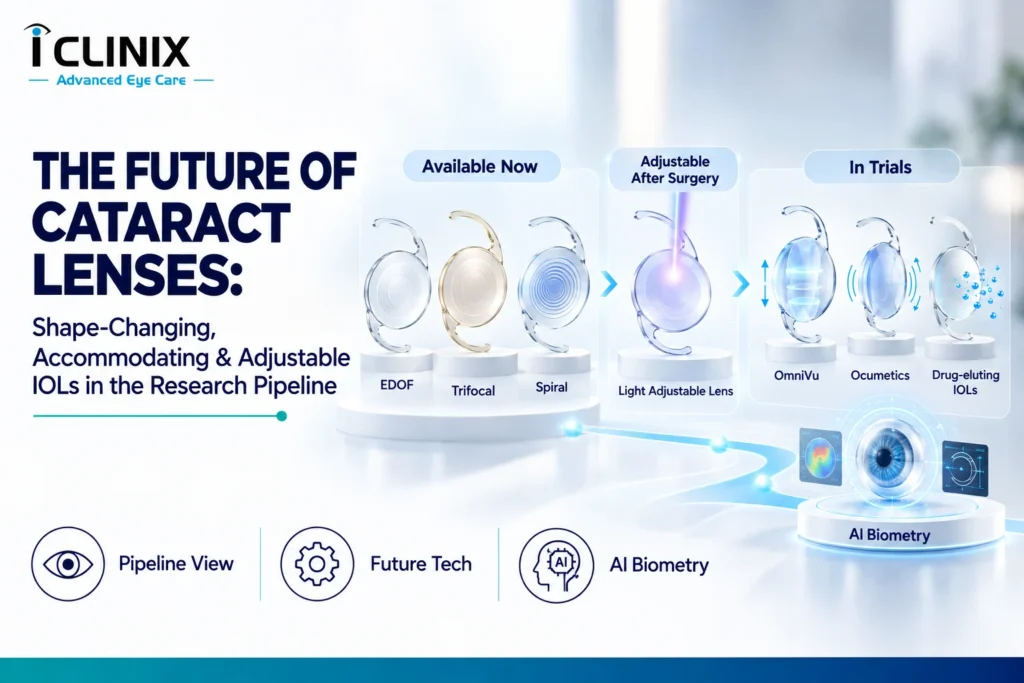
The next generation of cataract lenses is trying to do what your natural lens did when you were young: change focus smoothly from far to near. Accommodating and shape-changing IOLs, such as the OmniVu and Ocumetics lenses, aim to restore that flexibility rather than splitting light into fixed focus points. They are still in clinical trials. Light-adjustable lenses, which can be fine-tuned after surgery, are already approved in the US. And AI is improving how surgeons calculate lens power for everyone.
Here’s what’s real now, what’s close, and what’s still years away, so you can decide whether to wait or go ahead with surgery today.
Why the “perfect lens” is so hard to make
Your natural lens is soft and elastic. When you look at something close, a ring of muscle inside your eye (the ciliary muscle) relaxes its pull, and the lens rounds up to focus near. This is called accommodation.
With age, the lens stiffens and you lose this ability. That’s presbyopia. When the lens is replaced during cataract surgery, today’s IOLs are rigid. They can’t change shape, so they rely on clever optics to give a range of vision: multiple focus points, extended depth of focus or spiral designs. We compared those in our 2026 premium lens guide.
Every one of those designs involves trade-offs, such as halos, lower contrast or needing readers for small print. A lens that truly accommodates could, in theory, avoid them.
The pipeline at a glance
| Stage | Technology | Example | Status (Oct 2026) |
| Available now | EDOF, trifocal, full-range, spiral IOLs | PureSee, Vivity, PanOptix Pro, Galaxy | Approved; widely used |
| Available in some countries | Adjustable after surgery | RxSight Light Adjustable Lens | FDA-approved (US); limited elsewhere |
| In clinical trials | Modular, shape-changing | OmniVu (Atia Vision) | First-in-human, 36-month data |
| In clinical trials | Accommodating | Ocumetics lens | Early first-in-human study |
| In clinical trials | Drug-releasing IOL | SpyGlass BIM-IOL | Phase 3 trials |
Adjustable after surgery: the light adjustable lens
This one is already here in some countries. The Light Adjustable Lens, made by RxSight, is implanted like a normal IOL. A few weeks after surgery, once the eye has healed, the doctor shines a specific UV light on it in the clinic. The light changes the lens material’s shape, fine-tuning its power to sharpen your vision. A final treatment “locks in” the result.
The US FDA approved it in 2017, describing it as the first implanted lens that can be adjusted after cataract surgery.
Trade-offs: several clinic visits after surgery, and you must wear UV-protective glasses until the lens is locked in. It isn’t widely available in India yet.
Shape-changing and modular: OmniVu
OmniVu, from Atia Vision, is a modular lens system. It has a base lens that stays in the capsule bag and a front optic designed to change shape as the eye’s own focusing muscles work. The idea is to bring back natural accommodation.
At the ASCRS meeting in April 2026, Atia reported 36-month results from its first-in-human study. In 14 eyes of 10 patients, average uncorrected vision was about 20/17 for distance, 20/18 for intermediate and 20/26 for near, with stable refraction and no meaningful decline over three years. You can read the 36-month OmniVu summary from touchOPHTHALMOLOGY.
Those numbers are promising, but this was a very small study. Larger trials are needed before regulators can approve it.
Accommodating: Ocumetics
Canada-based Ocumetics is developing an accommodating IOL that also aims to restore natural focusing. In February 2026, the company reported early first-in-human results, saying the first group of patients met safety benchmarks and vision outcomes met or exceeded expectations.
As Ophthalmology Times noted, no detailed vision or refraction numbers had been released, and the results have not yet been peer-reviewed. It’s an early-stage project worth watching, not a choice for patients today.
Earlier accommodating lenses, launched in the 2000s, didn’t deliver enough near focus for most people. That history is why surgeons want strong, long-term data before getting excited about this new wave.
Drug-releasing lenses
Another direction is a cataract lens that also treats a second eye condition. SpyGlass Pharma’s BIM-IOL carries small pads that slowly release a glaucoma medicine for around three years. It’s in phase 3 trials. We covered it in more detail in our post on combining cataract and glaucoma surgery.
AI is already improving outcomes for everyone
Not all progress is a new lens. Some of the most practical advances are in how surgeons choose the lens power.
Modern formulas use large datasets and machine learning to predict where the lens will sit inside your eye and what power will give the sharpest result. AI-based IOL calculation was a featured topic at ASCRS 2026. For patients, this means more accurate results, especially for eyes that are unusually long or short, or that have had LASIK before.
You don’t have to wait for this. Many centres, including iClinix, already use advanced optical biometry and modern formulas when planning cataract surgery.
Should you wait for these lenses?
For most people, no. Here’s why:
• Timelines are long. Lenses in early human trials typically need several more years of studies before approval, and more time again before they reach India.
• Cataracts keep progressing. Waiting years for a lens that may or may not arrive means years of blurry vision, glare and higher fall risk.
• Today’s lenses are very good. Most people with a well-chosen modern lens are very happy with the result.
• Your eye can only have its lens replaced once, in practice. Lens exchanges are possible but carry more risk, so it’s better to pick the right lens for you now than plan to swap later.
If your cataract is mild and not bothering you, it’s reasonable to keep monitoring it. If it’s affecting driving, reading or work, waiting for future tech rarely makes sense.
The short answer
Accommodating and shape-changing lenses could one day give cataract patients something close to the natural, flexible focus of youth. Early data from OmniVu is encouraging; Ocumetics is at an earlier stage. Light-adjustable lenses already let surgeons fine-tune vision after surgery in some countries, and AI is quietly making lens calculations more accurate. For now, the best lens for you is still the one that suits your eyes today.
If you’d like to talk through your options, book a cataract consultation at iClinix.
Frequently asked questions
What is an accommodating IOL?
An accommodating IOL is a cataract lens designed to change focus from far to near by moving or changing shape inside the eye, much like a young natural lens. New designs such as OmniVu and the Ocumetics lens are in clinical trials.
Are shape-changing lenses available in India?
No. As of October 2026, shape-changing and accommodating lenses like OmniVu and Ocumetics are investigational and available only in clinical trials.
What is a light adjustable lens?
It’s an IOL whose power can be fine-tuned after cataract surgery using a special UV light in the clinic. The RxSight Light Adjustable Lens was approved by the US FDA in 2017. It isn’t widely available in India.
Should I delay cataract surgery for a better lens?
Usually not. New lenses in trials are likely years away from routine use, and today’s premium lenses give excellent results. If your cataract is affecting daily life, surgery with a well-chosen current lens is generally the better choice.
How is AI used in cataract surgery?
AI-based formulas help predict the correct lens power and where the lens will sit in your eye, improving accuracy, especially for unusual eye shapes or after previous LASIK.
Tempted to wait for the next big lens? Book a consultation at iClinix first, and we’ll tell you honestly whether waiting makes sense for your eyes.
This article is for general information and does not replace a personal eye examination.