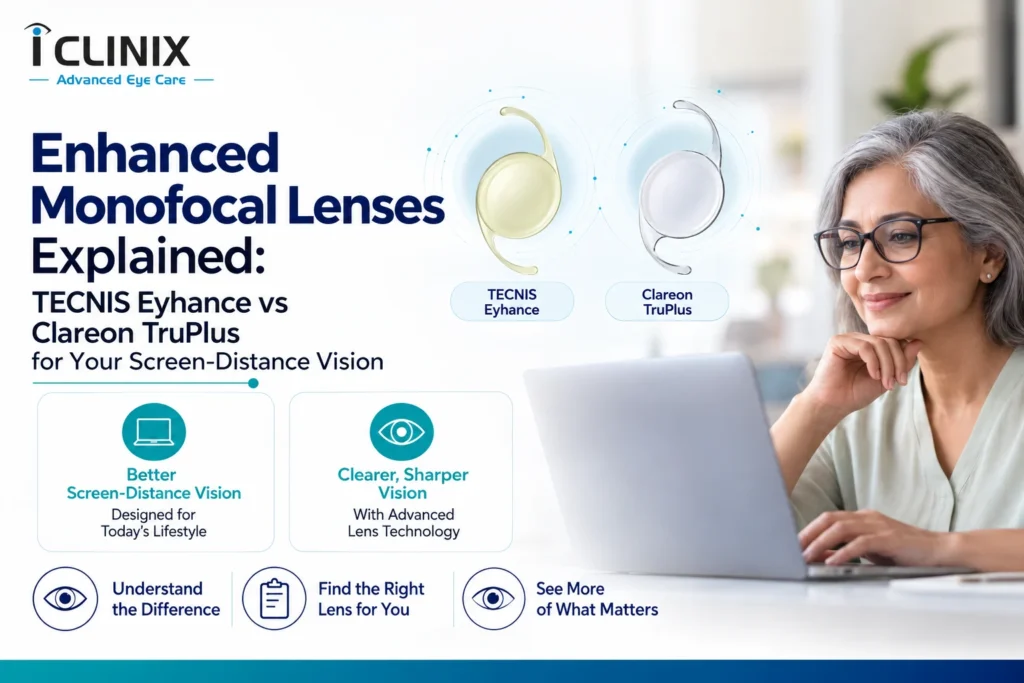
An enhanced monofocal lens is a cataract lens that gives the clear distance vision of a standard monofocal, plus a bit more range at arm’s length. That extra range is roughly where your laptop, car dashboard and supermarket shelves sit. TECNIS Eyhance from Johnson & Johnson and Clareon TruPlus from Alcon are two of the best-known lenses in this group, and both are designed to do this without the halos linked with multifocal lenses.
If you want sharp distance vision, decent screen vision and very little night glare, and you don’t mind reading glasses for small print, this category is worth understanding.
The problem enhanced monofocals solve
A standard monofocal IOL focuses at one distance. Most surgeons set it for far, so driving and TV look crisp. But anything closer than about a metre and a half starts to soften. Many people who had cataract surgery a decade ago still wear glasses for the computer and for reading.
Multifocal and trifocal lenses fix that by splitting light into several focus points. The trade-off is some loss of contrast and a higher chance of halos and glare at night.
Enhanced monofocals sit in the middle. They don’t try to give you full near vision. They aim to stretch the focus a little, enough for the 60–70 cm range of a desktop screen, while keeping the optical quality and night comfort of a monofocal.
The three distances that matter
| Distance | Typical tasks | Standard monofocal (set for far) | Enhanced monofocal |
| Far, 6 m and beyond | Driving, TV, faces across a room | Sharp | Sharp |
| Intermediate, about 66 cm | Laptop, dashboard, cooking, shelves | Often soft | Usually functional |
| Near, about 40 cm | Phone, books, medicine labels | Needs readers | Usually still needs readers |
That last row is important. An enhanced monofocal is not a reading lens. If your goal is to read a menu with no glasses at all, you are looking at an EDOF, full-range or trifocal lens instead, which we compare in our premium lens guide later this month.
TECNIS Eyhance: the lens that started the category
TECNIS Eyhance is made by Johnson & Johnson Vision and is built on the TECNIS monofocal platform. Its front surface has a continuous change in power from the edge of the optic towards the centre. That gentle shift adds a small amount of depth of focus without creating separate zones or rings.
Eyhance has been in wide use in Europe and Asia for several years, so there is a good body of real-world experience behind it. A toric version is available for people with astigmatism.
Clareon TruPlus: Alcon’s newer entry
Alcon launched Clareon TruPlus in the US at the ASCRS meeting in April 2026, in both monofocal and toric versions. According to Alcon’s launch announcement, the lens uses a proprietary optic design Alcon calls Opti-Balance Technology to extend depth of focus while holding on to distance image quality.
Alcon reports a 3.5-letter improvement in simulated visual acuity at the intermediate range, compared with its standard Clareon monofocal. In its own bench testing, Alcon also says TruPlus showed higher distance image quality than Eyhance across pupil sizes and a lower glare and halo profile.
Two points to keep in mind. First, these are manufacturer claims from lab and simulated testing, not head-to-head trials in patients. Second, small differences on a lab bench don’t always translate into something you would notice in daily life.
TruPlus sits on Alcon’s Clareon material, which is a hydrophobic acrylic designed to stay clear without glistenings over time. We explain why lens material matters in our 9 October post.
Eyhance vs TruPlus at a glance
| TECNIS Eyhance | Clareon TruPlus | |
| Maker | Johnson & Johnson Vision | Alcon |
| Design idea | Continuous power increase towards the centre of the optic | Opti-Balance Technology for added depth of focus |
| Track record | Several years of global use | US launch April 2026 |
| Toric version | Yes | Yes |
| Best suited to | Sharp distance, functional screen vision, minimal halos | Sharp distance, functional screen vision, minimal halos |
| Reading glasses for small print | Usually needed | Usually needed |
In practice, both lenses are aiming at the same patient. The choice between them often comes down to your surgeon’s experience with each lens, measurements of your eye, astigmatism, and what is available locally.
Who should consider an enhanced monofocal?
This type of lens is often a good fit if you:
• Spend a lot of the day on a laptop or desktop and want that to be comfortable without glasses.
• Drive at night regularly and want to keep halos and glare to a minimum.
• Have mild glaucoma, early macular changes or other conditions that make multifocal lenses less suitable. Ask your surgeon; many of these patients still do well with an enhanced monofocal.
• Are comfortable using reading glasses for fine print.
• Want something better than a basic monofocal without the trade-offs of a multifocal.
It may not be the right lens if your main goal is reading without glasses, or if you want to stop wearing glasses entirely. A lens with a longer range, such as the spiral design we covered in our RayOne Galaxy explainer, may suit you better, provided your eyes are healthy.
What about monovision?
Some surgeons combine enhanced monofocals with mini-monovision. One eye is set for distance and the other slightly closer. This can widen your glasses-free range further. It is not for everyone, so it is usually tested first with contact lenses or a trial in the clinic. Ask whether it suits you.
Cost and practical points in India
Enhanced monofocal lenses usually cost more than a standard monofocal but less than trifocal or full-range lenses. Exact prices depend on the brand, toric power, hospital and insurance cover. Some insurance policies cover only a basic lens and treat the difference as an out-of-pocket upgrade. Our article on what cataract surgery really costs at iClinix breaks down how lens choice affects the bill.
Before deciding, it helps to know:
• Whether your insurer covers the lens or only part of it.
• Whether you need the toric version.
• Which brands your hospital stocks and how often your surgeon uses each.
At iClinix, lens options are discussed after full biometry and imaging, as part of our cataract surgery consultation. The American Academy of Ophthalmology’s page on intraocular lens types and Cleveland Clinic’s guide to IOL pros and cons are useful neutral reading before your appointment.
The short answer
If you want crisp distance vision, comfortable screen vision and very few night-time halos, an enhanced monofocal is one of the most sensible upgrades in cataract surgery. Eyhance has the longer track record; TruPlus is newer, with promising lab data. Your surgeon’s familiarity with the lens and the measurements of your eye matter more than the brand name.
Frequently asked questions
What is an enhanced monofocal IOL?
It is a cataract lens that gives distance vision like a standard monofocal, with a modest extra range for intermediate tasks such as computer work. It does not split light into several focus points.
Is Clareon TruPlus better than TECNIS Eyhance?
Alcon’s lab data suggests TruPlus has higher distance image quality and a lower halo profile than Eyhance. These are manufacturer bench results, not patient trials. Both lenses aim at the same goal, and either can work well.
Will I need reading glasses with an enhanced monofocal lens?
Most people still need reading glasses for small print, such as phone text or medicine labels. Screen-distance tasks are usually comfortable without glasses.
Do enhanced monofocal lenses cause halos?
Halos and glare are generally similar to a standard monofocal and lower than with multifocal or trifocal lenses. Individual experience varies.
Can an enhanced monofocal correct astigmatism?
Yes. Both TECNIS Eyhance and Clareon TruPlus come in toric versions for patients with astigmatism.
Medically reviewed by Dr. Varun Gogia, MBBS, MD Ophthalmology (AIIMS), Vitreo-Retina, Refractive & Cataract Specialist, iClinix Eye Hospitals.
Spend most of your day on screens and planning cataract surgery? Book a lens consultation at iClinix to see whether an enhanced monofocal fits the way you work.
This article is for general information and does not replace a personal eye examination.