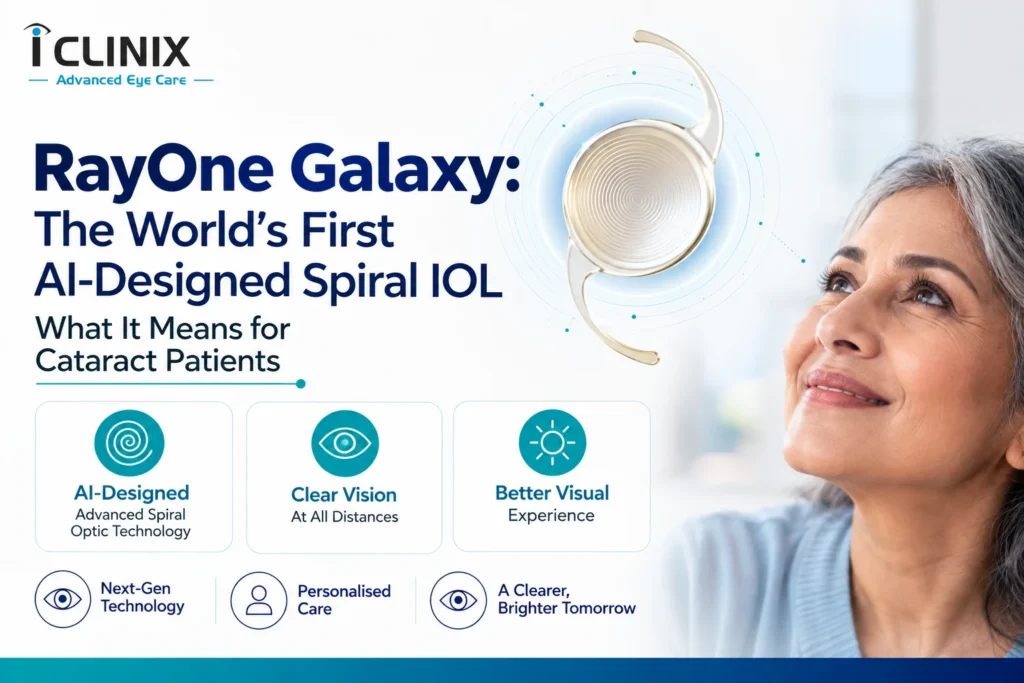
RayOne Galaxy is a cataract lens with a continuous spiral on its surface instead of the rings used in most multifocal lenses. Rayner says the design gives a full range of vision, from distance to near, while keeping glare and halos low. The US FDA approved RayOne Galaxy and Galaxy Toric in late September 2026, after the lens had already been used in more than 200,000 eyes across 75 countries.
If you are planning cataract surgery and want to cut down on glasses, this is a lens you will hear more about. Here is what it is, how it differs from older designs, and the questions worth asking before you choose it.
What is RayOne Galaxy?
During cataract surgery, your cloudy natural lens is removed and replaced with an artificial one called an intraocular lens, or IOL. The basic version, a monofocal IOL, gives sharp vision at one distance, usually far. Most people with a monofocal lens still need reading glasses.
Premium IOLs try to give you more than one focus point. RayOne Galaxy, made by the UK lens company Rayner, does this with a spiral-shaped optic. Rayner describes it as the first IOL whose optic was designed with the help of artificial intelligence, which was used to model and refine the spiral pattern.
The lens first launched internationally in 2024. By the time of its US approval, Rayner reported more than 200,000 implants in 75 countries, according to Eyewire+’s report on the FDA approval.
How a spiral optic works, in plain words
Most multifocal and trifocal lenses use diffraction. Their surface has a series of tiny concentric steps, like the grooves on a vinyl record. Each step bends light so that part of it focuses far, part focuses at arm’s length, and part focuses up close.
That works well for many people, but it has two side effects:
• Some light is lost. A share of incoming light does not land at any useful focus. In dim light, this can make vision feel a little flatter.
• Rings can cause rings. At night, the sharp steps can scatter light from car headlights and street lamps into halos or starbursts.
RayOne Galaxy takes a different route. Its surface rises and falls in one smooth, continuous spiral rather than separate steps. The spiral spreads focus across a range of distances instead of splitting light into fixed points. Rayner states that the design has 0% loss of transmitted light and is non-diffractive.
A simple way to picture it: a diffractive lens is a staircase, and a spiral lens is a ramp. Both get you from the ground floor to the top floor, but the ramp has no sharp edges for light to catch on.
What the studies say so far
The US approval was based on an IDE (investigational device exemption) study of more than 250 patients at 10 US sites. Rayner reports a strong safety profile and low rates of bothersome dysphotopsia, which is the medical term for glare, halos and similar light effects.
Those are manufacturer-reported results, and they come from carefully selected patients. Independent long-term data will keep building over the next few years. That is normal for any new lens, and it is one reason your surgeon’s own experience matters as much as the brochure.
Galaxy, Galaxy Toric and Galaxy Hydrophobic: what’s the difference?
There are now three versions to know about:
| Version | What it adds | Status (Oct 2026) |
| RayOne Galaxy | Spiral optic for distance, intermediate and near | CE-marked; US FDA-approved Sep 2026 |
| RayOne Galaxy Toric | Same optic plus astigmatism correction | CE-marked; US FDA-approved Sep 2026 |
| Galaxy Hydrophobic | Same spiral optic in a glistening-free hydrophobic acrylic material | Launched at ESCRS 2026; CE-marked markets from Q4 2026 |
The original Galaxy is made from Rayner’s hydrophilic (water-loving) acrylic. In September 2026, Rayner announced a hydrophobic version of Galaxy with a 360° square edge and a new laser-cutting process designed to reduce posterior capsule opacification (PCO), the “secondary cataract” some people develop months or years after surgery. Lens materials deserve their own explainer, and we cover them in our 9 October post.
If you have astigmatism, the toric version matters. Uncorrected astigmatism blurs vision at every distance, and no premium lens can do its job well if astigmatism is left behind.
Who might be a good fit?
A spiral lens is still a premium, presbyopia-correcting lens. The usual rules apply. You may be a reasonable candidate if:
• You have a cataract (or are considering lens replacement) and want less dependence on glasses for daily tasks.
• Your retina, optic nerve and cornea are otherwise healthy.
• You drive at night often and have been worried about the halos linked with ring-based multifocals.
• You understand that “less dependence” is not the same as “never wearing glasses again”.
You may be better served by another lens if you have advanced glaucoma, macular degeneration, diabetic retinopathy affecting the centre of the retina, an irregular cornea, or a job that needs the crispest possible distance vision in low light. In those cases a monofocal or enhanced monofocal lens is often the safer choice. Our guide on choosing between monofocal, EDOF and trifocal lenses walks through those trade-offs.
Spiral vs trifocal vs EDOF: where Galaxy sits
Think of premium lenses in three broad families:
1. Trifocal (diffractive) lenses give three set focus points. Near vision is usually strongest in this group, but halos at night are more common.
2. EDOF (extended depth of focus) lenses stretch one focus into a longer zone covering distance and intermediate. Halos are fewer, but you may need readers for small print.
3. Full-range non-diffractive lenses like Galaxy aim for the full range without diffractive rings.
None of these is “best” for everyone. The right lens depends on what you do all day, the health of your eyes, your pupil size and how much night glare you can live with. The American Academy of Ophthalmology’s page on presbyopia-correcting IOLs is a good neutral overview if you want to read further.
Is RayOne Galaxy available in India?
Rayner lenses are distributed in India, and Galaxy carries CE marking. Availability of a specific model can vary by city and hospital, and new versions such as Galaxy Hydrophobic usually reach Indian clinics after their European rollout. If this lens interests you, ask your surgeon directly whether they use it, how many they have implanted, and what alternatives they would consider for your eyes.
Questions to ask your surgeon before choosing a spiral lens
• Are my eyes healthy enough for a presbyopia-correcting lens?
• Do I have astigmatism, and would I need the toric version?
• How will my vision compare at night with a monofocal or EDOF lens?
• How many of these lenses have you implanted, and what do your patients report?
• What happens if I’m not happy with the result?
• What is the total cost, including tests, the lens, surgery and follow-up visits?
A good surgeon will answer these plainly, and will tell you if a simpler lens suits you better. At iClinix, lens choice is made after detailed biometry and imaging as part of our cataract surgery evaluation.
The bottom line
RayOne Galaxy is a real step in lens design. A smooth spiral instead of diffractive rings is a fresh idea, early results on glare and halos are encouraging, and the FDA approval adds weight. It is still a lens that suits some eyes better than others. The best outcome comes from matching the lens to your eye health, your daily life and your tolerance for trade-offs, not from picking the newest name.
If you are weighing up lenses for cataract surgery, book a consultation at iClinix and bring your questions. We will tell you what fits your eyes.
Frequently asked questions
What is the RayOne Galaxy IOL?
RayOne Galaxy is an intraocular lens used in cataract surgery. It has a continuous spiral optic, designed with AI assistance, that aims to give distance, intermediate and near vision without diffractive rings.
Is RayOne Galaxy FDA-approved?
Yes. The US FDA approved RayOne Galaxy and RayOne Galaxy Toric in September 2026. The lens was already CE-marked and in use in 75 countries before that.
Does the Galaxy lens cause halos?
Any premium lens can cause some halos or glare. Rayner’s US study reported low levels of bothersome halos and glare, and the non-diffractive design is meant to reduce them compared with ring-based lenses. Individual results vary.
Will I still need reading glasses with RayOne Galaxy?
Many patients do most daily tasks without glasses, but some still use readers for very small print or dim light. No lens can promise complete freedom from glasses.
What is the difference between Galaxy and Galaxy Hydrophobic?
They share the same spiral optic. The original Galaxy is made of hydrophilic acrylic; Galaxy Hydrophobic uses a glistening-free hydrophobic acrylic and is rolling out in CE-marked countries from late 2026.
Can I get RayOne Galaxy if I have astigmatism?
Yes, if your eyes are otherwise suitable. RayOne Galaxy Toric corrects astigmatism along with offering the full range of vision.
Medically reviewed by Dr. Varun Gogia, MBBS, MD Ophthalmology (AIIMS), Vitreo-Retina, Refractive & Cataract Specialist, iClinix Eye Hospitals.
Wondering whether a spiral lens like RayOne Galaxy would suit your eyes? Book a lens consultation with Dr. Gogia at iClinix and get an honest answer before you decide.
This article is for general information and does not replace a personal eye examination.