Guides, explainers and NRI planning notes
Read specialist-written guides on pre-surgery preparation, recovery, insurance and planning eye care visits from abroad.

Bladeless LASIK in India is usually priced per eye or as a two-eye package, and the price depends mainly on the laser technology used: femtosecond (bladeless) LASIK, topography-guided Contoura Vision, or flapless SMILE. Two quotes that look similar can cover very different things, so the smartest way to compare is to check what each package […]
Read guide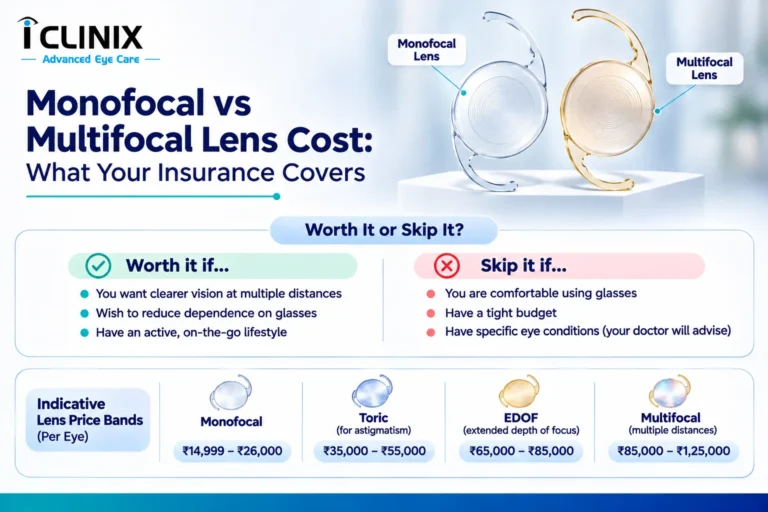
In India, cataract surgery with a multifocal (or trifocal) lens costs noticeably more than with a monofocal lens, mainly because of the lens itself. Most health insurance policies cover cataract surgery, but many have a fixed limit per eye, and that limit is often built around a standard monofocal lens. So the real question is […]
Read guide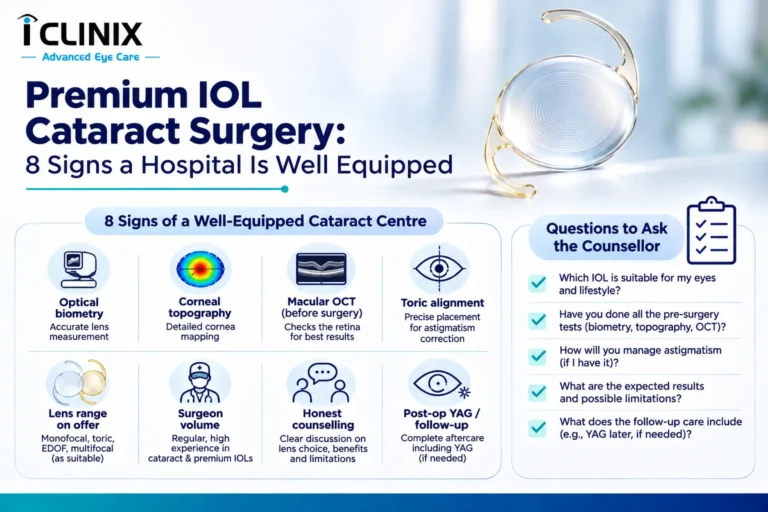
The best hospital for premium IOL cataract surgery is one that measures your eye precisely, checks your retina and cornea before recommending a lens, offers a full range of lens types, and tells you honestly when a premium lens isn’t right for you. A multifocal, EDOF or toric lens can cut your dependence on glasses, […]
Read guide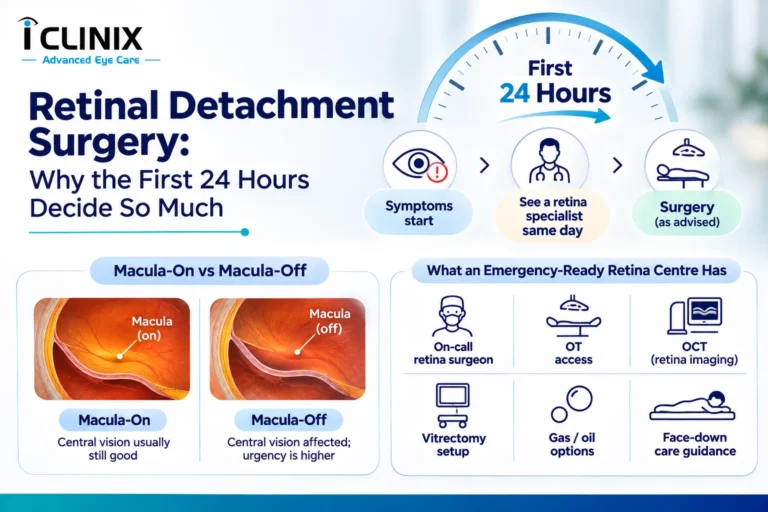
A retinal detachment is an eye emergency. If you notice a sudden shower of new floaters, flashes of light, or a dark curtain spreading across your vision, you should see a retina specialist the same day. Speed matters most while the macula, the centre of the retina that gives sharp reading vision, is still attached. […]
Read guide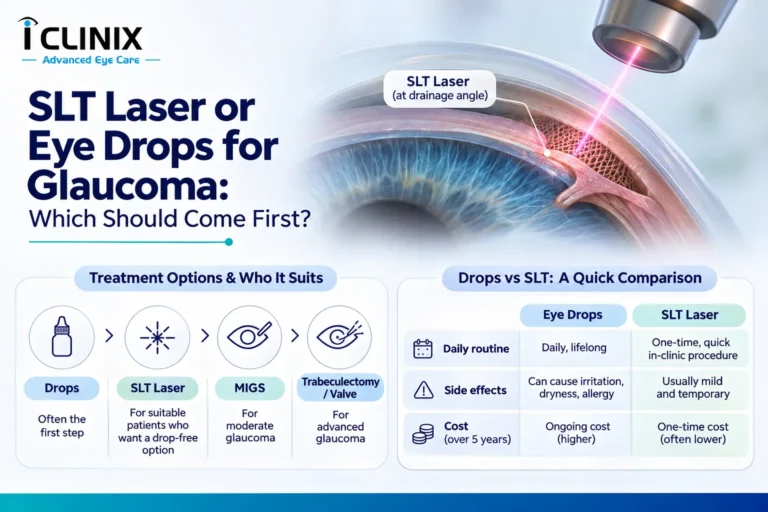
For many people with newly diagnosed open-angle glaucoma or high eye pressure, SLT laser is a strong first treatment, not just a back-up when drops fail. In the large UK LiGHT trial, about three out of four people treated with SLT first were still free of glaucoma drops after three years, and nearly 70% after […]
Read guide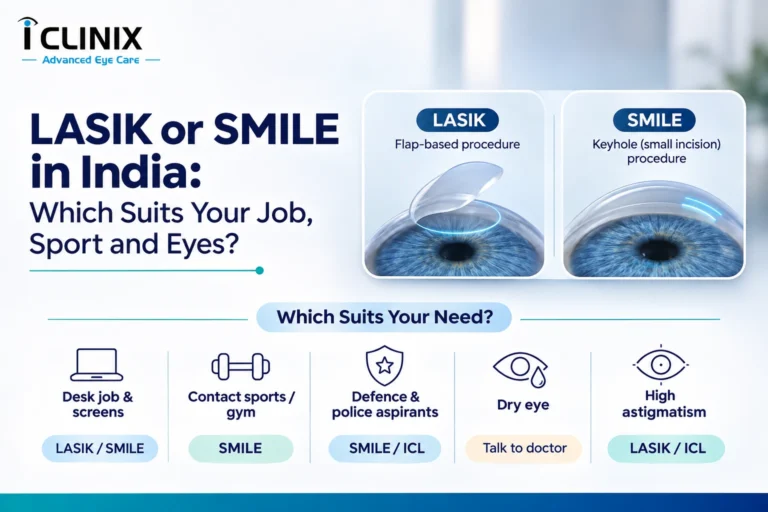
For most people with short-sight and astigmatism, LASIK and SMILE give equally sharp vision. The real differences are elsewhere: LASIK creates a thin corneal flap, while SMILE works through a small keyhole incision. That makes SMILE a little gentler on the eye’s surface nerves and removes the small long-term risk of flap injury, while LASIK […]
Read guide
Yes, the correction LASIK makes is permanent: the laser reshapes your cornea, and that new shape stays. What LASIK can’t do is stop your eyes from ageing. Most people keep sharp distance vision for many years, but reading glasses still arrive in the 40s, and a small number of people see their prescription drift and […]
Read guide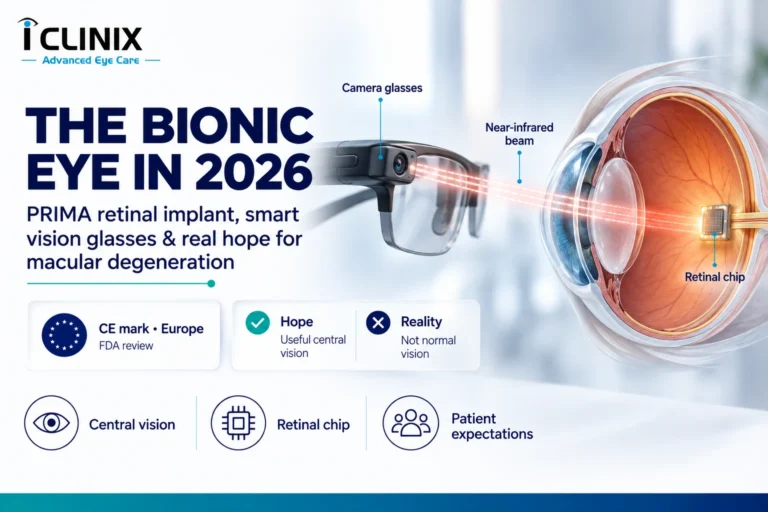
A “bionic eye” for macular degeneration is now a real treatment in Europe. The PRIMA system, made by Science Corporation, uses a tiny wireless chip placed under the retina and a pair of camera glasses to restore some central vision in people with advanced dry age-related macular degeneration (geographic atrophy). In its main trial, most […]
Read guide
The next generation of cataract lenses is trying to do what your natural lens did when you were young: change focus smoothly from far to near. Accommodating and shape-changing IOLs, such as the OmniVu and Ocumetics lenses, aim to restore that flexibility rather than splitting light into fixed focus points. They are still in clinical […]
Read guide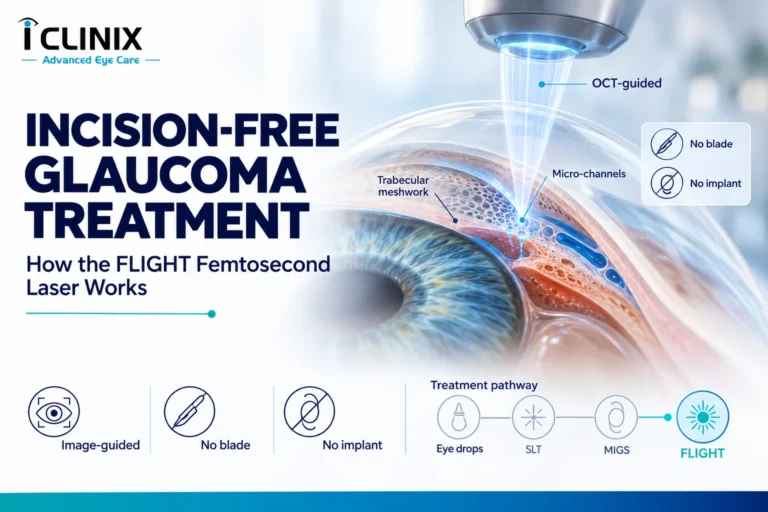
FLIGHT is a new laser treatment for open-angle glaucoma that creates tiny drainage channels inside the eye without any incision or implant. It uses a femtosecond laser guided by high-resolution OCT imaging to open precise pathways through the eye’s natural drainage tissue, helping fluid flow out and lowering eye pressure. The first commercial FLIGHT procedures […]
Read guide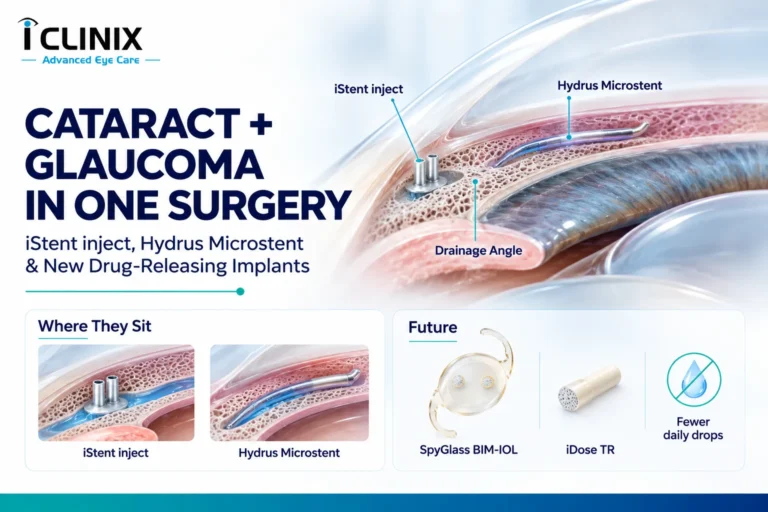
If you have both a cataract and early-to-moderate open-angle glaucoma, the two can often be treated in a single operation. During cataract surgery, the surgeon can place a tiny drainage device, such as the iStent inject W or the Hydrus Microstent, to help lower eye pressure. This approach, part of a group called MIGS (minimally […]
Read guide
Femtosecond laser-assisted cataract surgery (FLACS) uses a computer-guided laser to perform some of the most delicate steps of cataract surgery: opening the lens capsule, softening the cataract and, in some cases, making the corneal incisions. Large trials show it is about as safe and effective as standard phaco surgery for most patients. Where it can […]
Read guide
The best premium cataract lens in 2026 is the one that matches your eyes and your daily life. There is no single winner. EDOF lenses such as TECNIS PureSee and Clareon Vivity give strong distance and intermediate vision with few halos. Trifocal and full-range lenses such as PanOptix Pro, FineVision HP and TECNIS Odyssey give […]
Read guide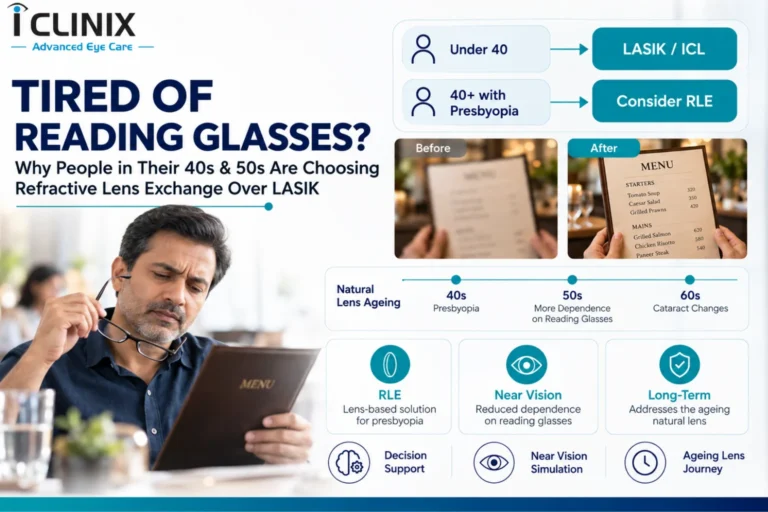
Refractive lens exchange (RLE) replaces your eye’s natural lens with an artificial one to correct your prescription, including the need for reading glasses that starts in your 40s. It is the same operation as cataract surgery, done before a cataract has formed. For many people over 45 who want to reduce their dependence on glasses, […]
Read guide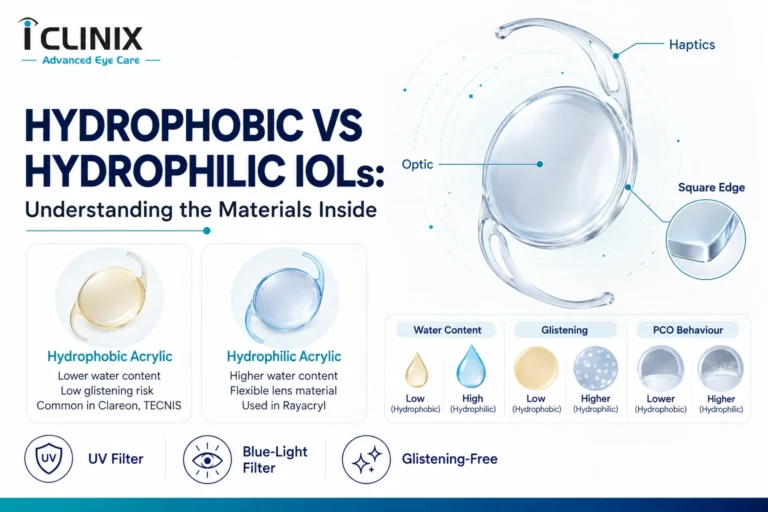
Most modern cataract lenses are made of one of two kinds of acrylic: hydrophobic, which repels water, or hydrophilic, which absorbs some water. Both are safe, well-tested materials. The differences show up in small ways: how the lens handles during surgery, how it behaves over decades, and, to a lesser degree than once thought, your […]
Read guide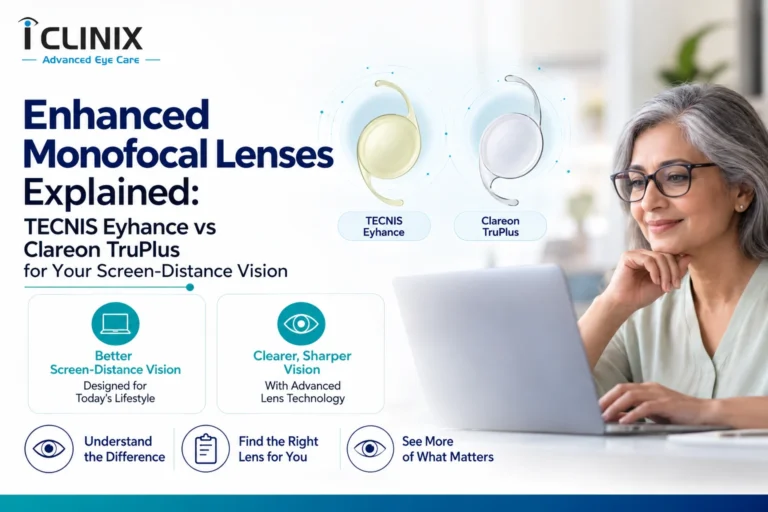
An enhanced monofocal lens is a cataract lens that gives the clear distance vision of a standard monofocal, plus a bit more range at arm’s length. That extra range is roughly where your laptop, car dashboard and supermarket shelves sit. TECNIS Eyhance from Johnson & Johnson and Clareon TruPlus from Alcon are two of the […]
Read guide
RayOne Galaxy is a cataract lens with a continuous spiral on its surface instead of the rings used in most multifocal lenses. Rayner says the design gives a full range of vision, from distance to near, while keeping glare and halos low. The US FDA approved RayOne Galaxy and Galaxy Toric in late September 2026, […]
Read guide
A daughter flew back to Melbourne five days after her mother’s cataract surgery last year, having done everything right during the visit — attended the consultation, sat through the procedure, arranged the first follow-up. Then, three weeks later, she called us in a slight panic because her mother mentioned her eye “felt a bit itchy” […]
Read guide
The question we get most often from NRI families, usually somewhere in the third or fourth email once trust has built up a bit, is simply: “Okay, but what does this actually cost?” It’s a fair question, and one that’s genuinely hard to answer with a single number, because the honest answer depends on the […]
Read guide
“My father says his eyes have gotten worse, but I don’t know if he needs surgery or just a new glasses prescription” is a message I get from NRI families almost weekly, usually followed by a slightly apologetic “sorry, I know this probably sounds like a silly question.” It isn’t. From abroad, without being able […]
Read guide
A grandmother near our Lajpat Nagar centre mentioned to her daughter-in-law, visiting from Dubai with her 4-year-old, that the little girl seemed to “look sideways sometimes” when she was tired. The parents had noticed something similar but assumed it was just a habit their daughter would grow out of. It turned out to be an […]
Read guide
A patient’s son messaged us from Toronto last month with a fairly common scenario: his father had been told he needed glaucoma surgery “soon,” but the family wasn’t sure whether that meant this month or sometime in the next year, and the local ophthalmologist hadn’t fully explained the reports in a way that made the […]
Read guide
A patient’s daughter called our emergency line from London at 2 am her time last year, after her father in Gurugram described “something like a black curtain” coming down over part of his vision. She’d looked it up while still on the phone with him, found “retina detachment” and “emergency,” and had him at our […]
Read guide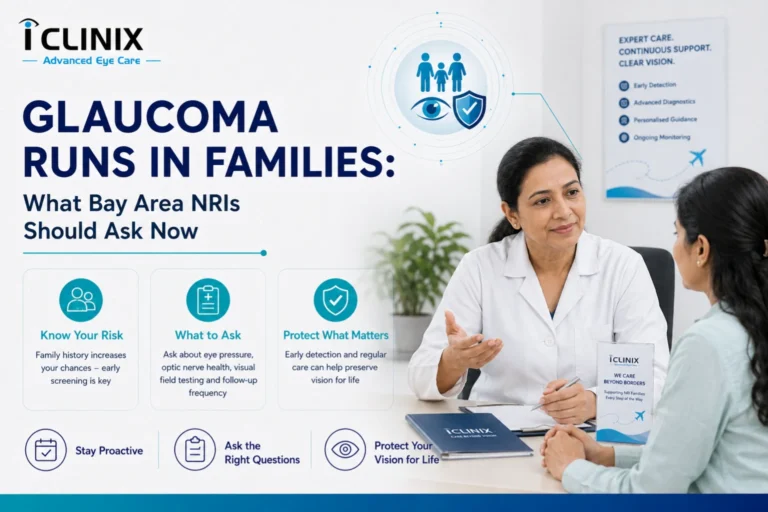
I had a patient last year whose glaucoma was picked up almost by accident — her daughter, living in the Bay Area, happened to mention during a routine call that their grandfather had gone blind from “high pressure in the eye” decades ago in Punjab, a detail nobody had thought to bring up during her […]
Read guide